
The Business of Saving Souls
Aspire to inspire before you expire.

In the city of Cape Coast in Ghana, West Africa, stands a castle.

It doesn't look the way you probably expect a castle to look. It's not pretty like the ones in Disney theme parks or stately like the ones you might see in many parts of Europe. Instead, this castle seems unwelcoming and somehow ominous - a place marred by history and terrible memories. That's because this castle is one of the country's "gates of no return" where native Africans were once sold into slavery and taken away to work on plantations in the American South.
Since that time, Ghana has undergone a radical transformation, gaining its independence from Britain in 1957 and establishing itself as one of Africa's leading centers of political consciousness. The city of Cape Coast, in particular, is widely recognized and revered for the outstanding quality of its educational system.
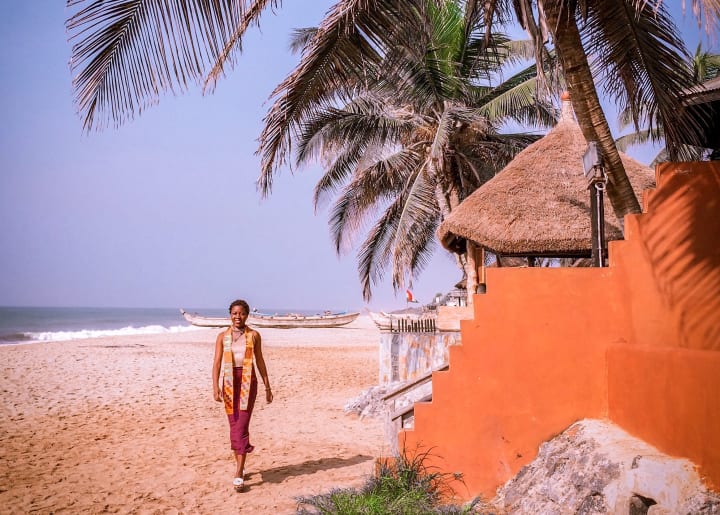
It was here that Godfrey Andoh was born into a devoutly Catholic family on July 12, 1973. He says the Church's presence is very strong in many parts of Africa, because its teachings and practices have been seamlessly blended into the larger culture in a process known as inculturation of the faith.
"During the offering, for example, we don't simply pass a basket around from person to person. We place the basket in front of the altar and the people come to it singing and dancing and praying with joy, offering themselves as a living sacrifice to God. This is very important to the people of Ghana."
Father Godfrey also explains that priests in Africa are not sustained through a paid salary, but rather through the generosity of their congregations. "The people bring the priests raw materials like sugar, grain, non-perishable items, and vegetables from their gardens. They take good care of them."
Godfrey did not understand these things when he was a young altar boy, but he noticed that his parish priest was always beaming with great happiness. One day he asked him, "How much do you get paid for doing this job?"
The priest laughed and said, "I don't receive any salary, but the blessings I receive for doing this work are more than any salary could afford." These words have stuck with Father Godfrey ever since.

A few years later, at the same priest's suggestion, he took a seminary entrance exam and eventually entered the school. "I had a choice between the regular high school and the seminary. I joined the seminary because I heard there were bullies at the other school and I thought a Catholic environment would be a little kinder. But I had no intention of becoming a priest. I thought I would leave after my schooling and become a marine engineer."
As he advanced in his studies, however, he began to feel what most priests refer to as a calling. "I started recognizing that there was something that was pulling me to stay on."

Godfrey pursued this feeling by immersing himself in the great works of spirituality, theology, and philosophy, but like everyone who experiences a spiritual awakening, he often found himself overcome with struggles and insecurities.
"What is a Christian?" he asks. "A Christian is someone who follows Jesus Christ. Jesus stood out from other people. God has always called his people to stand out from the world. But human nature is the opposite. We want to fit in and be the same. I can remember five pivotal moments when I wanted to leave the seminary."

Plagued with uncertainty, he once again contacted the parish priest of his youth - "a very holy man" - who encouraged him to undergo a full week of prayerful retreat. "At each important point of those seven days," Godfrey remembers, "I felt more resolved to go on."
Central to this resolution was his devotion to the Eucharist, the sacrament by which Catholics receive the body and blood of Christ as described in the Biblical Book of John (chapter 6). "I believe the Church has preserved this teaching in its authenticity," he says. "It is something I would not trade for anything else."

In 2002, after fourteen years of preparation, Father Godfrey was ordained a diocesan priest of the Roman Catholic Church.

Shortly thereafter, his old friend, the parish priest, took him aside and asked, "Do you remember what you asked me when you were younger?"
"Yes, Father," Godfrey said, "because I've never forgotten your answer."
"Well," said the older priest," the day you asked me that question I started praying for you. And each time I prayed for you, I saw you standing in front of many people proclaiming the word of God."
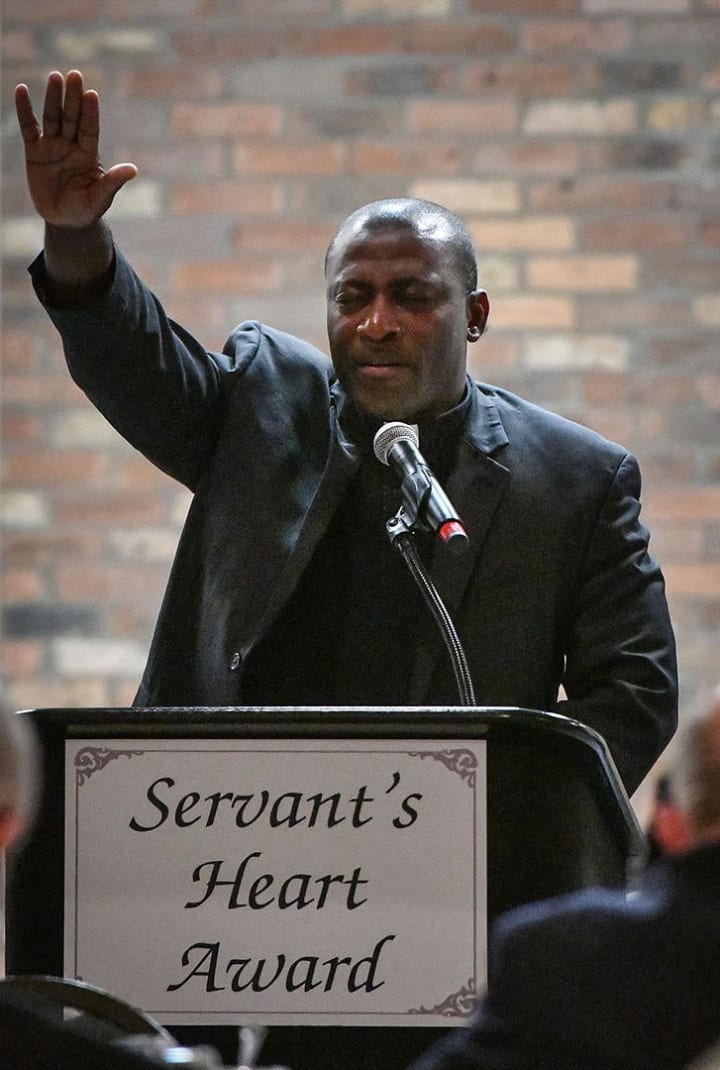
As if in fulfillment of this prophecy, Father Godfrey worked as a chaplain in one of the outstanding Catholic girls' high schools in Ghana, Holy Child School.

Then, in 2009, he went to Sacred Heart Seminary in Detroit to pursue a post-graduate program in Theology.
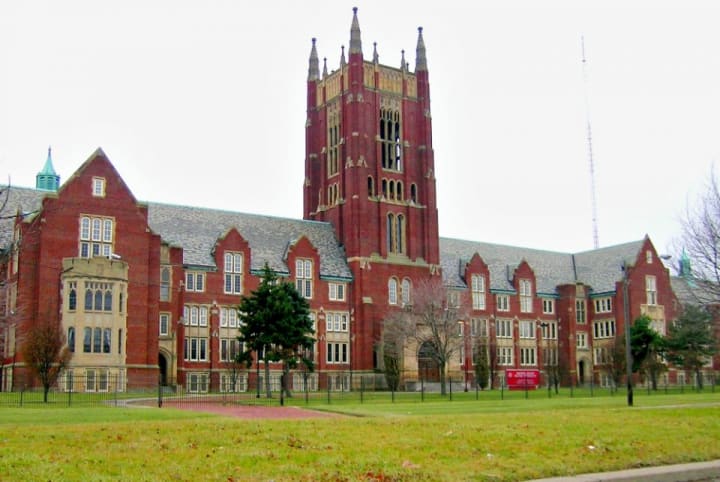
Then, he was transferred once again, this time to Mississippi of all places - one of the deep Southern states his countrymen were once taken to in chains.
"One of my students asked me why I would go to Mississippi, a state that was well known for racism against black people. But I didn't know anything about that, so I had to read and do some research."

Now familiar with the state's explosive Civil Rights period, Father Godfrey arrived in Hattiesburg to find it was nothing like his student had described. In many ways, he says, Mississippi was actually quite similar to his native Ghana. "I have not experienced any direct acts of racism. That doesn't mean that other people haven't had those experiences, but I have not. Everyone has been very loving, welcoming, and nice."
The same is true in Biloxi, Mississippi, where he has become the much-beloved pastor of Our Mother of Sorrows and Blessed Francis Xavier Seelos Catholic Church.


In addition to overseeing the administrative affairs of his parish, Father Godfrey makes his celebration of the mass - where he can sometimes be found playing bongo drums in the choir - available via livestream during the covid pandemic. He also devotes a great deal of time to counseling, spiritual direction, and visiting with the sick and elderly (including my grandmother, for which my family is eternally grateful).

Asked which issues he most often sees Americans (and especially black Americans) struggling with, Father Godfrey says he is witnessing an epidemic of despair. "People feel the odds are stacked against them. They want to give up and throw in the towel."
The solution to this problem, he says, can be found in that horrible castle sitting on the shore of his hometown. "When we think of our ancestors, what they went through, how they overcame those great struggles. And we think of the words to that old song 'We Shall Overcome,' that should be an inspiration, an encouragement, and a hope not to give up."
"There's always hope for the future," he says.
About the Creator
J. Wiltz
J. Wiltz is a native of Biloxi, MS, where he is currently working on a collection of short stories after nine years of teaching English and developing curriculum in Seoul, South Korea. He invites you to visit him at linktree.com/geminihills
The Numbers Behind the Name: Echos News ZA
Got myself into blogging, again. So I dusted my desk, laptop in front of me, cup of fresh tea. I searched for my blog account which had been sitting there for years — blank. Instead of writing a blog like everyone else, a News Hub idea came to me, and it sounded nice. Suddenly, a name appeared: ECHOS.
By Vongani Bandi7 days ago in Journal


Comments
There are no comments for this story
Be the first to respond and start the conversation.