
The Albatross Paradox: Where Every Choice is Meaningless, Yet Absolutely Essential
A dive into a philosophical paradox and the beautifully absurd challenge of making a choice when no choice is the 'right' one
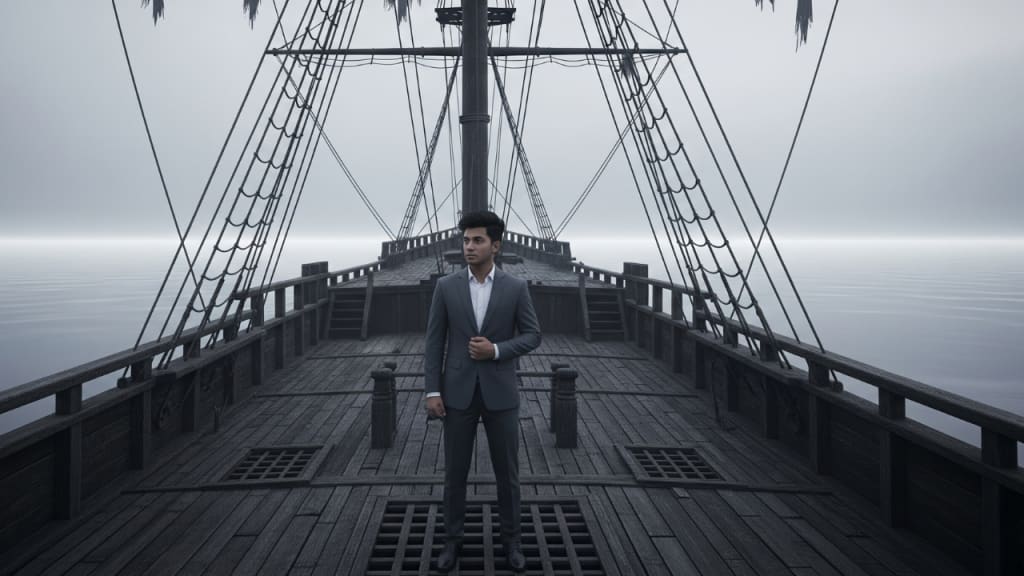
Imagine waking up one morning on a colossal ship, adrift in the vast, silent expanse of an unknown ocean. You don't know the sea's name, nor anything about the vessel. There is only water, stretching to every horizon. You are utterly alone. Time feels frozen. You have no destination, no map, and no digital aids like a smartphone's GPS. In this perfectly symmetrical world, there are no stars, no sun, no discernible currents—no reference points at all.
You feel an urge to act, to make a decision. You could steer the ship north, south, east, or west. You pick a direction—let's say, North. Why? Perhaps you imagine an island lies that way, a bustling city, or even a new continent. Then again, North could just as easily be a path to an endless, watery void.
You have the power to choose a direction, but you have absolutely no way of knowing if that choice will lead to your salvation. You've made a decision simply because a decision felt necessary. In this scenario, however, the act of choosing is stripped of its power. Your 'skill' in decision-making is irrelevant; your 'wisdom' is meaningless. Whatever you decide is a coin toss, entirely surrendering your fate to chance. The ship could just as easily drift to shore on a random current, or it might never see land again. Nothing is in your hands.
The Paralysis of Inaction
Now, consider the alternative. Overwhelmed by the sheer pointlessness of it all, you decide not to choose. But this inaction brings its own form of despair. You might torture yourself with the thought, "What if I had just picked a direction? At least there was a chance, even a 0.000001% chance, of finding something.
But here's the kicker: that same infinitesimal possibility exists even if you do nothing. The ocean's currents might guide you to safety. A rescue team might appear on the horizon. Or, none of that could ever happen.
Things are getting a little complicated, aren't they?
Let’s break it down to its simplest form. You have two fundamental arguments:
1. To decide on a specific direction and act.
2. To sit quietly on the ship and wait.
These two arguments effectively cancel each other out. If the outcome of any chosen path is the same as choosing no path, what's the point of deciding? Yet, sitting still doesn't feel like a solution either. In a world demanding action, passivity feels like its own kind of failure. And besides, choosing to do nothing is also a decision. It’s a perfect stalemate of logic, where each argument renders the other pointless.
The Philosophy of a Pointless Choice
This thought experiment is a version of a philosophical puzzle sometimes called the ‘Birds of a Paradise’ or 'Albatross' paradox. It doesn't have a single famous creator; instead, it exists in the realm of logic as a way to explore the philosophy of irrationality and neutrality.
It echoes the ideas of Albert Camus's Absurdism. Camus famously wrestled with a similar question: if life inevitably ends in death, isn't every effort we make, every decision we agonize over, ultimately arbitrary? This question doesn't have to lead to despair. Instead, it intensifies our very human "struggle to find meaning" in a universe that offers none.
We are all floating in a sea of infinite possibilities, terrified by the lack of a guaranteed 'right' path. Yet, the unassailable truth of life is that we must choose one anyway, often arbitrarily. And in that very act, in that brave, defiant choice, lies the tragic and profound beauty of our existence.
This paradox serves as a powerful reminder: the logic and justification for our choices don't come from the outside world. They are something we must create for ourselves.
About the Creator
Keep reading
More stories from Selina Khatun and writers in Journal and other communities.
The goals I did not achieve
Every writing goal I made for the year is a wash. It has been this way for a while, but I think it's important to be open about my failures and the reality of how life can get in the way. This is especially true considering the several times I have posted on Vocal about my writing goals, how I was changing my approach, and where I was hoping to be for the upcoming year. I will probably do that again in a couple months, but for now, it is time to acknowledge where I am today.
By Kay Husnick22 days ago in Journal
Why Florida Car Dealers Must Carry a Surety Bond
If you’re planning to open a used car dealership in Florida, one of the first compliance requirements you’ll encounter is the dealer surety bond. Many people assume this is just another formality in the licensing process, but it plays a much bigger role than most applicants realize.
By American US Insurance3 days ago in Journal



Comments
There are no comments for this story
Be the first to respond and start the conversation.