
STOP Buying “Breast Cancer” – An EXPLOSIVE Report
NOT another health scare. This is a WAKE-UP CALL.

Study Published on National Institutes of Health Website
The information you are about to read is based on a peer-reviewed study published on the official website of the U.S. National Institutes of Health, the most trusted source for medical information in the United States:
https://pubmed.ncbi.nlm.nih.gov/36746253/
This .gov designation signifies official U.S. government information, ensuring reliability.
This is SCIENCE, not speculation.
Are the products you use EVERY SINGLE DAY increasing your risk of breast cancer?
A groundbreaking new study reveals alarming connections between common chemicals in personal care items and cancer-related changes in breast tissue.
This isn't some conspiracy theory; it's backed by solid scientific research. This is happening. This is REAL.
The Silent Threat: Parabens and Phthalates
We slather them on our skin, wash our hair with them and even use them on our babies.
Parabens and phthalates are in almost every personal care product.
But a growing body of research suggests these chemicals are doing more harm than good.
Could these everyday ingredients be contributing to breast cancer risk?
The answer is a terrifyingly possible YES.
Parabens and phthalates are classified as xenoestrogens – foreign substances that mimic estrogen in the body. While estrogen is essential, overexposure or disruption of its natural pathways can be a major catalyst in breast cancer development and progression. Think of it as pouring gasoline on a fire – estrogen can fuel the growth of certain breast cancer cells.
- Parabens: These preservatives are in countless cosmetics, lotions, shampoos, and even some foods.
- They prevent bacteria and mould growth, extending shelf life. But they can be absorbed through the skin and have been detected in human breast tissue.
- Scientific evidence suggests parabens interfere with estrogen receptors, potentially promoting cancerous changes within breast cells.
- Phthalates: These chemicals make plastics more pliable and are in fragrances, nail polish, hair spray, and various personal care products.
- Disturbingly, they are often NOT explicitly listed on product labels, hiding under the generic term "fragrance." Phthalates are known endocrine disruptors, meaning they interfere with the body's hormonal system, and have been linked to reproductive problems and potentially increased breast cancer risk.
A study in Chemosphere, highlighted by the National Institutes of Health, provides a crucial wake-up call.
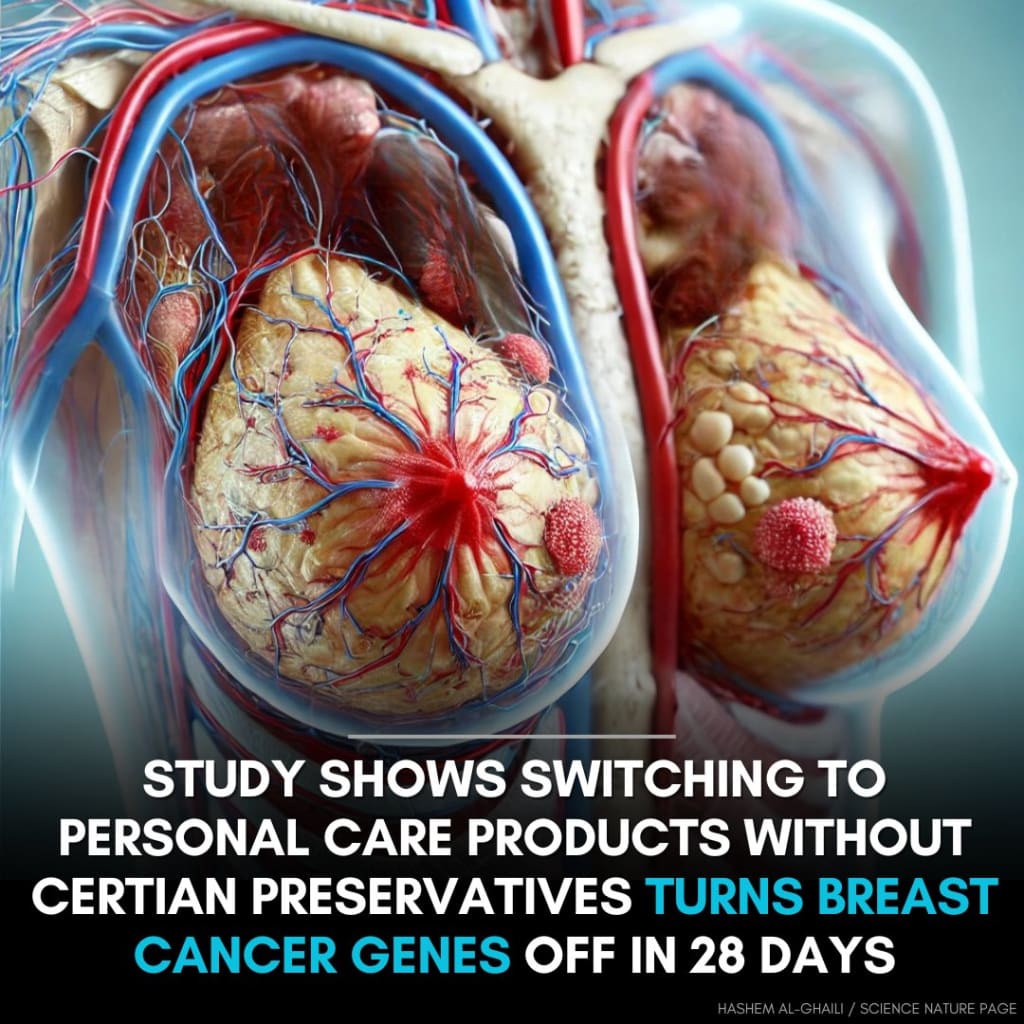
Researchers asked women to eliminate products containing parabens and phthalates for just 28 days.
Before and after this short "detox," breast tissue samples were analysed.
The results were REMARKABLE: a significant reversal of cancer-associated changes was observed.
This included improvements in key cellular pathways – PI3K-AKT/mTOR, autophagy, and apoptosis – all crucial in cancer development and suppression. This research, while needing further expansion, offers a powerful message: even a short break from these chemicals can positively impact breast tissue at a molecular level.
The Hidden Culprits: Are YOUR Products Putting You at Risk?
These harmful chemicals are EVERYWHERE.
A U.S. study revealed parabens in roughly 40% of rinse-off and 60% of leave-on products.
Phthalates, especially DEP, were frequently detected in perfumes, skin toners, and nail polishes.
Infants and young children are PARTICULARLY VULNERABLE.
Common Product Categories Harboring These Chemicals (Always Check the Label):
- Cosmetics: Many mainstream makeup brands use parabens. Look for "paraben-free" labels. "Fragrance" often conceals phthalates.
- Lotions and Moisturizers: Parabens are common preservatives. Phthalates can also be present, especially in fragranced lotions.
- Shampoos and Conditioners: Frequently have parabens.
- Nail Polish: Phthalates, especially DBP, are often added for flexibility.
- Sunscreens: Many use parabens.
- Toothpaste: Some brands still use parabens.
- Shaving Products: Gels and creams often include these chemicals.
- Deodorants: Some still contain parabens.
- Perfumes and Fragrances: Phthalates are commonly used.
- Baby Products: Scrutinize labels.
Food and Beverages
Parabens are also used in certain food products.
This is beyond topical – we are INGESTING these chemicals.
- Processed Foods: Often have higher levels of parabens.
- Examples: Cereal-based snacks, dried meats, sauces, frozen dairy products, jams, jellies, pickles, flavoured syrups, soft drinks, and beer.
- Studies have identified high concentrations of parabens in foods like chicken burgers, frozen chopped onions, canned tuna, and pancake syrup.
Empowering Yourself: Take Back Control - NOW
- Become a Label Detective: Look for ingredients ending in "-paraben." Be aware that phthalates may be hidden under "fragrance."
- Choose Wisely: Opt for "paraben-free" and "phthalate-free" products.
- Go Fragrance-Free: Choose unscented products or those scented with essential oils.
- Prioritise Baby Safety: Select baby products explicitly labelled paraben- and phthalate-free.
- Simplify Your Routine: Reduce the number of products you use.
- Support Transparent Brands: Choose companies that disclose ingredients and prioritise safer alternatives.
Common Parabens to Watch Out For:
- Methylparaben,
- Ethylparaben,
- Propylparaben,
- Butylparaben,
- Isobutylparaben,
- Isopropylparaben.
- "Parahydroxybenzoate" also refers to parabens.
Tools for Informed Choices:
- Mobile Apps: Clearya, Think Dirty, EWG's Healthy Living App, Yuka.
- Beware of Misleading Labels: "Paraben-free" or "natural" doesn't guarantee safety. Always check the ingredient list.
Individual choices are essential, but systemic change is equally vital. Support legislation that regulates these harmful chemicals. Further research is needed.
This isn't about panic. It's about POWERING you with knowledge.
By making informed choices and advocating for stricter regulations, we can protect ourselves and future generations.
The information is out there, backed by the National Institutes of Health.
It's time to ACT.
I'm sharing this because I care about you.
Share this with EVERY woman you know.
Parabens and phthalates, found in so many everyday products, could be putting their health at risk.
We can protect ourselves and our loved ones.
Start the conversation TODAY.
About the Creator
Tales by J.J.
Weaving tales of love, heartbreak, and connection, I explore the beauty of human emotions.
My stories aim to resonate with every heart, reminding us of love’s power to transform and heal.
Join me on a journey where words connect us all.
Reader insights
Good effort
You have potential. Keep practicing and don’t give up!
Top insight
Expert insights and opinions
Arguments were carefully researched and presented
Keep reading
More stories from Tales by J.J. and writers in Journal and other communities.
When the Shelter Closes
Across the street from my house, a man slept under a tree, his dog by his side. My first, naive thought: he must be traveling through. But he kept coming back, often sleeping there during the day. Then it hit me—that person might not have a home.
By Bride of Sound6 days ago in Humans




Comments (10)
A fascinating study. Very well researched!
I recently read an article about "plastics" being found in organs of our bodies...even the brain... Thanks for writing this!
Thanks for sharing! I have always stayed away from make-ups and most other unnecessary things, it's terrifying that people don't know about this and use these items on their children. And it seems impossible to stear clear of all of it.
Thank you for sharing this important information! God Bless you!
You have issued a clarion call for crucial examination of products before we buy. Informative and concisely presented. Excellent.
It's so hard to stay healthy when so many chemicals are used in the products we use and eat. Thanks for writing this informative article <3
Good job and thanks for writing and sharing this insight.
Maybe you should name the products?
Thanks for sharing
Thank you for sharing this, I stay away form Parabens.