
Smart Squeeze: How Innovations in Manual Resuscitators Market Are Enhancing Patient Safety & Usability
Manual resuscitators may have a low-tech look, but they are steadily improving in terms of smarts, precision, and being patient-centered tools for every provider to rely on.

In the blink of an eye, life can change. On the battlefield, in the back of an ambulance, or in the ICU, every second counts when a patient can no longer breathe for themselves. Manual resuscitators, also known as bag-valve masks (BVMs), are first-line, lifesaving tools that healthcare providers rely on when machines are not available, or they need to provide high-flow oxygen in a pinch. Despite the decades-old design of most manual resuscitators, the market for these devices is heating up with a new crop of innovations, largely spurred on by the imperatives of safety, ergonomics, and usability.
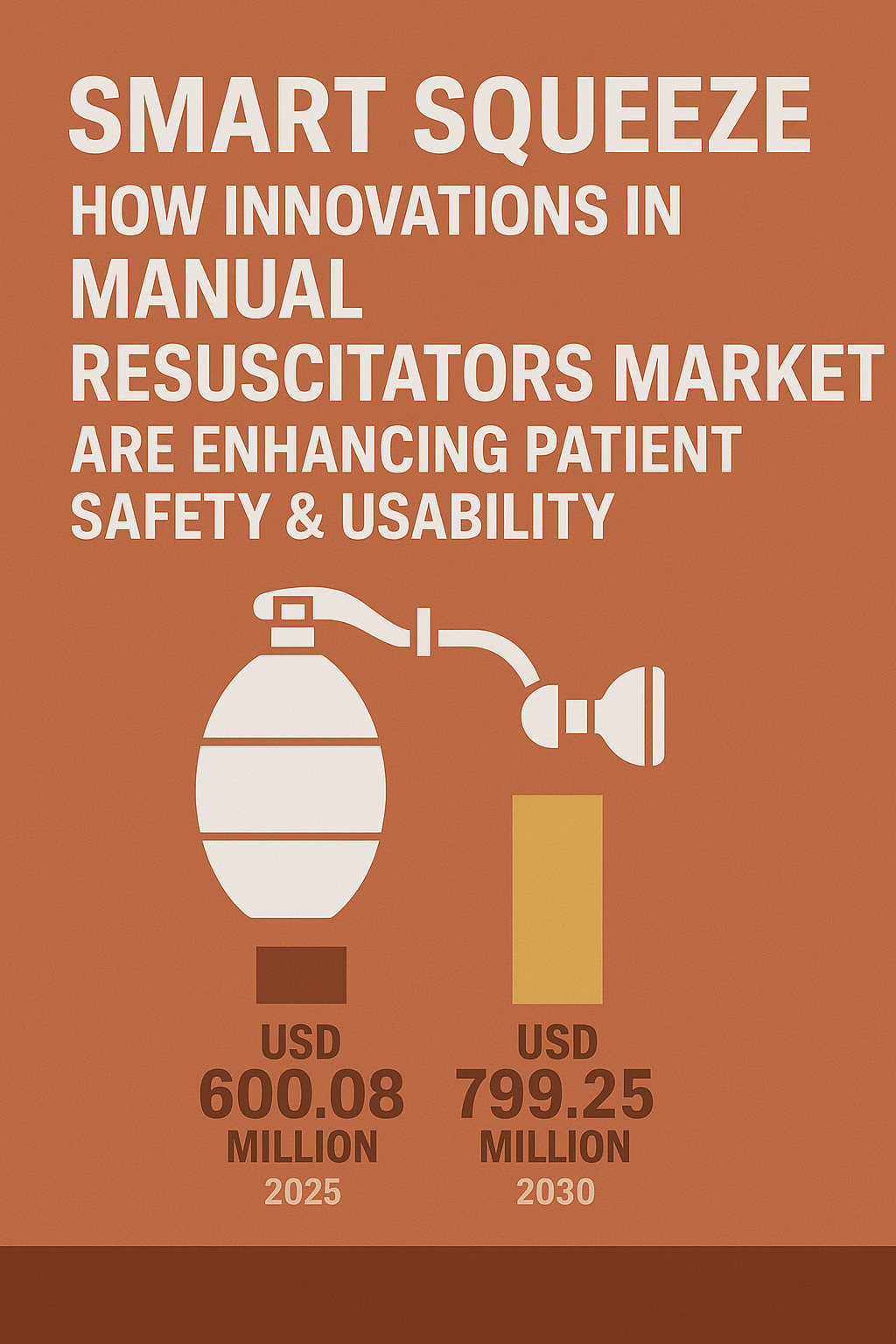
Expected to hit USD 799.25 million by 2030, the global manual resuscitators market is expanding at a steady CAGR of 5.90% on the back of material design improvements, single-use device demand, and increasing focus on clinical accuracy during resuscitation.
🩺 About Manual Resuscitators
Manual resuscitators are hand-operated devices that provide positive pressure ventilation to patients who are not breathing adequately or at all. They are primarily used in:
• ERs & ICUs
• Ambulances & EMS kits
• Surgical centers
• Military field care units
The most common manual resuscitator is a BVM, which consists of a self-inflating bag, a one-way valve, and a face mask. While the concept is simple, there is a surprisingly high margin of error when it comes to delivering the appropriate amount and rate of ventilation—mistakes that can result in inadequate respiration, gastric insufflation, or even patient lung injury.
🚀 Driving Forces Behind Innovation in the Market
1. Patient Safety & Ventilation Accuracy
Manual resuscitators inherently have a large human error component, and manufacturers are building in features like:
- Pressure-limiting valves that mitigate risk of barotrauma
- PEEP valves to maintain alveolar recruitment
- Tidal volume indicators that show real-time flow or air given
These additions help prevent healthcare professionals from over-ventilating a patient as well as customizing delivery based on weight, age, and other factors.
2. Disposable and Single-Use Resuscitators
Improved infection control standards during the post-pandemic era are also fueling demand for pre-assembled, sterile, single-use resuscitators which minimize cross-contamination risk, particularly during field application and transport.
3. Ergonomic and Lightweight Design Enhancements
New devices are being created for one-hand operation and increased fatigue reduction, with:
- Soft-touch grip surfaces
- Clear plastic housing to easily view valve function
- Low-resistance valves to allow easier air passage
These improvements support better performance under high-stress conditions such as cardiac arrest or trauma cases.
4. Monitor Integration
Advanced BVMs with compatible fittings are emerging that can connect to oxygen sensors, pulse oximeters, or capnography lines for real-time manual ventilation feedback—particularly helpful in neonatal or critical care scenarios.
🌍 Global Market Dynamics
North America & Europe: Adoption of PEEP-capable, single-use resuscitators is leading innovation.
Asia-Pacific: Significant growth potential with healthcare infrastructure growth, EMS deployments, and emergency preparedness awareness.
Africa & Latin America: Increasing demand in rural and remote areas via public health initiatives and trauma response training.
💼 Top Market Players
The key market players in the space are:
• Ambu A/S – high-performance single-use BVMs
• Laerdal Medical – training-integrated, ergonomic devices
• Medline Industries – affordable, scalable units
• Teleflex, Smiths Medical, CareFusion (BD) – active in resuscitation kits, hospital-grade units
The market leaders compete on the basis of durability, price-performance, and how well their devices integrate with existing emergency response protocols.
🧠 Market Challenges
In spite of its growth potential, the market also faces certain key challenges:
• A lack of performance standardization across different devices and geographies
• Training gaps around proper BVM application and techniques, especially in low-resource settings
• Limited feedback or guidance in traditional resuscitators without electronic monitoring
Each of these is catalyzing investment in both next-gen devices with built-in safety alerts/guidance, as well as in simulation-based BVM training platforms.
🔮 2030 Market Predictions
In the coming decade, look for fast-paced innovation in:
• Smart resuscitators with embedded sensors and Bluetooth-based feedback
• 3D-printed, custom fit face masks for improved sealing, comfort
• AI-assisted ventilation training platforms for EMS
• Tele-resuscitation support systems in rural, military use cases
Conclusion: Toward Smarter, Safer Resuscitation
As the market grows for safer and more efficient ventilation devices in both hospital and pre-hospital care settings, one of the most critical considerations is going to be patient and clinician safety, breath by breath.
Get Sample PDF Copy at https://www.theresearchinsights.com/request_sample?id=173
About the Creator
Paxton Templeton
I’m a storyteller at heart with a passion for turning data into compelling narratives. With a focus on industry trends, market insights, and growth statistics, I bring clarity to complexity
Keep reading
More stories from Paxton Templeton and writers in Journal and other communities.
Online Radiology Education Platforms Market to Surge by 2030 Amid AI & Imaging Tech Integration
“The new age of radiology is being transformed. The traditional method of learning on a couch or in a hospital has changed completely. Radiologists today are learning online.” As reported by Healthcare IT News.
By Paxton Templeton9 months ago in Journal
Author’s Advice
If you would’ve asked me 20 years ago did I know I’d become a writer and an author, I would’ve said “nope, ain’t happening”. As fate would have it I did become an author and I can honestly say I’m loving it so far. It really does feel good to be a writer. I’ve learned a lot on this journey and I feel like with even me being as new to this world as I am, there’s some wisdom I need to share with every other aspiring author.
By Joe Patterson5 days ago in Journal
The War for Attention Is Exhausting — and Artists Are Feeling It
In the modern creative world, attention has become the most valuable currency. Every platform, every algorithm, and every scrolling feed competes for it. For artists, writers, musicians, and creators, the result often feels less like a creative renaissance and more like a battlefield. Instead of simply making meaningful work, many creators feel trapped in what can only be described as a war for attention.
By Navigating the Worlda day ago in Journal
A Transparent Look at Vocal Challenges and Top Stories
Almost three years ago, we shared a resource article that served as a place for people to suggest new challenge prompts. We thought it would be a good idea to refresh that thread, and take the opportunity to answer a few common questions about top stories, how challenges are judged and how submissions are reviewed.
By Vocal Curation Team4 days ago in Resources



Comments
There are no comments for this story
Be the first to respond and start the conversation.