
Online Radiology Education Platforms Market to Surge by 2030 Amid AI & Imaging Tech Integration
Online platforms are already leading the way to the smarter, more connected, and more future-ready radiology workforce.

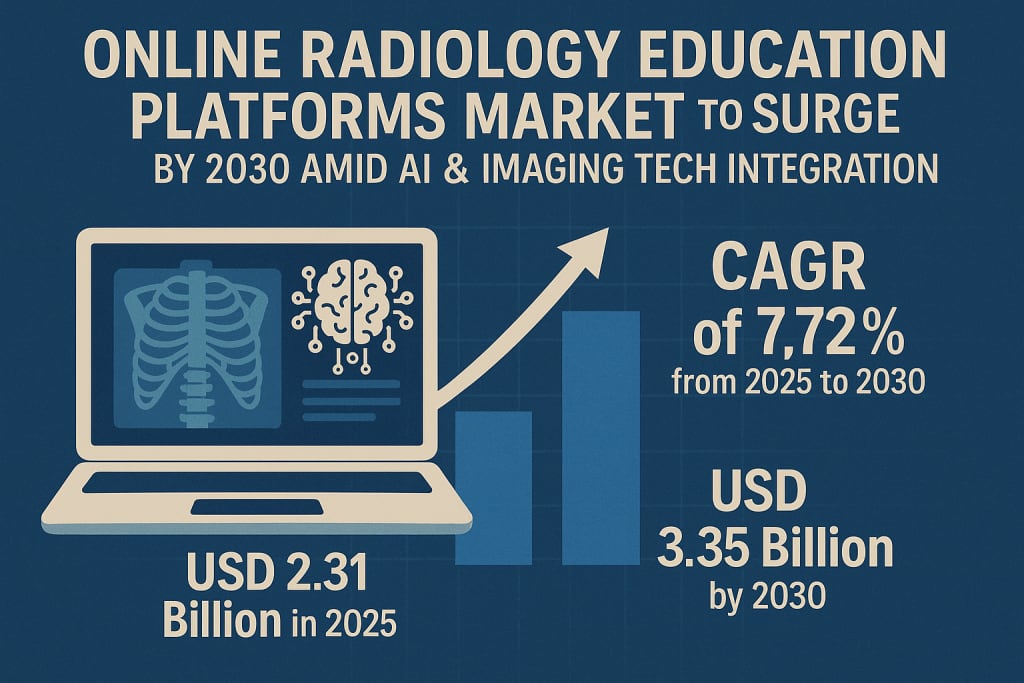
“The new age of radiology is being transformed. The traditional method of learning on a couch or in a hospital has changed completely. Radiologists today are learning online.” As reported by Healthcare IT News.
The Global Online Radiology Education Platforms market size is expected to reach USD 3.35 billion by 2030, growing at a CAGR of 7.72% from 2025 to 2030.
✨ How online learning is Changing Radiology Training
Radiology training is rapidly moving online. With digital content platforms offering access to interactive case libraries, PACS simulators, AI-driven learning modules, virtual CME, and even teleradiology job boards, residents and practicing radiologists can now learn:
• On-demand, high-quality training
• Collaborate and learn from peers across the globe
• Upskill and advance to sub-specialty level, easily
The reasons are simple. Online learning is flexible, clinically relevant, and has the ability to offer continuous upgrade courses at the point of care for residents, practicing radiologists, and even imaging technologists. All of this is critical in a specialty that is rapidly adopting new imaging modalities, and advancing the creation of dedicated subspecialties.
🚀 What is driving the market?
1. AI in Imaging & Education
AI-based clinical decision support tools are being integrated directly into practice workflows across specialties (lung nodule detection, breast imaging, stroke triage, etc.). Online education platforms are also leveraging AI simulations and interactive tutorials to teach learners to interpret and use machine learning-based tools in the clinical setting.
2. Demand for Subspecialty Training
As sub-specialty certifications and advanced content areas (neuroradiology, pediatric imaging, interventional radiology, etc.) become more popular, learners need modular and hyper-focused content that includes real cases and commentaries by thought leaders in the field.
3. COVID-19 Pandemic Accelerates Remote Learning
Remote medical education and training have been catalyzed by the pandemic as learners and institutions quickly adapted to the shift in learning preferences and now see the benefits of a hybrid or completely virtual learning format. Radiology is a unique specialty in medicine that has less dependence on hands-on patient care so it has seen the full transition.
4. Online Growth in Emerging Markets
Countries in Asia, Africa, and South America, are seeing the highest enrollments in online radiology and medical imaging courses due to a high demand for, but short supply of trained and certified radiologists. Platforms are helping scale these needs by providing affordable, easy-to-access, accredited content in mobile and low-bandwidth formats.
🌐 The main players are
The prominent Online Radiology Education platforms companies are
• Radiopaedia.org
• e-Anatomy by IMAIOS
• StatDx (Elsevier)
• Coursera & edX (partnered with university medical institutions)
• Kenhub
• Health e-Learning & Radsource
The strategies adopted by them
• Interactive DICOM viewer
• Virtual PACS and training modules
• Certification based CME Programs
• Cloud-based LMS
📈 Regional Outlook
North America & Europe: Demand for AI-integrated learning tools and accredited CME content. Institutions also developing their own platforms to train residents.
Asia-Pacific: Rapidly increasing adoption. Contributed by massive expansion of radiology departments, affordable mobile learning access, and national-level professional upskilling programs
Middle East & Africa: Growing with global partnerships and the expansion of teleradiology across the regions. Also, rapidly increasing demand for diagnostic imaging capacity.
🔍 Challenges in the market
Although the market is on the fast track, the current challenges being faced by companies in this industry are:
• Lack of content standardization across different platforms, and even across countries.
• Technological challenges (low access to high bandwidth internet)
Credential recognition
But, these are being overcome by partnerships with academic accreditation bodies, mobile-first UX, and use of AI-assisted learning and personalization.
🔮 Future of The Online Radiology Learning Platforms Market
• Integration of AR/VR for anatomy and IR training
• Expansion of AI-powered tutors, and case-based learning modules
• Subscription-based access and micro-learning features
• Multilingual learning content delivery
Conclusion: Online Radiology Education Platforms Are the Future
Online education platforms for radiologists and trainees are no longer a side hustle. As radiology goes digital, and advanced technologies like AI start to influence clinical decision-making, there is no escaping the need for continual and practice-based learning.
Get Sample Brochure at https://www.theresearchinsights.com/request_sample?id=168
About the Creator
Paxton Templeton
I’m a storyteller at heart with a passion for turning data into compelling narratives. With a focus on industry trends, market insights, and growth statistics, I bring clarity to complexity
Keep reading
More stories from Paxton Templeton and writers in Journal and other communities.
Ultrasound Needle Guides Market | Navigating Growth Across Healthcare Applications & Emerging Markets
Background: The Future is Clear Amid the buzz of robots and catheters, one of the most promising accessories for ultrasound-based image-guided interventions is gaining momentum in hospitals and clinics worldwide: ultrasound needle guides. In short, this portable add-on allows clinicians to insert a needle at a fixed angle relative to the ultrasound transducer, thereby simplifying the alignment of the probe and needle tip while navigating complex anatomy.
By Paxton Templeton9 months ago in Journal
Author’s Advice
If you would’ve asked me 20 years ago did I know I’d become a writer and an author, I would’ve said “nope, ain’t happening”. As fate would have it I did become an author and I can honestly say I’m loving it so far. It really does feel good to be a writer. I’ve learned a lot on this journey and I feel like with even me being as new to this world as I am, there’s some wisdom I need to share with every other aspiring author.
By Joe Patterson5 days ago in Journal
Inspection Drones Market Enabling Safer and Smarter Infrastructure Monitoring
The Flying Inspector Above Critical Infrastructure Across industries such as energy, utilities, construction, and transportation, infrastructure inspection is essential for safety and operational efficiency. Traditionally, inspections required manual labor, scaffolding, helicopters, or technicians working in hazardous environments.
By james robert5 days ago in Journal




Comments
There are no comments for this story
Be the first to respond and start the conversation.