
Smart Home Market: The AI-Driven Future of Living Spaces
What’s Fueling the Smart Home Revolution

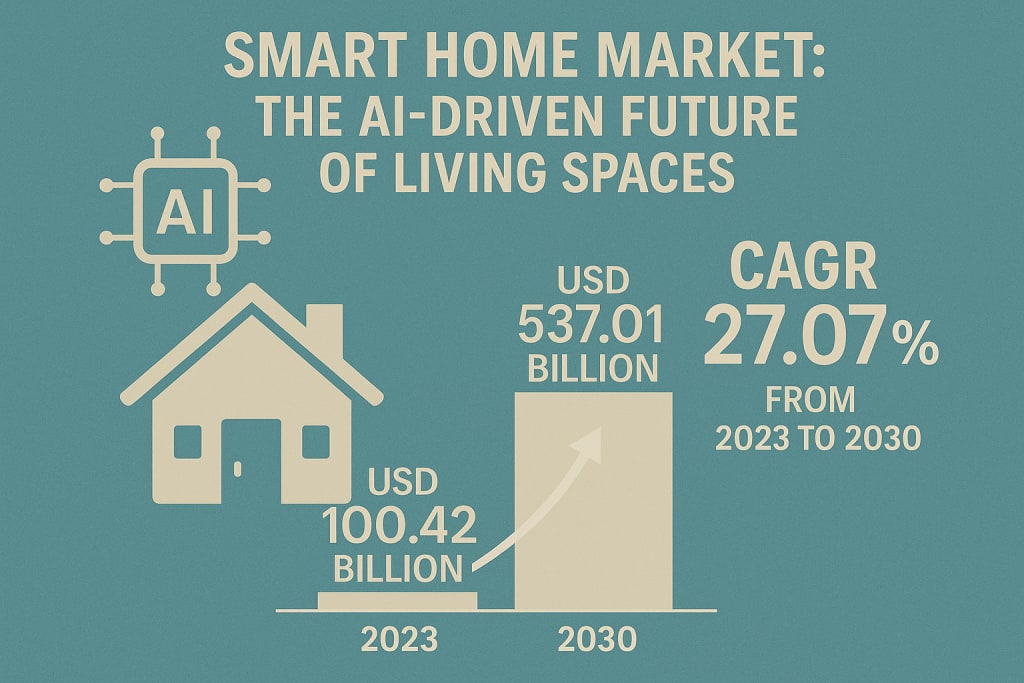
The definition of “home” has continuously transformed alongside technological advance-ments including fire and electricity leading up to internet access and smart devices. Artificial Intelligence (AI) is transforming domestic innovation today by integrating seamlessly into our daily surroundings. The smart home market transforms from simply a collection of gadgets into an intelligent and responsive ecosystem that predicts needs and improves security while optimizing comfort because smart devices continue to advance and connect with each other.
Embrace the AI-powered future of residential environments.
🌐 The Smart Home Market at a Glance
The worldwide smart home market is expanding at an unprecedented rate. The smart home market which had a valuation of more than USD 100.42 billion in 2023 is projected to ex-pand to approximately USD 537.01 billion by 2030 due to growing customer demand, re-duced prices of devices and wider use of AI-driven solutions.
Smart thermostats along with voice assistants intelligent lighting security systems connected appliances and integrated energy management systems are no longer futuristic concepts but standard elements in today's modern homes. AI technology drives the transformation from basic automation functions to advanced contextual intelligence in modern applications.
🤖 How AI is Transforming Smart Homes
1. Predictive Personalization
AI allows smart devices to analyze user behaviors alongside environmental inputs to create customized experiences. Google Nest smart thermostats go beyond manual control by using data about your behavior patterns and local weather conditions as well as occupancy infor-mation to automatically adjust temperatures.
Smart lighting systems detect your home occupancy patterns to modify brightness and color temperature settings which support daytime productivity and promote nighttime relaxation.
2. Voice Assistants Get Smarter
Devices that respond to voice commands such as Amazon Alexa, Google Assistant, and Apple Siri have become common throughout households. The fusion of natural language processing with contextual understanding technology has transformed these devices from simple task executors into conversational partners that interpret complex commands and recognize emotional tones.
By stating "I’m feeling cold," users can command their assistant to modify home settings which includes raising the temperature through thermostat control while activating the fire-place and creating a warm ambiance with dimmed lighting and a relaxing playlist.
3. Proactive Security and Surveillance
AI security systems provide more capabilities than simple motion detection. Modern smart home cameras and sensors combine computer vision with facial recognition and anomaly detection to distinguish between family members, delivery drivers and potential intruders.
A number of systems integrate behavioral analysis with sound detection to forecast abnor-mal activities thus sending instant notifications to homeowners and emergency responders which transforms proactive home safety.
4. Energy Efficiency and Sustainability
AI-driven smart homes offer convenience while promoting environmental awareness through eco-friendly operations. Intelligent energy systems track appliance usage while predicting peak hours and automatically minimize energy consumption to optimize usage and decrease expenses.
Through smart grid integration and renewable energy systems homes transform into minia-ture power stations where they store solar energy and return excess power to the grid to support sustainable living worldwide.
Linking Devices to Ecosystems demonstrates the Strength of Integration
The most significant development in smart home technology comes from combined system integration rather than separate devices. Samsung (SmartThings), Apple (HomeKit), Google (Home), and Amazon (Alexa Smart Home) are dedicating substantial resources to build in-teroperable ecosystems where all devices communicate with one another.
The central brain of AI analyzes information from various devices including lights, cameras, appliances, wearables and electric vehicles to establish a unified and smart environment. The outcome is an adaptive residence which reacts immediately to your personal require-ments and external environmental variations.
🧠 AI at the Edge: Smarter, Faster, Safer
Smart home systems are increasingly using edge AI which enables local data processing at the device or home network level despite the strength of cloud-based AI. This offers several advantages:
• Faster responses (no reliance on cloud latency)
• Improved privacy and data security
• Reduced bandwidth usage
Edge AI enables instantaneous decision-making through local detection of emergencies like fires and intruders without server delays — essential for rapid response scenarios.
🚧 Challenges on the Road to Smarter Homes
AI-driven smart homes still encounter several obstacles even though they show great poten-tial.
• Privacy Concerns: Consumer anxiety about surveillance and data misuse grows as smart homes begin to use cameras and microphones together with behavioral data tracking.
• Security Risks: The security of connected devices can be easily compromised through hack-ing attacks if appropriate protection measures are not implemented.
• Fragmentation: Device compatibility issues tend to surface between different brands when universal standards do not exist.
• Affordability: Despite falling prices fully-integrated AI-powered systems still represent a luxury item for many consumers.
The Matter initiative from key industry leaders Apple, Google, Amazon and more resolves these problems by enabling devices to work together smoothly while enhancing privacy se-curity measures.
🔮 The Road Ahead: Ambient Intelligence and Emotional AI
Smart homes are set to transform from basic reactive systems into environments that under-stand and respond to human emotions. Future homes will utilize biometric sensors alongside sentiment analysis and user interaction-based AI models to detect mood shifts and improve stress reduction and sleep quality while creating environments that evolve together with us.
Ambient computing will become essential because it will make technology invisible which will result in intuitive experiences that remain constantly available.
🏁 Conclusion: Redefining the Home with AI
The smart home market is undergoing a fundamental transformation rather than simple growth. AI has progressed beyond convenience to become the driving force behind trans-forming homes into dynamic self-regulating systems. The evolution of AI technology will lead to a merging of living spaces and intelligent environments until homes become entities that are both connected and aware.
AI advancements will enable homes of the future to do more than provide shelter by devel-oping capabilities to understand our needs while offering protection and empowerment.
About the Creator
Silvie Karson
Passionate storyteller exploring the world of trends. With a background in digital marketing, I craft compelling narratives that inform and inspire. Whether diving into deep-dive features, growth analysis, or trend analysis.
Keep reading
More stories from Silvie Karson and writers in Journal and other communities.
The AI Adoption Curve in Life Sciences: Where Do You Stand
AI integration in life sciences enables researchers, clinicians, and pharmaceutical companies to transform their approach to health challenges through early disease detection and real-time drug discovery. Predictive, personalized and preventive medicine now embraces a concept that was originally considered futuristic.
By Silvie Karson8 months ago in Journal
The goals I did not achieve
Every writing goal I made for the year is a wash. It has been this way for a while, but I think it's important to be open about my failures and the reality of how life can get in the way. This is especially true considering the several times I have posted on Vocal about my writing goals, how I was changing my approach, and where I was hoping to be for the upcoming year. I will probably do that again in a couple months, but for now, it is time to acknowledge where I am today.
By Kay Husnick24 days ago in Journal



Comments (1)
The smart home market's growth is amazing. I've seen how tech like smart thermostats has changed homes. It's cool how AI enables predictive personalization. But I wonder, with all these devices collecting data, how can we ensure user privacy isn't compromised? Also, will there be a standard for seamless integration across different brands?