
The AI Adoption Curve in Life Sciences: Where Do You Stand
The fusion of AI with life science analytics initiates a healthcare revolution where data serves dual purposes of informing decisions and forecasting results.

AI integration in life sciences enables researchers, clinicians, and pharmaceutical companies to transform their approach to health challenges through early disease detection and real-time drug discovery. Predictive, personalized and preventive medicine now embraces a concept that was originally considered futuristic.
This is the beginning of the next stage in predictive healthcare which utilizes AI-powered life science analytics.
The life sciences industry has shifted its focus toward Artificial Intelligence to advance medical research and development.
The life sciences sector is inherently data-rich. The life sciences industry produces terabytes to petabytes of data every day through genomics research, proteomics analysis, clinical trials, medical imaging, patient record systems, wearable technology devices, and research databases. Extracting actionable insights from the vast amounts of data in life sciences continues to present significant challenges.
Conventional data analysis methods show inadequate performance when handling the complex and large-scale data of life sciences that must be processed quickly. That’s where AI steps in.
AI algorithms deploy machine learning, natural language processing, and deep learning technologies to discover patterns while making predictions and proposing actions that traditional human analysis would require months or years to achieve. The result? AI-driven analytics lead to faster discovery processes while enhancing clinical results and streamlining research operations.
Market Snapshot: Rapid Growth and Opportunity
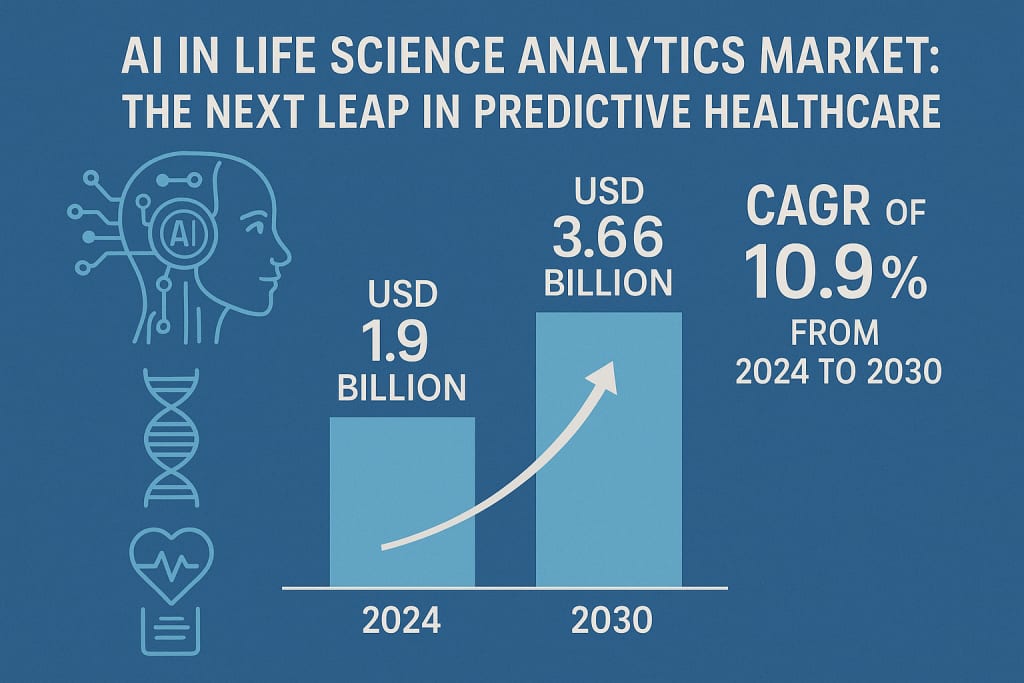
Market researchers predict the AI in life science analytics market will grow substantially to reach $3.6 billion by 2030 from just over $1.9 billion in 2024 while experiencing a compound annual growth rate (CAGR) that exceeds 10.9%. A range of essential elements propels this rapid growth.
• Increasing demand for precision medicine
• Rising healthcare data volumes
AI technology is seeing increased application in both drug discovery processes and optimization of clinical trials.
• Supportive government and regulatory frameworks
• Surging investments in digital health and biotech
Major pharmaceutical companies along with startups and academic research centers are investing substantial resources into AI analytics platforms to secure competitive advantages.
Key Applications Redefining Predictive Healthcare
1. Drug Discovery and Development
The drug development lifecycle goes through significant changes due to AI which affects target identification and molecule design as well as preclinical testing. AI models use large datasets of biological and chemical data to forecast drug-target interactions and potential side effects while determining effectiveness before any physical experiments begin.
Case in point: AI platforms enabled the rapid identification of potential antiviral compounds during the COVID-19 pandemic. The revolutionary protein structure prediction tool AlphaFold from DeepMind brought about a "once-in-a-generation" scientific breakthrough.
2. Genomics and Precision Medicine
AI's capability to interpret genomic data enables advancements in personalized medical treatments. Medical algorithms assess genetic profiles together with lifestyle and clinical information to determine disease risk and customize treatment approaches.
AI technology in cancer research helps identify cancer-causing mutations while predicting how tumors will progress and suggesting more successful targeted treatment options. Healthcare delivery moves from waiting until illness occurs to actively predicting health issues and taking preventive measures.
3. Clinical Trial Optimization
The process of conducting a clinical trial requires substantial financial investment while demanding extensive time commitment and presenting significant risks. AI analytics lessen these challenges through proper trial candidate identification along with dropout prediction and site selection optimization.
Mining electronic health records enables AI systems to identify patients who fit specific trial inclusion criteria and enhances both trial efficiency and participant diversity. Digital twins which represent virtual patient profiles enable outcome simulations that help minimize both time and cost.
4. Epidemiology and Public Health Monitoring
Public health officials use AI-driven analytics to forecast disease outbreaks and simulate infection transmission patterns. AI utilizes mobility data along with environmental variables and health reports to develop predictive models during pandemics and seasonal flu waves which support resource allocation and policy-making decisions.
Challenges in AI Adoption in Life Sciences
The enormous potential exists but substantial challenges remain to be addressed.
• Data Privacy and Security: Life science data remains sensitive because it must follow strict regulations such as HIPAA and GDPR. Leveraging AI for data security demands strong infrastructure alongside strict compliance measures.
• Algorithm Transparency: AI models that function as black boxes present interpretability challenges when applied to critical fields such as healthcare. Explainable AI (XAI) development is essential to establish trust between clinicians and regulatory bodies.
• Integration with Legacy Systems: Numerous healthcare institutions operate their systems with obsolete IT infrastructure. Successfully blending AI solutions into current operational workflows demands time resource allocation and active change management efforts.
• Talent and Training: Data science and AI expertise shortages are currently affecting the life sciences sector. Long-term success depends on raising the skills of current employees and promoting collaboration between different disciplines.
The Road Ahead: What to Expect
Artificial intelligence continues to develop within life science analytics while important emerging trends capture attention.
• Federated Learning: A machine learning method maintains data privacy by training algorithms across multiple decentralized data sources without transferring the data from its original location. Ideal for cross-institutional healthcare collaboration.
• Real-Time Analytics: Real-time AI systems analyze data from wearable devices and mobile health applications to enable ongoing patient monitoring and preventive healthcare services.
• AI Co-Pilots for Scientists: AI technologies utilized for software development are finding similar applications as research lab copilots that help scientists with tasks such as interpreting data and generating scientific text.
Conclusion: A Smarter, Healthier Future
Artificial Intelligence functions as an enabling force that supports scientists and clinicians in their research instead of replacing them. Life science professionals use AI to boost discovery speed while enhancing outcomes and transforming healthcare toward predictive and personalized models.
The next stage of healthcare advancement will be driven by AI in life science analytics as data quantities grow exponentially and the need for efficient patient-focused care continues to rise. Our work goes beyond medicine enhancement because we are transforming the entire scope of health for the future.
Predictive healthcare has reached a new milestone through the power of data analysis driven by AI technology.
About the Creator
Silvie Karson
Passionate storyteller exploring the world of trends. With a background in digital marketing, I craft compelling narratives that inform and inspire. Whether diving into deep-dive features, growth analysis, or trend analysis.
Keep reading
More stories from Silvie Karson and writers in Journal and other communities.
Automation Nation: How Robotic Process Automation Market is Reshaping Global Industries
Robotic Process Automation (RPA) represents a silent revolution that transforms business operations during the digital acceleration era. What was originally perceived as a back-office enhancement tool now stands as a strategic focus point for businesses aiming to reduce costs and increase efficiency while freeing employees to focus on higher-value tasks. The result? The global market for RPA is expanding rapidly and transforming industries as it grows.
By Silvie Karson9 months ago in Journal
How to Enjoy Thai Food and Island Life Without Losing Your Fitness
Krabi is a tropical paradise where jagged limestone cliffs meet the turquoise Andaman Sea. It is easy to get lost in the beauty and forget your fitness routine, but staying active here is actually part of the fun. You do not have to sacrifice delicious Thai flavours to stay healthy. By mixing smart choices with the region’s natural adventures, you can enjoy a guilt-free getaway. Here is how to keep your lifestyle balanced while exploring one of Thailand's most iconic coastal gems.
By Jeewanthi Armstrong6 days ago in Journal




Comments
There are no comments for this story
Be the first to respond and start the conversation.