
Simple Works!
Why do marketers always seem to go to the complex, when simplicity sells?

It ALWAYS amazes me! As a strategic management consultant and professor, I am constantly—and consistently—amazed at just how complicated companies make things today!

Now, being an AARP-card carrier, I have to avoid the sound of an "old guy rant" here, but really people? From remote controls with a hundred buttons to confuse seniors to having to register on a website and give away all your personal data to read an article to just trying to order a cup of coffee in the morning today, very smart, well-meaning folks, sitting in conference rooms across America, just seem to spend long hours trying to come-up with ways to complicate modern life, rather than to simplify it.

Exhibit A of this trend would certainly be the rush to put kiosks seemingly everywhere in the fast food business—well, as fast as the Chinese factories can make those giant touchscreens! There is definitely an age-based—and really tech-comfort level distinction—here when it comes to customer reactions to the kiosks at McDonald's and beyond. Younger customers, who are by and large more digital native and comfortable with all forms of technology, just see the kiosk as another ordering channel—in addition to the apps on their phone and yes, the drive thru. However, it is more likely that older customers—yes, those of us 40, 50, 60 and especially those "seasoned citizens" above those numbers of rings in the tree—and those who still have a flip-phone and have never seen, let alone installed and used an app—well, they might as well be on Mars when they encounter a kiosk instead of a person at their neighborhood McDonald's!
Now to McDonald's credit, they do make counter service available to customers—but really only as a last resort! There are many demonstrated operational and service-related reasons for restaurants to turn to kiosk and app-based ordering. And yes, there are cost issues involved, both in terms of order thoughput (efficiency) and the need for less personnel—at least those upfront dealing directly with customer ordering. The latter, by definition, becomes more important in an era characterized by the push for higher wages in the restaurant sector overall and the #Fightfor15 (raising the minimum wage).
And yet, survey after survey shows that most consumers of all ages prefer to order from a real, live human being as opposed to a touchscreen when "dining" (such as it is) at a fast-food restaurant. In fact, a recent MSN survey, reported by Business Insider, shows that approximately 4 in 5 (78%) of consumers "said they would be less inclined to go to a restaurant that has automated ordering kiosks." But guess what, the kiosks are here to stay! And they will soon be the norm, rather than the curiosity, when you choose to go to a McDonald's or almost any fast-food restaurant. Set the scoreboard to: Complication 1, Simplification, 0.
This brings us to what I might call "The Starbucks Conundrum." And perhaps it's not fair to apply the coffee giant's name to this phenomenon, but well, it really is! In the words heard many times by every parent and every teacher, every toddler and teenager most often starts their excuse for bad behavior with three words: "He started it!"

And yes, Starbucks started it! The company famously not only made their coffee menu as exotic and esoteric as possible, using creative labels for every offering, but they applied high-language words to sizing their cups! As anyone who has happened to walk into a Starbucks knows, there simply "ain't no small, medium, large, extra large!" No, around a conference table at Starbucks' Seattle headquarters, a gathering of likely very smart, again, very well-meaning, and yes, highly paid people—and likely consultants—came-up with a whole new language for sizing the chain's cups. And yes, we have come to learn that in "Starbucks-eze," a small is a "tall" (don't even get me started!!)....
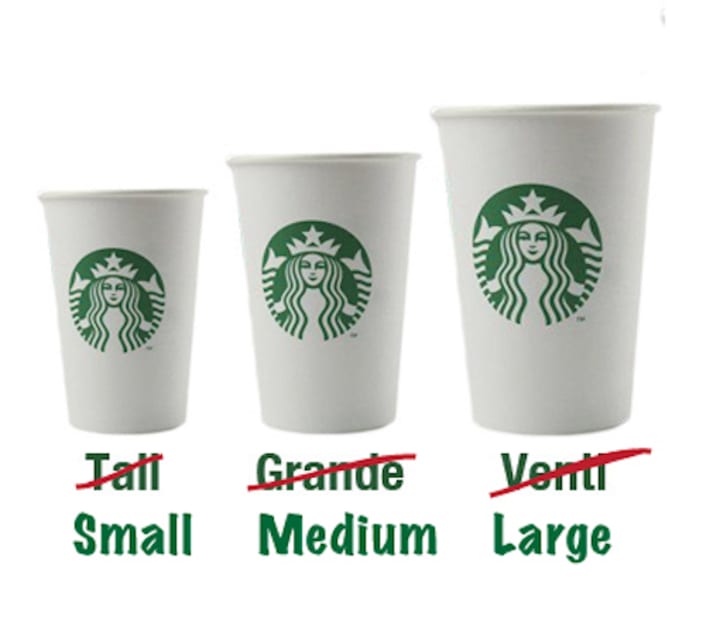
... and a "Trenta" - the biggest size, is not just the "extra large" in "Starbucks-eze." No, in the age in which we live, the Trenta (some would say a ridiculously large drink) has become the target of many a meme, a cartoon, and even some rants on social media!

So what does this over-complication of the menu at Starbucks—and yes, many, many—even perhaps most other competing coffee houses, both large and small alike, mean from a marketing perspective. Well, if a customer feels embarrassed just trying to make an order for a cup of coffee, well... their takeaway of the whole experience can—in their mind at least—be more like an encounter with the "Soup Nazi"...
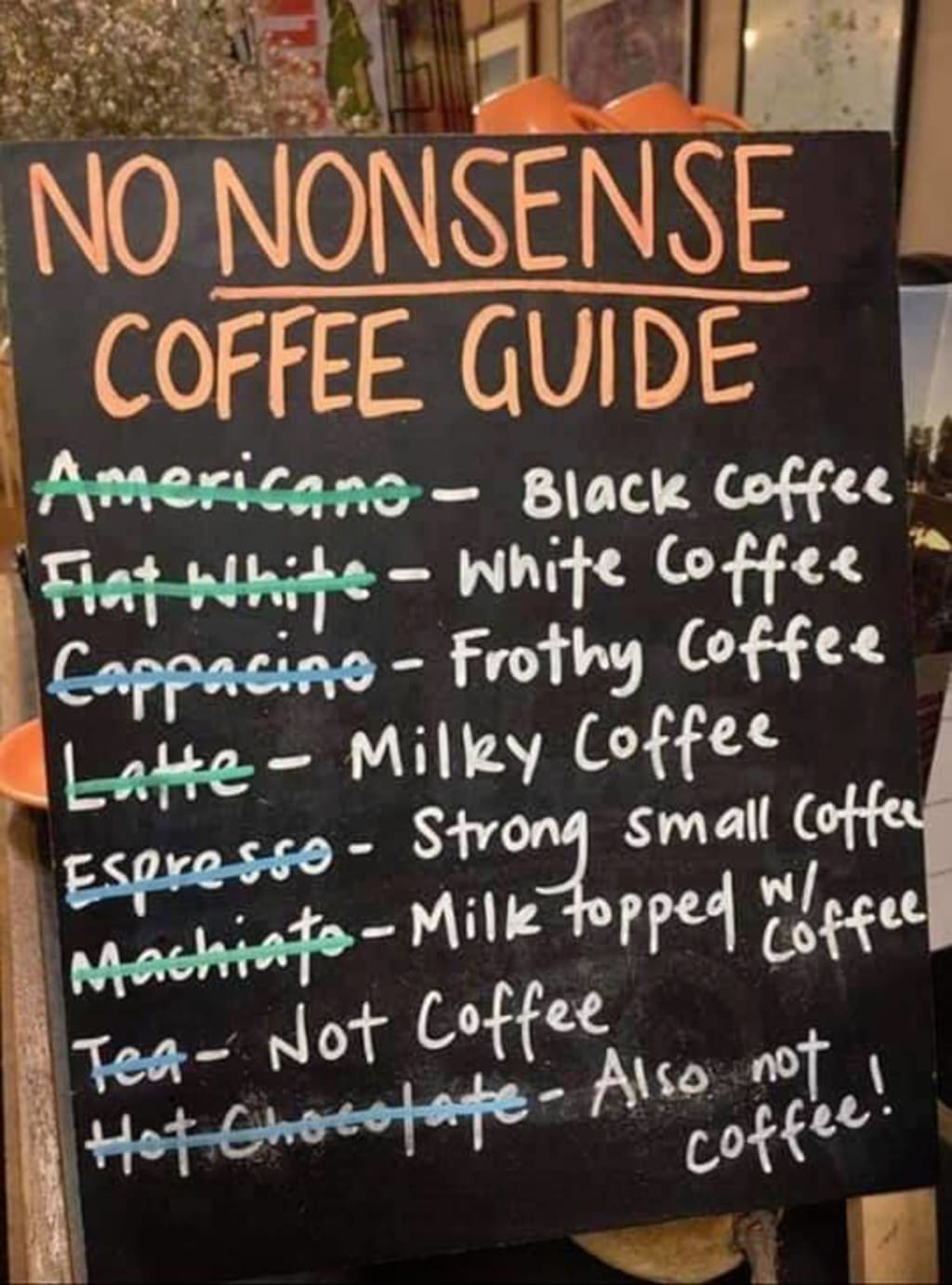
This brings us to the photo posted at the outset of this article. A few days ago, while "working" in the modern way—meaning having way too many tabs open and just sort of productively multitasking—I ran across this photo posted on Facebook by Dreams Come Twogether (and yes, that spelling is right!):

Ahhhhhh... Simplicity!
When I saw this photo, I immediately had one thought: Thisone image is it! This image encapsulates the unnecessary complications that far too many businesses make today to make the customer experience nothing short of hard! And Starbucks—yes, Starbucks—is the face of this trend! It is as if Dr. Evil himself thought of this diabolical scheme to take more money from customers by making it harder and harder to get what they want—coffee (and in truth, maybe just the caffeine!).
There are compilations of just how complicated Starbucks—and yes, with the mostly willing complicity of some of their most frequent and loyal customers—can make what should be a straightforward ordering process into what—to many—might sound more like a "word salad!" There are many Reddits dedicated to variations on the theme: "Most complicated Starbucks order..." There have been a wealth of articles, blog posts, and such posted along this same line over the years. Here below is just a sampling of them (and trust me, this is really just scratching the Internet's surface!):
- The Most Obnoxious Starbucks Drink Orders
- The Most Annoying Starbucks Orders Baristas Have Ever Gotten
- 15 Drink Orders From Starbucks That Will Make You Ask, "Are These Customers Okay?"
- 11 Of The Most Annoying Starbucks Orders
- 7 Starbucks Orders That Went Too Damn Far: They're longer than the longest book you've ever read.
"Simply" ordering at Starbucks has even been the source of great comedy over the years...
... and yes, if you have reached the proverbial "End of the Internet," there are many, many videos where customers try and outdo one another to fashion as complicated a Starbucks order as possible—all while videoing their ordering it, of course!
And so yes, the Starbucks Conundrum is a very real thing! Now Starbucks may be unique in positioning itself as being more exclusive—and yes, more expensive (and indeed, worthy of higher prices)—in the eyes of many consumers by virtue of being more complex and more confusing. Generally however, outside of perhaps the world of coffee, complexity is not a good thing! Making one's product or service unnecessarily complex tends to drive away potential customers and/or not enable you to retain the "light users" of your brand who basically, whatever your line of business may be, simply want the equivalent of a small black cup of coffee from you! There may be a market for high-end exclusivity that is very real. However, for 98% of all customer-facing businesses (and really, what other kind are there?), making it easy to do business with your company will net you far, far more in all the important metrics—sales, order size, repeat customers, client loyalty, word of mouth, etc.—than making it intentionally harder than how they can interact with your competitors.
So what is the takeaway from all of this. It is amazingly simple—as it really should be, given the topic!
A golden rule of marketing is this: The harder you make it to be a customer, the less likely it is that the purchase will be made in the first place. And the corollary to this is just as important: The harder I had to work just to be your customer, the less likely it is that I will continue to be your customer! And a very important "corollary to corollary" is especially important to remember in the age of online reviews and social media: the harder you make it for the customer, the more likely it will be that the "pissed off" man or woman will say bad things—sometimes very bad things—about you to their friends and to the world!
And the irony here is that all of this was indeed made way too complicated by me in trying to convey what is, in essence, a very simple piece of executive wisdom that you and everyone around you should keep front of mind when thinking about how your company will interact at every possible touch point with its customers and its potential customers: Don't overly complicate things!

Of course, one can express this bit of managerial advice even more succinctly and easily with the one simple, age-old acronym—KISS (“keep it simple, stupid”). Little did I know as one with his finger on the pulse of organizations that some have tried to make this expression more "politically correct" by omitting the "stupid" part—lest anyone's feelings get hurt (Snowflakes!!!).

So, in the end, Starbucks is very much an anomaly! One should not model after them. They are unique in that making things intentionally complex—and yes, with the willing aid of often very loyal customers who know—and can order—exactly what they want—this does work for them. However, you are far better off looking at everything you do from a customer perspective and asking one simple question: Are we really following the "KISS" (or the more PC-"KIS") principle? And the next question, regardless of how that first question was answered, should be how can we make things even simpler?
Eliminating the obstacles, the friction, the hassle of being a customer will pay far greater dividends than likely any other strategic move you can make! And so simplicity should be a consideration in every marketing, advertising, packaging, customer service, and Internet strategy discussion anyone in your company has from today forward. In short, simplicity works! Make it work for you! And yes, that simple coffee menu does say it all!

About David Wyld
David Wyld ([email protected]) is a Professor of Strategic Management at Southeastern Louisiana University in Hammond, Louisiana. He is a management consultant, researcher/writer, publisher, executive educator, and experienced expert witness. He is the founder and publisher of both The IDEA Publishing (The Best in News, Information and Content Marketing) and Modern Business Press (Creating the Readable—and Enjoyable—Academic Journal—Not an Oxymoron!).
David Wyld’s Online CV
Social Media Links to David Wyld:
on Facebook
on Twitter
on LinkedIn

Professor David C. Wyld
Show Your Support for Professor Wyld and the Vocal Platform
Like what you just read? Did it make a difference to you? If so, please see and share this article through social media, email, and even the old-fashioned way of printing it off for a colleague or friend!
And while you’re at it, ask yourself a simple question: Was the info worth a buck or two—or perhaps a whole lot more to you, your career, your company? If so, please consider “tipping” (after all, it is the polite thing to do!) using the easy link below. In providing a small tip—even a dollar or two, you not only help support the author's work, but you help keep the unique platform that Vocal Media is building be an advertising-free environment—and don't we all need more of that to make our online experiences better today? Please consider showing your support below and voting for good writing and ad-free content on the web!
About the Creator
David Wyld
Professor, Consultant, Doer. Founder/Publisher of The IDEA Publishing (http://www.theideapublishing.com/) & Modern Business Press (http://www.modernbusinesspress.com)
Keep reading
More stories from David Wyld and writers in Journal and other communities.
Part 2: What It Takes to Stay Close to the Customer Today
In the first part of this article (Part 1: What It Takes to Stay Close to the Customer Today), we looked at the idea that you can—and must—stay close to your customer today. As we demonstrated, this idea has become nothing less than a core concept of modern marketing strategy. In the noisy world in which live, work, and yes, attempt to market products and services, companies are realizing that it is not enough just to be following the prescription laid out almost four decades ago now by Tom Peters and Robert H. Waterman, Jr. in their best-selling classic,In Search of Excellence to be close the customer. Today, the pressure is on for companies to get even closer to their customers.
By David Wyld7 years ago in Journal
Two Grumpy Old Men Solve the Problem
Marty and Steve were two grumpy old men who lived together. They had known each other for years. Marty had been a bachelor all his life. Steve said it was because no one could stand to ever live with. Marty’s standard reply was “Well, you are, so what sort of a moron does that make you!”
By Calvin Londona day ago in Humor




Comments
There are no comments for this story
Be the first to respond and start the conversation.