
Should We Prefer Handwritten Notes or a Mobile Notepad?
Choosing Between Paper and Screen: What's Best for You?
In today’s fast-paced, technology-driven world, mobile notepads have become an integral part of how we organize our lives. They are handy tools, always at our fingertips, allowing us to quickly jot down lists, thoughts, or ideas — especially when pen and paper are not within reach. Whether it's a grocery list, a sudden spark of inspiration, or a to-do task for the next day, mobile notepads make capturing information swift and effortless.
Beyond convenience, mobile notepads offer features that streamline our day-to-day activities. They help improve our typing speed, automatically organize our notes, and offer functionalities like reminders, voice inputs, and cloud storage. These digital notes can be searched, backed up, color-coded, and even shared across devices. Since our phones are rarely out of reach, it becomes easy to update and revisit these notes multiple times a day. In many ways, mobile notepads bring structure to the scattered fragments of our thoughts, helping us keep pace with modern life.
However, the question remains — when it comes to genuine self-expression, can the sterile blue light of a screen match the tactile intimacy of pen and paper? Can typed words carry the same emotional weight as those written by hand in a personal diary?
There is something deeply human about the act of writing by hand. It is slow, deliberate, and profoundly personal. Unlike tapping on a keyboard or phone screen, writing with a pen allows thoughts to unfurl naturally, guided by the rhythm of the hand. The flow of ink across paper seems to mirror the flow of emotion from within. Every letter, every pause, every underline or margin note carries a part of the writer’s mood, their tempo, and even their unspoken hesitation. In contrast, digital text feels uniform — efficient, yes, but often stripped of personality.
Even in academics, particularly in subjects like mathematics, our instinct is to reach for a piece of paper. Solving equations, sketching graphs, or brainstorming ideas is often best done with pen in hand. The physical act of working through a problem on paper engages the mind more holistically — combining cognitive reasoning with motor activity. Typing mathematical steps can feel rigid or unnatural, especially during the early stages of learning or conceptualization.
Similarly, when it comes to storytelling, journaling, or reflecting on our lives, many of us still prefer the quiet company of a notebook. The blank page offers a kind of silence — a patient space that invites us to think deeply and write honestly. That first line written often unlocks a flood of ideas, much like opening a door to an inner world. There’s no blinking cursor urging us to hurry, no app notifications pulling us away. Just the steady scratch of pen on paper, a comforting sound in a distracted world.
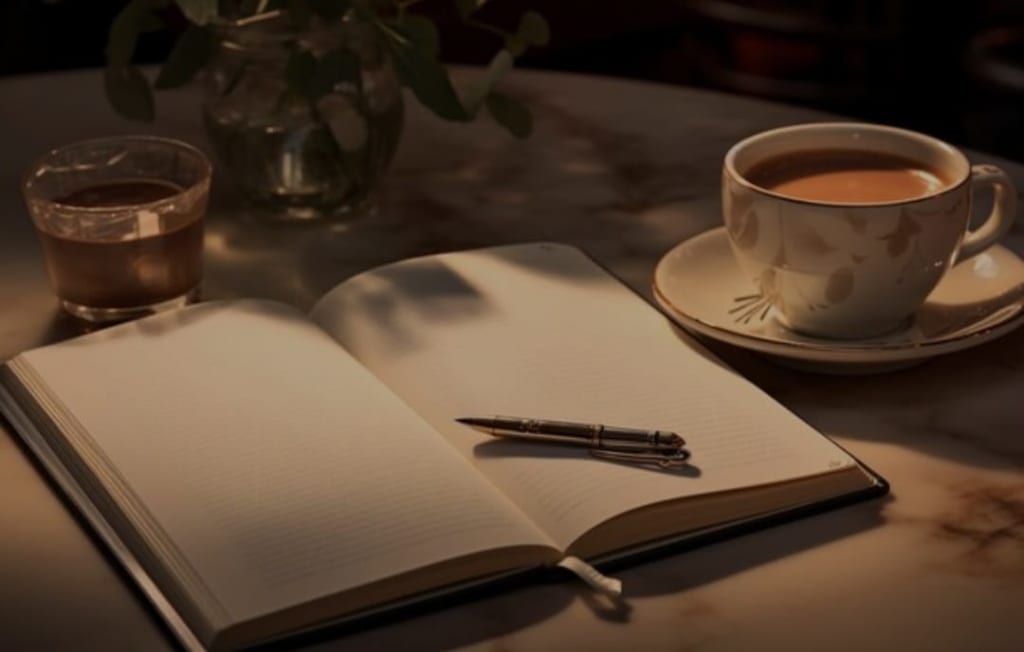
There’s also a sensory depth to handwriting that digital devices simply cannot replicate. The texture of the paper, the scent of ink, the weight of the pen — these physical sensations ground us in the moment. Imagine a quiet afternoon, sunlight spilling across the table, a notebook open before you. In that stillness, with no digital noise or interruptions, writing becomes not just a task, but a meditative experience. It's a moment of reflection, connection, and inner clarity.
Moreover, handwritten notes often become cherished keepsakes. A parent’s grocery list, a friend’s handwritten letter, or an old journal entry found years later carries emotional weight that no digital file ever could. There’s authenticity in the imperfections — the smudged ink, the crossed-out words, the hurried handwriting — all echoing the very human nature of the writer.
That’s not to say mobile notepads don’t have their place. In fact, the best approach may be a thoughtful balance between the two. Use mobile notepads for efficiency and organization, but reserve pen and paper for when it matters — when you want to slow down, think deeply, and express your truest self.
In a world increasingly dominated by screens, the act of writing by hand remains quietly revolutionary. It reminds us that not everything needs to be fast, polished, or shared. Some thoughts are meant to be felt slowly, recorded in ink, and kept just for ourselves.
About the Creator
Sushree Sneha
I am Sushree Sneha, a last yr CSE student and I’m an entry-level programmer with a strong passion for coding and technology. Apart from academics, I enjoy reading novels, writing tiny tales, and exploring arts and crafts love travelling.
Keep reading
More stories from Sushree Sneha and writers in Journal and other communities.
The Gita Wisdom: Path of Dharma
The Bhagavad Gita is not just a religious scripture but a manual for life, offering profound wisdom on duty, patience, self-control, and devotion. It teaches us how to face life’s challenges with strength and clarity, helping us discover the true meaning of existence. The Bhagavad Gita is a spiritual guide delivered by Lord Krishna to Arjuna on duty and righteousness, set within the Mahabharata, a war ignited by the Kauravas’ injustices — usurping the Pandavas’ kingdom and disrobing Draupadi in court.
By Sushree Sneha9 months ago in BookClub
Gaza’s Collapsing Economy Drives Youth to Create Unconventional Solutions
Gaza’s economy has been in a state of prolonged crisis for years, shaped by conflict, restrictions on movement, political division, and repeated shocks to already fragile systems. Today, the situation is more severe than ever. Unemployment is widespread, poverty is deepening, and traditional paths to stability—education, salaried jobs, and entrepreneurship—are increasingly out of reach. In this bleak economic landscape, Gaza’s youth are responding not with resignation, but with unconventional, grassroots solutions aimed at survival and dignity.
By Salaar Jamaliabout 2 hours ago in Journal




Comments
There are no comments for this story
Be the first to respond and start the conversation.