
Shane Windmeyer on DEI in 2026: From Headlines to Handrails
Why Progressive and North Carolina Hm Headlines to Handrails, and elp Us See the Next Chapter

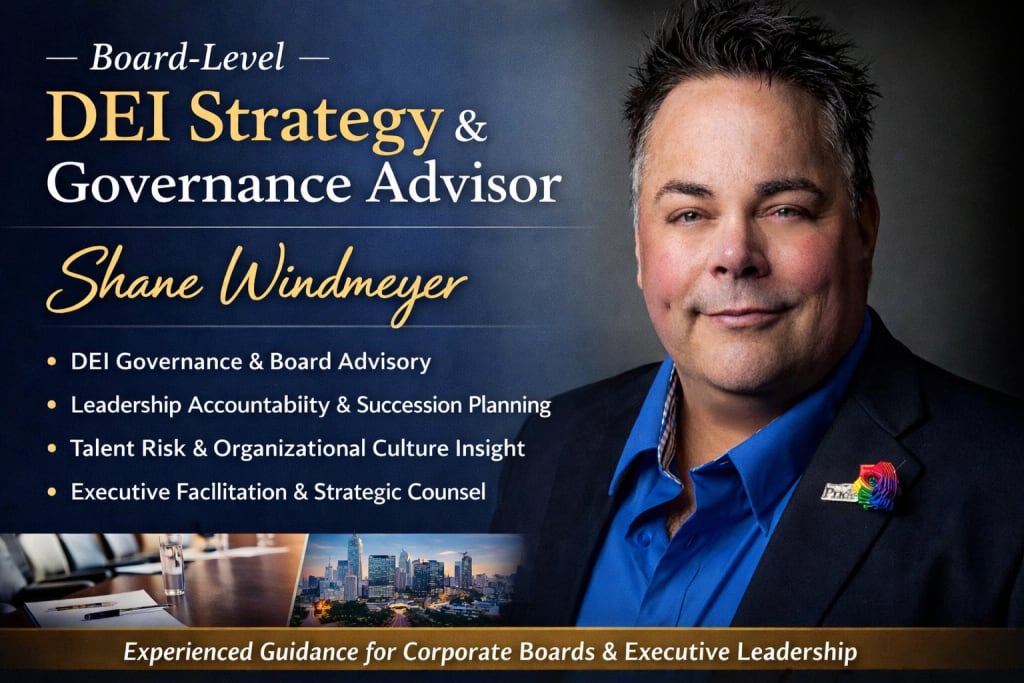
DEI in 2026 feels like it’s living in two worlds at once.
In one world, the public conversation is louder than ever. You see lawsuits, legislation, policy shifts, and hot takes that reduce complex workplace realities into a handful of charged words. In the other world, inside actual organizations, people are still trying to do the same fundamental things they were trying to do before: hire well, develop talent, retain good employees, build managers who can lead, and create environments where teams can do hard work without tearing each other apart.
That tension is why DEI can feel exhausting right now. The external debate makes it tempting for organizations to go silent, to rename everything, or to treat inclusion as a communications risk rather than a leadership responsibility. But the internal need hasn’t changed. People still notice when promotions are mysterious, when workloads are uneven, when managers avoid feedback, and when “culture” becomes code for comfort and sameness.
In 2026, my working definition of DEI is simple: it’s the set of practices that determines whether opportunity is real and whether people are treated with consistent respect while the business performs under pressure. The label matters less than the lived experience, and the lived experience is shaped by the small mechanics most companies don’t post on their website.
That’s why Progressive Insurance is a useful case study, and why North Carolina is a relevant backdrop. Progressive is one of the companies still choosing to speak publicly about DEI while explicitly acknowledging the controversy around the term. North Carolina is one of the states where the policy environment around DEI in public institutions has been actively contested, creating a real-time example of how quickly external conditions can force internal recalibration. Put them together and you can see what DEI in 2026 is becoming: less speech, more structure; fewer slogans, more guardrails.
DEI in 2026 is shifting from “what we believe” to “how we operate”
A few years ago, many organizations treated DEI as a statement of identity. Now, the organizations that will keep traction are treating DEI as a form of operating discipline. That shift is happening for a practical reason: belief statements don’t hold up under scrutiny if the day-to-day mechanisms contradict them. When the environment gets more legally and politically complex, organizations either build discipline or they retreat.
In 2026, the most durable DEI work tends to show up in places that don’t look like DEI at first glance: clear job architecture, structured hiring, consistent performance standards, transparent promotion criteria, manager training on feedback and conflict, and credible channels for employee concerns. Those are the handrails that keep a culture stable when the external world is unstable.
When I say “handrails,” I mean the things that make fairness repeatable. Fairness that depends on a single leader’s personality is fragile. Fairness that depends on a process is scalable.
Progressive’s public posture: “DEI is polarizing” and we’re defining it anyway
Progressive has made a notable choice in how it talks about DEI. On its public DEI page, it acknowledges that “DEI can be a polarizing term,” then emphasizes its approach is grounded in its Core Values and “not to be confused with any other interpretations.” It also states, “We’ll never change our commitment…to sustaining a culture where every one of us can risk, learn, and grow.”
That is not a minor messaging decision in 2026. Many organizations are reducing their public footprint. Progressive is doing something more nuanced: keeping the term, admitting the tension, and then narrowing the definition to its own operating values.
This matters because ambiguity is one of the biggest drivers of distrust right now. When employees and candidates can’t tell what DEI means inside a company, they either assume the worst or they stop asking questions. By drawing a boundary around meaning, Progressive is attempting to prevent the external debate from rewriting the internal culture story.
Progressive also links the idea of “voice” to civic participation and voting, saying it encourages employees to vote and stands against efforts to prevent people from fully participating in democracy. That’s another deliberate choice. You can agree or disagree with the stance, but you can’t miss the signal: the company is willing to place “voice” in a broader context than workplace performance.
The governance signal: what Progressive tells shareholders is more revealing than what it tells the internet
If you want to understand what a company truly stands behind, look at its investor-facing materials. That language is usually more careful than brand language. Progressive’s 2025 proxy statement is accessible via its proxy site and the SEC filing.
The reason this matters is simple: boards don’t casually connect topics to performance in official governance documents. When a board frames culture and inclusion as part of performance and risk oversight, it becomes harder for the organization to treat the work as a marketing accessory. In 2026, that board-level anchoring is one of the clearest indicators of whether DEI will survive leadership transitions and political pressure.
What DEI looks like in 2026 when it is actually working
Here’s the truth that both job seekers and executives often need to hear: DEI in 2026 is less about statements and more about predictability. A fair workplace is one where people can predict what success requires, predict how decisions get made, and predict that problems will be addressed consistently rather than personally.
In practice, this tends to show up in a handful of areas.
First, hiring becomes more structured. Not because structure is trendy, but because structure reduces bias, reduces the influence of “gut feel,” and makes interviews more defensible and consistent. Second, performance becomes more explicit. Third, promotions become less mysterious. Fourth, managers become more capable at feedback and conflict. Fifth, “voice” becomes safer because the organization has norms for disagreement that don’t punish the person who raises the issue.
Those are the handrails. They’re boring. They’re also everything.
Progressive’s public language about “integrity,” “honesty,” and welcoming “healthy disagreement” is useful here because it points toward a culture that wants disagreement to generate better decisions rather than better drama. The candidate’s job is to evaluate whether that’s true on the specific team they are joining.
The interview shift in 2026: candidates must evaluate the team, not the company story
One of the biggest changes I see in 2026 is that candidates are becoming culture auditors, whether they mean to or not. They’re asking, “Will I be supported here?” and “Will I have to decode hidden rules?” and “Can I grow without becoming a different person?”
If you’re interviewing at Progressive, the advantage you have is that the company has made specific claims you can test. When Progressive says it will “never change” its commitment to a culture where people can “risk, learn, and grow,” you can explore what risk and learning look like in the day-to-day.
Does the manager describe mistakes as learning moments with clear coaching and accountability? Or do they describe a culture where mistakes are quietly punished through reduced opportunity? A company can claim growth, but if a team punishes mistakes socially, growth becomes performative.
When Progressive says it welcomes “healthy disagreement,” you can ask for a real example of disagreement on the team and how it was resolved. Do you hear a clear decision process? Do you hear leaders who can tolerate dissent without defensiveness? Or do you hear stories where disagreement is allowed only from certain voices?
And when Progressive connects “voice” to participation, you can explore whether internal voice is protected. Are there norms for raising concerns? Do managers invite feedback or merely tolerate it? Do employees have channels that feel credible?
None of those questions require you to debate DEI as a political topic. They evaluate whether the workplace operates with clarity and respect.
North Carolina’s relevance: the external climate changes the language even when the need stays the same
North Carolina matters in this 2026 conversation because it illustrates how quickly the DEI environment can shift in public-facing institutions. Reporting has covered legislative activity around restricting DEI programming in public schools, higher education, and state agencies, including veto dynamics and ongoing debate about bans and limits.
Separate from legislation, the UNC System has experienced policy changes and implementation pressure, including communications about an “Equality Policy” and expectations that campuses verify realignment away from DEI structures.
Regardless of where you land politically, the operational takeaway is the same: external governance can force internal change in vocabulary and structure. That means job seekers in North Carolina can’t rely on whether an employer uses the term “DEI” to determine whether a workplace is fair. Especially if you’re evaluating public institutions, you may see fewer visible DEI references even while the organization still needs to address fairness, belonging, and employee experience.
This is where private employers can look very different from public institutions in the same state. A private company like Progressive can choose its public language more freely. A public university system may have constraints and oversight pressures that shape what it can say and how it organizes programs. North Carolina highlights why 2026 evaluation must be behavior-based rather than label-based.
A 2026 reality: DEI is increasingly tied to technology, analytics, and “who benefits from automation”
Here’s a dimension of DEI that doesn’t get enough attention in the public debate: the growth of automation and AI in decision-making. Whether you’re in insurance, healthcare, finance, or retail, more decisions are being shaped by models, workflows, and automated systems.
That creates a DEI challenge that is fundamentally operational, not ideological. If your company uses analytics to streamline hiring screens, claims triage, fraud detection, underwriting, customer service routing, or performance dashboards, the question becomes: are those systems producing fair outcomes, and can humans understand and challenge them?
This is where “healthy disagreement” becomes more than a culture phrase. It becomes a business need. A team that can question an output, test assumptions, and adjust a process is safer than a team that treats a model as unquestionable truth.
Insurance is a particularly relevant industry for this conversation because consumer trust is tied to perceptions of fairness. Even without getting into technical details, the direction of travel is clear: operational fairness will increasingly include how companies design and audit decision processes that are partly automated.
In 2026, I believe the most forward-looking DEI work will involve three things: transparency, review mechanisms, and accountability for outcomes. Not because transparency is a feel-good value, but because transparency is how you prevent systems from drifting into inequity without anyone noticing.
“Supporting the cause” in 2026 is less about slogans and more about protecting credibility
When someone asks whether a company is “supporting DEI,” I translate that question into something more practical: is the company building credibility with employees through consistency?
Progressive’s page says it will “never change” its commitment. A commitment like that is only meaningful if employees experience it through stable processes: promotion clarity, manager support, and voice that doesn’t come with retaliation.
For job seekers, “support” becomes real when you can answer questions like: Do people know how to grow? Do managers coach consistently? Does the organization handle conflict without scapegoating? Are standards consistent across teams?
For leaders, “support” becomes real when the organization can survive a leadership transition without losing fairness. That’s why governance language matters.
The new skill for 2026: reading culture through “friction points”
In 2026, I advise job seekers to evaluate employers by looking at friction points, because friction points reveal priorities.
The first friction point is workload. Who carries the invisible labor? Who gets the “good work” that leads to advancement? A workplace can sound inclusive and still distribute opportunity unevenly through work assignment.
The second friction point is feedback. Does the organization give direct, respectful coaching, or does it avoid hard conversations until the employee is already labeled as a problem?
The third friction point is disagreement. Does dissent produce better thinking, or does it produce punishment?
The fourth friction point is change. When processes change, does leadership explain why and invite questions, or does it push change through and leave employees to absorb the impact silently?
Progressive’s language about voice and disagreement gives candidates permission to explore those friction points in interviews. If an organization claims it values voice, it should not be threatened by a candidate asking how voice works.
Where North Carolina job seekers have an extra layer to consider
North Carolina candidates often face an additional complexity: the gap between what is said publicly and what is practiced privately can be wider in smaller networks and relationship-driven environments. In some regions and industries, hiring is still heavily referral-based. That can be a great thing when it opens doors. It can be a limiting thing when it creates closed loops.
If you’re interviewing in North Carolina, pay attention to whether an employer can describe clear pathways that don’t depend on insider relationships. In 2026, the strongest employers can explain how someone who is new to the network gets developed, seen, and promoted.
This is especially important for candidates relocating into North Carolina or transitioning industries. If advancement depends on social familiarity rather than measurable contribution, growth can stall quickly.
The long view: DEI in 2026 is becoming “culture engineering”
Here’s my broader thesis: the most effective DEI work in 2026 is becoming a form of culture engineering.
Culture engineering means you build systems that produce the behaviors you want. If you want fairness, you build clarity into job expectations. If you want voice, you build routines for feedback and disagreement that protect the speaker. If you want advancement equity, you build promotion criteria that can be explained and measured. If you want high performance without burnout, you build workload norms and staffing discipline.
In other words, you stop hoping culture will improve and you start designing it.
Progressive’s public definition of DEI emphasizes values like integrity and honesty, and it explicitly welcomes healthy disagreement and creative solutions. Whether any specific team lives that is an empirical question, but the framing itself aligns with culture engineering: disagreement isn’t a threat, it’s a tool.
North Carolina’s policy environment underscores why culture engineering matters. If external forces change what you can say, you still need internal structures that keep fairness and respect alive. The label can shift. The handrails must remain.
My closing perspective
DEI in 2026 is not disappearing. It is evolving toward what it should have been all along: a set of practices that makes workplaces fairer, more stable, and more capable of performing under pressure.
Progressive is relevant because it has chosen to maintain DEI language while explicitly acknowledging the controversy and defining the term through its values, including voice and healthy disagreement. Its proxy materials provide an additional governance window into how the organization positions culture and performance.
North Carolina is relevant because it shows how quickly external policy and institutional oversight can reshape vocabulary and structures, particularly in public-sector settings, without eliminating the underlying need for fairness and employee trust.
If you’re a job seeker, the lesson is to evaluate behavior over branding. If you’re a leader, the lesson is to build handrails that make fairness repeatable. In 2026, the organizations that win will not be the ones that say the right words. They’ll be the ones that build workplaces where people can predict what success requires, raise concerns without fear, and grow without guessing the rules. Find more from Shane Windmeyer here.
About the Author:
Shane Windmeyer is a North Carolina based DEI strategist, speaker, and advisor who helps organizations build inclusive cultures grounded in trust, fairness, and measurable outcomes.
About the Creator
Shane Windmeyer
Shane Windmeyer is a nationally respected DEI strategist and author who has spent decades helping institutions rethink how they lead, listen, and build cultures that last.
Keep reading
More stories from Shane Windmeyer and writers in Journal and other communities.
Shane Windmeyer and the Promise of 2026 DEI: What to Look Forward To
As 2026 gets underway, it’s worth correcting a common framing error right up front: we’re not looking back from the middle of the year, and we’re not predicting from a distant horizon. We’re at the start of 2026—close enough to feel the carryover from last year, and close enough to shape what happens next.
By Shane Windmeyer24 days ago in Journal
~ Fired ~
— Ai Intrusion ~ Are you Next ~ Is Ai Evolution after your job? — Few workplaces haven't been affected. Ai is in supermarkets, at doctors' offices, and even monitoring farms. I just can't think of anything this machine is not getting into, can you? For instance: Education ~ Law and Tech jobs will one day have a major influence or be taken over by these inanimate machines, with accuracy and vigor. From mechanics' diagnoses to a wide variety of everyday jobs, including fast food workers, with this input having the ability to cut their unnecessary work hours. I'm certain all of us have been touched by this with our short stories and colorful headings, have you? Even comments are very questionable 'Non-Robot' insertions.
By Jay Kantor10 days ago in Journal
How to Enjoy the Maldives Like a Local
When people think of the Maldives, they frequently think of exclusive homes and calm beaches. But there is more to this island nation than just staying in resorts. You can find places with daily routines, street cuisine, and little villages that are happy to see tourists who wish to learn about daily life. You will see this side of the Maldives if you take small steps that lead to real contacts and honest conversations.
By haritha gunatilaka5 days ago in Journal



Comments
There are no comments for this story
Be the first to respond and start the conversation.