
Selling on eBay vs selling on Amazon: Analyzing from a Seller’s Perspective
Key Points To Note For Sellers While Choosing Between eBay & Amazon


Selling products on the internet is very easy today. Hence, there is a common discussion going around topics like selling on eBay vs Amazon- which is better? There are several platforms available for this. Amazon, eBay, Etsy, Walmart, and the list can go on. Also, in the present times, if you want to make a mark in the retail landscape, going online becomes imperative.
However, before choosing the ideal online shopping marketplace for your business, it is important to know how it will be advantageous to your niche. As brand owners, we all want to know how one platform is better than the other. This means if any one platform is offering better features and benefits for the brand to reach the right customers and make more revenue.
Just like every other dominant name across industries, comparison among eCommerce giants is also quite prevalent. From iOs vs Android to Coke vs Pepsi, we now see active comparison being done between two very popular marketplaces, Amazon and eBay. Both of these shopping websites are the grand oldies in the eCommerce arena. Hence, it is inevitable that every new seller would want to know the answer to how selling on eBay vs selling on Amazon is different.
In this blog, we try to find out facts on the debate of selling on eBay vs Amazon. We will also seek the answer to which marketplace is best suited for brands trying to make the most of the evolving internet retail scenario.
Selling on eBay vs Amazon: The Fact-Checklist
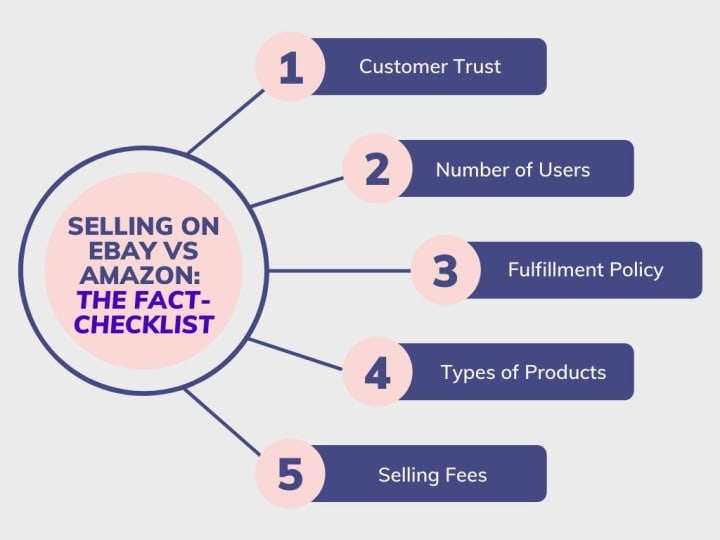
Customer Trust
Customer trust is crucial to ensure survival in the retail business. It is one of the cornerstones of a successful business, something that brands take years to cultivate. Once you have a considerable amount of customer trust, you can leverage it in myriad ways. When we study the trust factor for Amazon and eBay, we see that Amazon stands out as the clear winner here.
Amazon has always positioned itself as a customer-centric company, one that helps build transparency and good faith between buyers and sellers. Even the Amazon Mission, Vision, and Values clearly state their ideals that inculcate customers in the center. Another major factor that contributes to Amazon’s solid customer trust is its easy return policy. Customers are qualified to receive a full refund in case they are not satisfied with the product they bought.
On the contrary, returning products on eBay is a little more complicated than Amazon. Sellers can even opt for the No Return option while putting up their products. Now you may think that this option is seller-friendly because once a customer buys something, you no longer have to deal with the return and refund process. However, in the long run, this move discourages buyers from making purchases from your brand and prohibits the cultivation of brand trust.
Amazon’s move towards product return and refund is actually a concrete step in establishing their policy in firm actions that their customers reign supreme. With this option, customers feel encouraged to put their money into newer products and experience them, something they are unlikely to do on eBay as they will be stuck with the product in case they do not like it.
Number of Users
The number game is very important when deciding for an eCommerce platform. After all, it is that figure which will tell us how many visitors are likely to see your product and that will tell you the forecast of your brand’s performance on the platform. It was found that Amazon has 2.5 Billion monthly visits in the US, as of June 2021. Whereas, in a similar time frame, eBay witnessed a footfall of 885 million. The stark difference in the figures tells us that listing a product on Amazon instantly gets more chances of getting discovered than on eBay.
As a seller, you want to capitalize on those numbers and go with Amazon to launch your product. Another important factor that sides with Amazon in this selling on eBay vs Amazon debate, is the subscription scheme. We all know, Amazon Prime is one of the largest subscriptions globally. Initially, when Amazon offered its membership in lieu of a small price, most people were hesitant. However, once people started joining the Amazon Prime wagon, it was found to be filled with amazing benefits. Subscribers understood that they could enjoy so much more in return of the little annual subscription fee that they have to pay. These benefits include superfast deliveries, free deliveries, exclusive sneak peeks, etc.
Thus, when you become a prime seller on Amazon, you get your hands to a major chunk of customers who are loyal and committed to the platform and are sure to return, something that is not the case with eBay.
Fulfillment Policy
Before listing products on any eCommerce website, you need to understand their fulfillment policy. Something that every seller must abide by when onboarding a particular e-retail space. Now, every platform comes with different policies. While some are easy to ensure, some look cumbersome and tedious. Fulfillment policies do not impact your direct relationship with the customers but they do influence your experience with the platform. This in turn ensures how long you are associated with the website. Switching online shopping sites too frequently is not ideal for any seller as it tends to impact customer experience and brand reputation. So, it is imperative that you go through the fulfillment policy of the platforms in detail before you make a decision.
Selling on eBay vs selling on Amazon comes with some considerable differences when we compare the fulfillment policies of these two. For Amazon product listing, we have essentially 2 fulfillment requirements- Fulfillment by Merchant (FBM) and Fulfillment by Amazon. As the term suggests, Fulfillment by Merchant (FBM) means the seller will be taking care of order logistics. They can also hire a third party logistics partner, but Amazon will have no role to play here. Fulfillment by Amazon, on the other hand, means that Amazon comes in to handle all the logistics requirements for every order you receive. The service, of course, is chargeable.
Some sellers decide to go for Fulfillment by Amazon while some others give it a pass. When you calculate the fulfillment fees with Amazon, you will realize that it is in fact more of an investment. With Amazon experts handling your packing and shipping, you are free to concentrate on other core issues of the business and not put your head into these nitty-gritties.
This facility is not available on eBay. Sellers have to handle everything related to their products by themselves when it comes to eBay. While this is also equally popular among several sellers, it is always nice to have a choice where you get a trusted logistic service provider that is tied to a mutually beneficial relationship.
Types of Products to Sell
Even though both these platforms look and function very similarly, Amazon and eBay actually cater to very different aspects of the retail marketplace. Amazon has turned into a retail giant with its own line of electronics and other products, while also facilitating third-party selling. However, eBay has maintained a dominant position as a marketplace for secondhand products and rare collectibles.
Amazon also has a fair share of restrictions on the kind of products that can be sold on their site. Even when selling secondhand products, Amazon requires them to be functional. Amazon also has quite a long list of restricted items. Sellers can consider hiring Amazon virtual assistant that can guide them on the products.
eBay, on the other hand, is quite flexible in this regard. Here you can sell rare objects even when they do not operate properly. As long as the products match the description that you provide on eBay, customers are going to be happy. Most of the shoppers on eBay are not looking for the quality and performance that buyers look out for on Amazon.
This unique point of difference helps sellers pan out their brand marketing strategy in a clever way. Planning a well-thought-out strategy for selling on eBay vs Amazon can smartly segregate the target group and approach each group through different platforms to offer your products with a slightly different strategy.
Selling Fees
Another very crucial point to examine when studying the points of selling on eBay vs selling on Amazon discussion is the seller fees. As sellers, you will have to be aware of how much you will have to pay in order to use the services of the platform.
On Amazon, you have referral fees on top of the fulfillment fees. Referral fee is the part of the purchase that you pay Amazon for using their platform. Sometimes the referral fee can be a flat rate too. Whichever is more, usually that amount is considered as the referral fee. There are a few other kinds of fees too like premium user fee, inventory fee, refund administration fee, etc.
eBay has two main kinds of fees- insertion fees and final value fees. The insertion fee is the payment sellers have to pay for listing a new product. eBay gives every seller some number of listings free every month and charges some amount going forward. The final value fee is the commission that sellers pay to the eCommerce website after every sale. eBay’s final value fees may also include processing fees and fees for using account up-gradation services.
Final Thoughts
To sum up, we can say that there is no one clear winner in this ongoing conversation of selling on eBay vs selling on Amazon. Both the platforms come with their benefits that are advantageous to any brand, provided they are aware of their brand goals and the demographic target group.
eCommerce marketplaces are constantly evolving and brands can leverage the direct access and transparency of this space for their benefit, no matter which marketplace they choose. The success of selling on the internet is more than just picking the right platform. It includes a smart digital marketing strategy that entails inserting the right keywords, optimized images, feedback and review management, product listing variations, etc. Hence, to make our band a hit here, you will need a keen eye that will cover marketing, advertising, and strategizing also along with picking the right online shopping site.
About the Creator
Sophie Hayes
I am Sophie Hayes, living in California, innovative e-commerce and digital relations manager at Team4eCom. Results-driven, problem solver, and goal-oriented. Focusing on bringing creativity and value.
Keep reading
More stories from writers in Journal and other communities.
My Dog’s Treatment Cost £1,600 – Vet Bills Are Shocking
For pet owners across the UK, veterinary bills have long been a source of stress—but recent stories, such as one owner’s experience paying £1,600 for their dog’s treatment, have reignited concern about the rising cost of pet care. The owner, who wished to remain anonymous, described the ordeal as “shocking” and highlighted the financial burden that unexpected illnesses or accidents can place on families.
By Aarif Lasharia day ago in Journal




Comments
There are no comments for this story
Be the first to respond and start the conversation.