
Saylor Vs Chanos: Shorting the Cult Leader
A Short Love Story


So a legendary short seller Jim Chanos just closed out a trade that is chef's kiss levels of genius.
Chanos made a bet that said "bitcoin will go up" and ALSO "MicroStrategy stock will go down."
Hold on. MicroStrategy? The company whose entire personality is buying bitcoin?
Yes. That MicroStrategy. The one run by Michael Saylor. The guy who tweets about bitcoin like it's his religion. The company that has literally turned itself from "we make business software or something" into "we are a publicly traded bitcoin vault with a CEO."
So how do you bet FOR bitcoin but AGAINST the bitcoin company?
Welcome to the "pairs trade,"
Now, before your eyes glaze over at "pairs trade" jargon, let me translate: A pairs trade is when you bet on two related things moving in opposite directions, which keeps you "market neutral." You're not really betting on the market going up or down - you're betting on the spread between two things.
What MicroStrategy actually does
They buy bitcoin. Then they borrow money to buy more bitcoin. Then they issue new shares to buy even MORE bitcoin. And then Michael Saylor tweets about laser eyes. That's the business model. I'm not oversimplifying. That's genuinely it.
See, MicroStrategy's whole pitch is that they're not just holding bitcoin - they're offering "amplified bitcoin." That's their actual marketing line. Like bitcoin, but with MORE bitcoin-ness somehow.

So Chanos wasn't saying "bitcoin is going to crash." He was saying "MicroStrategy's stock price is UNHINGED relative to the bitcoin it actually owns."
And oh boy, was he right.
Last November, MicroStrategy's stock was trading at nearly 3 TIMES the value of the bitcoin they actually held. That was amplified insanity.
Investors were essentially paying $3 to get access to $1 worth of bitcoin. You know, instead of just… buying bitcoin directly. For $1.
That premium has collapsed from 3x down to about 1.2x. Meanwhile, bitcoin itself has gone UP by roughly a third over the past year.

And MicroStrategy's stock is down more than 25%.
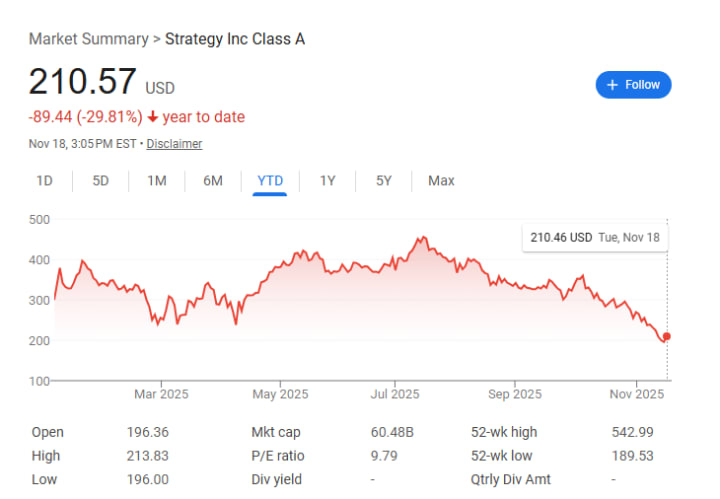
So Chanos's bet was to buy actual bitcoin (which went up), short the wrapper around bitcoin (which went down), and pocket the difference when reality reasserted itself.
Which it did. Gloriously.
But It Gets Better
This trade looks obvious in hindsight. "Oh, just short the overpriced bitcoin wrapper and buy actual bitcoin, duh."
But at the time it was legitimately terrifying.
Shorting stocks is already risky because your losses are theoretically unlimited. But shorting a stock with a CULT FOLLOWING led by Michael Saylor - a man who tweets about bitcoin with the energy of someone who's seen the face of God and it was shaped like a blockchain - that's a whole other level of danger.
And Chanos was shorting a stock whose CEO has the exact same "extremely online cult leader" energy as the GameStop situation.
One viral Saylor tweet about "bitcoin is freedom" or whatever, and suddenly you've got an army of retail traders buying MicroStrategy stock to "stick it to the shorts," and Chanos is staring at catastrophic losses.
The Beautiful Irony
When Chanos was shorting MicroStrategy stock, MicroStrategy itself was… also selling its own stock.
That's right. The company has been issuing new shares to raise money to buy more bitcoin. They're literally diluting their shareholders to buy an asset that you, the shareholder, could just buy yourself.
MicroStrategy's executives have been personally selling massive amounts of their own stock. And they timed a bunch of these sales right near the all-time highs last year.
So let me get this straight:
- The company is selling shares to buy bitcoin
- The executives are selling their personal shares for cash
- But they're telling YOU to buy the shares because it's "amplified bitcoin"
How to Fund a Bitcoin Addiction
Saylor's company, Strategy (formerly MicroStrategy), wants to buy bitcoin. Lots of bitcoin. Like, $70 billion worth of bitcoin. But they need cash to do that, right?
Normal person approach: Sell some stock, buy bitcoin, call it a day.
Saylor's approach: Hold my convertible bond.
Step 1: The Convertible Bond Phase
First, Saylor issued over $8 billion in convertible bonds. These are basically IOUs with a catch: if the stock price goes up enough, bondholders can swap their bonds for stock instead of getting paid back in cash.
Cool! Except… if the stock price doesn't go up enough, you actually have to pay people back.
And with a chunky pile of these coming due in 2028, Saylor had pumped the brakes on convertibles and quietly stopped issuing them at the end of last year.
Step 2: The Common Stock Firehose
So then it's back to selling regular stock, right? Sure! But there's a small problem: when you constantly flood the market with new shares, existing shareholders get diluted - their slice of the pie gets smaller - and the stock price starts sagging like a cake left out in the rain.
Not ideal when your whole pitch is "this is leveraged bitcoin exposure!"
Step 3: Enter the Preferred Stock Era (We Are Here)
Perpetual preferred stock. The company just announced its fifth offering, this time in euros, because why not go international with your financial Jenga tower?
Perpetual preferreds from a junk-rated company have to offer an extremely attractive yield to get anyone to buy them. This new euro offering had to sell it at 80% of face value, which works out to a 12.5% yield for investors.
That's… that's a lot!
The Payments Treadmill of Doom
All those convertible bonds charge interest.
All those preferred shares pay dividends.
Total annual bill: over $700 million.
Now, most companies would pay that with, you know, revenue or profits or cash flow - the boring stuff. But Strategy doesn't really generate operating cash flow anymore because they're too busy being a bitcoin treasury company.
So how do they pay the $700 million? By issuing… more equity or more preferreds.
Which means selling more stock. Which dilutes shareholders. Which puts pressure on the stock price. Which makes the convertibles less likely to convert. Which means… you see where this is going.
It's like using your new credit card to pay your old credit card bill, except everyone can see you doing it and they're charging you 12.5% interest.
"But Wait," You Say, "Don't They Have $70 Billion in Bitcoin?"
YES! Great point, reader! They do!
But Saylor's entire brand is "HODL" - Hold On for Dear Life. As in, "we will never sell bitcoin." That's the whole pitch. That's why people buy the stock instead of just buying bitcoin themselves - because Saylor is the bitcoin guy who doesn't sell the bitcoin.
If Strategy started selling bitcoin to pay dividends or debt, it would destroy the entire premise of the company.
So that $70 billion isn't really "collateral" in the normal sense.
Chanos looked at this entire circus and went: "Yeah, I'm gonna bet against the clowns and for the actual thing they claim to represent."
And he was right
The trade worked. Chanos walked away with what we're legally required to describe as "an undisclosed sum" because rich people never tell you the actual number. But given that he's out here talking about it? Safe to say he's celebrating.
This is not financial advice. But it is definitely entertainment.
About the Creator
Arsalan Haroon
Writer┃Speculator
Keep reading
More stories from Arsalan Haroon and writers in Journal and other communities.
Why Finance Won, Everyone Else Lost
Let’s time-travel to the 1980s. big hair, bigger shoulder pads, and Wall Street guys doing lines of… ambition. Back then, the “shadow banking” world — hedge funds, private equity firms, family offices — controlled assets worth about 40% of America’s GDP.
By Arsalan Haroon4 months ago in Journal
Why Ethical SEO Practices Are Essential for Long-Term Drug Rehab Marketing Success
Understanding Ethical SEO in the Context of Drug Rehab Marketing Ethical SEO, in the realm of drug rehab marketing, is the deliberate application of strategies that prioritize transparency, integrity, and compliance with search engine guidelines. Unlike manipulative tactics, ethical SEO seeks to enhance visibility without compromising credibility. For drug rehabilitation centers, where trust and reliability are paramount, employing ethical SEO ensures that prospective clients encounter accurate, supportive information rather than misleading promises. This approach fosters both immediate engagement and sustained growth, establishing a reputation grounded in authenticity. The use of ethically optimized meta descriptions, accurate schema markup, and precise keyword integration exemplifies how a methodical, principled approach can elevate search engine performance without courting risk.
By Fida Hassain5 days ago in Journal




Comments
There are no comments for this story
Be the first to respond and start the conversation.