
Riding the Rails: A Journey Through America's Train Travel Dilemma
The Rise and Fall of American Train Travel

Introduction
Train travel in the United States, a once-iconic mode of transportation that helped build the nation, now exists in a peculiar limbo. In a country known for its love-hate relationship with trains, the rail network that was once the envy of the world has faded into obscurity. So, what went wrong? How did the U.S. fall so far behind, and is there any hope of reclaiming its former glory? To explore these questions, a journey aboard Amtrak, from Los Angeles to New York City, spanning 70 hours, provides ample time to ponder the rise and fall of American train travel.
The Legacy of American Railroads
The history of American trains is intertwined with the nation's development. Railroads laid the foundation for modern America, and at one point, the U.S. boasted the largest, most well-funded rail network globally. However, contemporary travelers on Amtrak's trains may tell a different story of outdated infrastructure and lengthy journeys. So, how did the United States reach this point?
From Opulence to Utility: A Century of Transformation
A hundred years ago, the American rail system was a marvel, covering around 254,000 miles of track in 1916. Companies like the Pennsylvania Railroad, although nicknamed the "Pennsy," were titans of industry, contributing iconic structures like Penn and Grand Central stations. The train travel experience was luxurious, featuring chandeliers, barber shops, and gourmet dining.
However, the story of American trains took a turn as the 20th century unfolded. The transition from opulent carriages to more utilitarian travel options was marked by the rise of automobile ownership and air travel. By 1956, passenger rail travel plummeted from 98% to a mere 4% of total passenger travel. The U.S. began to prioritize other forms of transportation, and the railway's decline set in.
The Decline of American Trains: A Regulatory Shift
One factor contributing to the fall of American railroads was the unchecked power of the "robber barons," ruthless industrialists who prioritized profits over public welfare. To curb their excesses, the government introduced regulations, including fixed rates for railroads and restrictions on fare increases. These regulations, meant to protect consumers, inadvertently stifled innovation and profitability in the industry.
The Birth of Amtrak: A Flawed Solution
The creation of Amtrak in 1971 marked a significant turning point. Intended as a for-profit corporation, Amtrak was tasked with modernizing train service. Yet, the government allocated a meager budget of just $40 million for its first year. Over time, Amtrak's funding increased, but it remained dwarfed by federal highway budgets.
Private commercial passenger trains never proved profitable, with the industry's main revenue coming from freight. Consequently, Amtrak was burdened with passenger services while rail companies focused on more lucrative freight operations.
Amtrak's Underfunding and the Challenge Ahead
The United States has consistently prioritized roadways over railways, perpetuating Amtrak's underfunding. While a long-distance train journey produces fewer emissions than flying, Amtrak's budget remains a fraction of the funds allocated to highways. The disparities reflect national priorities, revealing why Amtrak struggles to expand and innovate.
The Potential of Train Travel: A Glimpse of What Could Be
Despite its challenges, train travel still offers several advantages, including environmental benefits, safety, and a more comfortable experience compared to air or road travel. With improved funding and attention, Amtrak could revolutionize domestic travel.
Conclusion: A Journey with Hope for the Rails
A cross-country journey on Amtrak is a nostalgic trip through time, offering travelers a glimpse of what train travel could be with the right investments. America's complex relationship with its railways paints a story of rise and fall, but with renewed focus and funding, the U.S. could once again become a global leader in train travel. By prioritizing Amtrak, the nation has the potential to create a modern rail network that combines efficiency, sustainability, and the romance of a bygone era.
About the Creator
Vivian Yao
News, economy, history, politics, and much more...
Keep reading
More stories from Vivian Yao and writers in Journal and other communities.
Imran Khan: From Cricket Superstar to Pakistan's Prime Minister
Introduction March 25th, 1992 marked a historic moment for Pakistan when its national cricket team clinched victory against England to secure the World Cup. At the forefront of this triumph was Imran Khan, a global celebrity known for his cricketing prowess and dashing persona. However, almost three decades later, Imran Khan has embarked on an entirely different journey – becoming Pakistan's Prime Minister. This article explores the transformation of Pakistan's cricket icon into a political leader and examines the challenges he faces in a nation long influenced by its formidable military.
By Vivian Yao2 years ago in Journal
The goals I did not achieve
Every writing goal I made for the year is a wash. It has been this way for a while, but I think it's important to be open about my failures and the reality of how life can get in the way. This is especially true considering the several times I have posted on Vocal about my writing goals, how I was changing my approach, and where I was hoping to be for the upcoming year. I will probably do that again in a couple months, but for now, it is time to acknowledge where I am today.
By Kay Husnick22 days ago in Journal
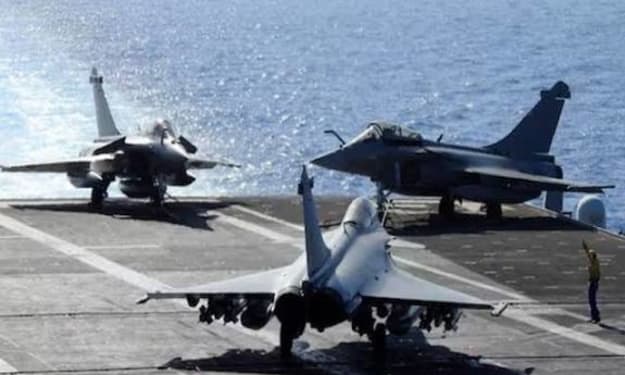
Indian weapons must on all 114 Rafale jets, govt tells Dassault
India’s defense modernization plans received a strategic boost as the government officially directed Dassault Aviation, the French manufacturer of Rafale fighter jets, to equip all 114 aircraft with Indian-made weapons. This move underlines India’s commitment to self-reliance in defense technology while strengthening the combat readiness of its air force. The Rafale jets, considered among the most advanced multi-role fighters globally, are now set to carry the nation’s indigenous missile systems, bombs, and electronic warfare packages, blending cutting-edge French airframe technology with homegrown armaments. The Rafale Program and Indigenous Weapons India’s Rafale acquisition, initially contracted in 2016, brought 36 jets into the Air Force inventory, with an additional 114 aircraft to be delivered in subsequent batches. While Dassault’s jets are equipped with state-of-the-art French systems, the Indian government has long emphasized the integration of locally produced weapons. These include BrahMos supersonic cruise missiles, Astra beyond-visual-range air-to-air missiles, and indigenous precision-guided bombs. By mandating the use of Indian weapons across all 114 Rafales, the government aims to reduce dependency on foreign arms supplies and ensure that India’s air force maintains operational flexibility in critical combat scenarios. A senior defense official stated, “Our aim is to ensure that the Rafale platform not only brings in technological superiority but also becomes a force multiplier for our indigenous weapons programs.” Strategic Implications The integration of Indian weapons on Rafale jets carries both operational and strategic significance. From an operational perspective, using indigenous weapons allows for standardized maintenance and training protocols across the fleet. It simplifies logistics, reduces costs, and ensures that India is not constrained by export restrictions or supply chain uncertainties from foreign manufacturers. Strategically, the decision sends a strong signal to both allies and adversaries. India demonstrates its growing capability in defense production and its intention to assert technological independence in critical military domains. Given the geopolitical tensions in the Indo-Pacific, particularly with China and Pakistan, equipping the Rafales with locally produced weapons enhances India’s deterrence posture. Challenges in Integration Integrating indigenous weapons with Rafale aircraft, however, is not without technical challenges. Aircraft and weapons systems must be seamlessly compatible, including software integration, aerodynamics, and avionics. The Air Force’s testing and evaluation teams, along with Dassault engineers, will have to ensure that Indian missiles, bombs, and sensors work flawlessly with French-designed flight systems. Past collaborations, such as integrating the BrahMos missile on Su-30MKI aircraft, offer a blueprint for success, but the Rafale’s advanced avionics and fly-by-wire systems necessitate meticulous engineering and rigorous testing. Officials assure that phased testing and gradual integration will ensure minimal disruption to the aircraft’s delivery schedules. Boosting India’s Defense Industry This directive aligns closely with India’s “Make in India” initiative, which aims to build a robust domestic defense manufacturing ecosystem. By mandating the use of Indian weapons, the government hopes to create opportunities for local defense firms, enhance research and development capabilities, and encourage private sector participation in high-tech defense projects. According to industry experts, this approach will provide a significant boost to companies involved in missile development, precision-guided munitions, and electronic warfare systems. It also signals potential for future export opportunities, as Rafale jets equipped with Indian weapons could be offered to other countries, increasing India’s global defense footprint. Diplomatic and Industrial Balance While this move strengthens India’s self-reliance, it also requires careful diplomatic balancing. Dassault Aviation, which must now adapt its jets to accommodate Indian weapons, plays a critical role in maintaining delivery timelines and contractual obligations. Successful collaboration will require constant communication and technical coordination between French and Indian engineers. In the long term, this partnership could evolve into a model for international collaboration, where global platforms are paired with indigenous systems to create hybrid solutions tailored to specific national needs. Looking Ahead India’s decision to equip all Rafale jets with local weapons is a bold step toward achieving strategic autonomy in defense. It demonstrates the country’s commitment to blending cutting-edge technology with self-reliance, ensuring that the Air Force is equipped with a versatile, powerful, and locally sustainable arsenal. As the delivery of Rafale jets continues, the coming years will likely see a seamless integration of India’s missiles, bombs, and electronic warfare systems into the fleet, creating a formidable air power platform that combines the best of French aeronautical engineering with India’s indigenous defense innovation. This initiative not only strengthens India’s air defense capabilities but also reinforces its position as a rising power in global defense technology. It’s a reminder that modern warfare increasingly depends on the ability to combine advanced platforms with locally developed systems—a strategy India is now executing with clarity and purpose.
By Fiaz Ahmed Brohia day ago in Journal
So You Decided To Become a Nurse Practitioner:
So you decided to become an "Advanced Practice" nurse. Congratulations!... is what I would say if this was a good idea. Grad school? In this economy? What were you thinking? Likely it was something along the lines of either 1) “I've seen these other chucklefucks do it— Why can't I?” or even 2) “I've got a nice career, I should shake it up. I miss feeling like I have no clue what I'm doing.”
By Sandor Szaboa day ago in Fiction



Comments
There are no comments for this story
Be the first to respond and start the conversation.