
Rethinking Insurance Policy Administration Systems: From Legacy to Automated to Gen AI
Evolving Policy Systems: Legacy to Automation to Gen AI


There’s a day and night change in customer expectations today compared to what they were a few years ago. They want quick responses, hassle-free experiences, and products tailored specifically for them. As a result, insurance agents and carriers are under pressure to deliver value in real-time. What worsens the situation is that traditional systems fail to support these needs. Thus, insurers are always on the lookout for new ways to ensure efficiency and meet customer expectations.
Or, let’s put it this way that insurers stand at a point where traditional business workflows are being reshaped by the latest technologies. The shift from legacy systems to automation and now to generative AI marks a profound rethinking of how insurers operate, engage with customers, and drive business value.
And, at the core of this lies the insurance policy administration system, responsible for managing policy lifecycles, from underwriting and issuance to renewals and claims processing. Let’s take a closer look at why insurers had to shift from legacy to automated policy management solutions, and how gen AI further enhances the automated tools.
The Challenges of a Legacy Policy Administration System
While legacy policy management platforms have reliably supported insurers for decades, they now present serious challenges. Understanding these limitations is important for insurance businesses weighing the decision to modernize. Take a look:
1. Outdated Technology and High Maintenance Costs
Legacy policy administration systems usually have outdated programming languages and architectures. For many IT teams, this implies spending time putting out fires instead of innovating. What’s even worse is that the niche technical skills required to keep these platforms running are becoming scarce. As a result, organizations have to bear the rising costs and increasing downtime.
2. Poor Customer and Agent Experience
Imagine an experienced insurance agent managing multiple policies for different clients. In doing so, the agent has to jump from several disjointed screens and re-enter data manually. By default, the response gets delayed. Sadly, this is the routine for many insurance firms relying on legacy systems. This isn’t painful only for agents; policyholders feel the impact too, as they are the ones enduring slow policy issuance and limited visibility into their own coverage details.
3. Lack of Integration and Scalability
Traditional policy administration software generally operate in silos, obstructing the flow of real-time data across the company. This fragmentation hampers the rollout of new services, impedes integration with third-party platforms, and restricts overall scalability. Insurers find themselves constrained, unable to meet evolving customer needs or respond to market shifts quickly.
4. Compliance and Security Risks
Older systems, with rigid and inflexible architectures, lack the security frameworks needed to counter advanced cyber threats. Other than incurring fines, non-adherence to rules puts customer trust and brand reputation at risk. No business can afford this as it takes years to build loyalty and carve a unique niche in the industry.
While these systems once served insurers well, the accumulating challenges make one thing clear: embracing technological advancements is the way forward. Automated policy administration solutions have become the savior here. And insurance businesses that fail to keep up with these changes end up paying substantial costs.
The Shift to Automated Policy Administration Systems
To address the limitations of legacy platforms, insurers increasingly adopt automated policy administration tools. These solutions serve as a critical bridge between outdated infrastructure and the demands of a digital-first future.
An automated policy administration system helps insurers streamline policy management, reduce manual intervention, and deliver more agile customer experiences. By employing workflow automation, business rules engines, and integrated data platforms, these systems redefine policy lifecycle management. The good news is that it not only improves processes but also enhances the experiences of every agent and policyholder. Here’s how:
Straight-Through Processing
Consider an underwriter with mid-level expertise who previously spent days reviewing standard applications. But with automated systems, routine cases can now be processed in minutes. Thus, underwriters can focus on edge cases that require human insight.
Cost Savings
By automating repetitive tasks such as data entry and document handling, insurers can reduce costs and minimize the chances of human errors. This frees up staff to focus on customer engagement and value-added services. For operations teams, it means fewer bottlenecks and more time spent solving meaningful problems.
AI-Based Validations
These platforms use advanced validation logic and pattern recognition to detect inconsistencies, potential fraud, and data quality issues in real time. Hence, frontline employees get decision-ready insights at critical moments.
Enhanced Self-Service Capabilities
For policyholders, PAS platforms translate into convenience and empowerment. Mobile apps and web portals enable users to update policies, make payments, and file claims anytime. There’s no need to wait for a call or visit a branch. For customers juggling busy lives, this shift marks a new standard of service.
For many insurers, automation has already delivered significant gains. The arrival of generative AI further enhances the existing capabilities of these solutions. Or, let’s put it this way that machines got “intelligence” to think and act like humans. Wondering how? Let’s explore this in the next section.
Generative AI as the Next Frontier in Policy Administration
Gen AI is redefining what’s possible in policy administration. If you consider this just a marginal upgrade, you are probably missing out on a lot of benefits. That’s because gen AI empowers the systems to understand context, generate human-like interactions, and make intelligent decisions autonomously.
Unlike automation which executes rules, gen AI adapts, learns, and grows more intelligent with each interaction. In short, it offers capabilities that mirror human judgment at the speed of technology. This is quite evident in the use cases:
I. Automated Document Processing
Take, for example, a policy operations team receiving hundreds of claim-related documents daily. Gen AI can ingest and interpret forms, flag discrepancies, and summarize key points. This saves countless hours and reduces the risk of oversight.
II. Dynamic Pricing Models
By analyzing a wide range of variables instantly, such as individual risk profiles, regional trends, and competitor pricing, GenAI enables insurers to create adaptive pricing strategies. This ensures fair, personalized premiums and transparency for policyholders.
III. Intelligent Fraud Detection
When a suspicious claim is filed, traditional rule-based systems may miss the nuance. Gen AI, however, can scan vast amounts of historical claims data, spot anomalies, and flag subtle fraud patterns, alerting investigators before issues escalate.
IV. Hyper-Personalized Policy Creation
The best part about policies generated using AI is that these are tailored to the unique needs of individual customers. In other words, the terms, exclusions, and benefits are customized as per the individual. A young driver, for example, may receive coverage options that reflect lifestyle and driving behavior, not just demographics.
V. Intelligent Customer Service
Virtual assistants powered by gen AI offer responsive, human-like support. They can guide customers through claims, answer policy questions, and provide recommendations based on historical interactions and real-time data. For policyholders, this creates a sense of immediacy and trust in every interaction.
These use cases highlight gen AI’s potential to change every touchpoint in the insurance value chain for good, from underwriting to customer service.
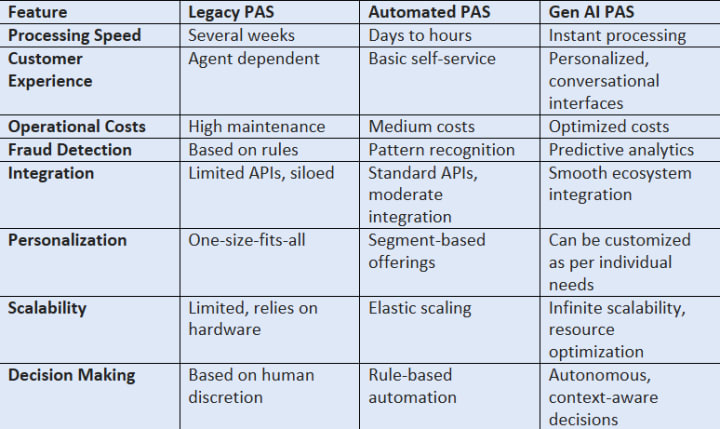
Comparing Legacy vs. Automated vs. Gen AI PAS
While the differences are stark, the move to gen AI is a blessing in disguise for insurance businesses. It adds a layer of intelligence to smart processes. And, insurance businesses that utilize these advanced policy management solutions get an upper hand in the industry.
Closing Lines
The shift from outdated policy management processes to automated solutions and now to gen AI is reshaping the very roots of insurance operations. All these advancements are aimed at changing how insurers create value for today.
Moreover, as customer demands grow and more competitors enter the market, sticking to outdated systems puts insurers at risk of falling behind. But those who utilize a GenAI-driven policy administration system in insurance can deliver personalized, secure, and efficient services at scale. So, now you know what is to be done next!
About the Creator
Surya C.
Surya Choudhary is a Project and Software Delivery Manager at Damco Solutions with demonstrated experience in streamlining processes for insurance companies.
Website: https://www.damcogroup.com/insurance/
The goals I did not achieve
Every writing goal I made for the year is a wash. It has been this way for a while, but I think it's important to be open about my failures and the reality of how life can get in the way. This is especially true considering the several times I have posted on Vocal about my writing goals, how I was changing my approach, and where I was hoping to be for the upcoming year. I will probably do that again in a couple months, but for now, it is time to acknowledge where I am today.
By Kay Husnick25 days ago in Journal



Comments
There are no comments for this story
Be the first to respond and start the conversation.