
Prostate Cancer Therapeutics Market Surging on Demand for Minimally Invasive & Targeted Treatments
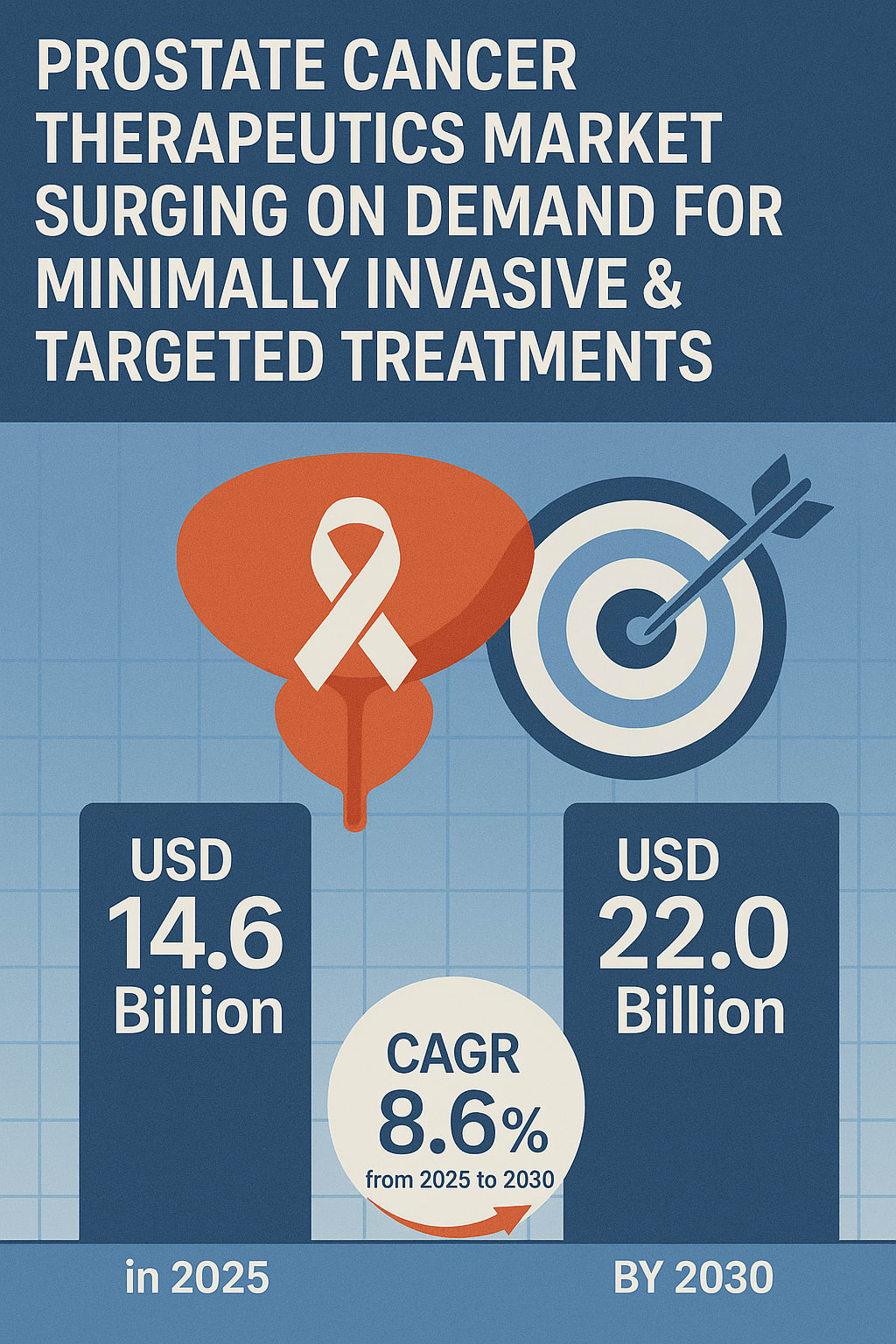
The prostate cancer therapeutics market is poised to exceed USD 22.0 billion by 2030 due to the increasing demand for precise treatment options, fewer adverse effects, and improved quality of life among patients, healthcare providers, and payers.

Prostate cancer, the second most prevalent cancer among men worldwide, is on the cusp of a therapeutic revolution. The market, long dominated by conventional hormone therapies and invasive surgeries, is now being reshaped by the emergence of minimally invasive procedures, targeted treatments, and precision medicine.
In 2025, the global prostate cancer therapeutics market size was valued at USD 14.6 billion and is expected to register a CAGR of 8.6% from 2025 to 2030.
Factors Driving Market Growth
1. Increase in Global Disease Burden
Due to increased life expectancy and improved prostate cancer screening programs, the disease’s incidence is expected to increase, particularly in North America, Europe, and the Asia-Pacific region. Early detection will allow more patients to be eligible for various advanced and alternative treatment modalities.
2. Surge in Minimally Invasive Therapies
Radical prostatectomy is being replaced by minimally invasive approaches such as:
• High-intensity focused ultrasound (HIFU)
• Cryotherapy
• Proton beam therapy
They help shorten hospital stays and recovery times, reduce the risk of post-operative complications, and preserve sexual function and urinary continence—leading to increased adoption by physicians and patients.
3. Advances in Targeted Therapies
The advent of drugs such as:
• Xtandi (enzalutamide)
• Zytiga (abiraterone acetate)
• Pluvicto (lutetium Lu 177 vipivotide tetraxetan)
has helped revolutionize prostate cancer care. These medications are designed to selectively target androgen receptors, genetic mutations, or PSMA-positive cancer cells, resulting in better efficacy with fewer systemic side effects.
Emerging Innovations in the Market
PARP inhibitors, such as olaparib, are emerging as an important treatment option for men with BRCA1 or BRCA2 gene mutations.
Radioligand therapies and bispecific T-cell engagers (BiTEs) are also being evaluated in late-stage clinical trials.
Digital health tools like AI-driven diagnostics and liquid biopsy platforms are also helping improve early detection and matching of patients to the right treatments.
The increased use of genomic profiling and biomarker-driven therapies is also resulting in a gradual shift in the treatment approach to “personalized” or precision oncology, particularly for metastatic castration-resistant prostate cancer (mCRPC).
Market Leaders: Key Players Shaping the Landscape
The major players operating in the prostate cancer therapeutics market are:
• Pfizer Inc.
• Astellas Pharma
• Johnson & Johnson (Janssen)
• Bayer AG
• Novartis AG
• Myovant Sciences
In order to expand their portfolios, the companies are investing aggressively in R&D, as well as entering into strategic partnerships and alliances, to compete in both the patented and generic segments.
Regional Outlook
North America:
The North American market is leading in the adoption of next-generation targeted therapies due to a high level of awareness, reimbursement availability, and strong research and development infrastructure.
Europe:
European countries, on the other hand, are making rapid progress, thanks to government-led national cancer plans and an emphasis on precision oncology.
Asia-Pacific:
Asia-Pacific is the fastest-growing market due to a rise in the number of cases, a growing awareness of the disease, an increase in healthcare spending, and government-led programs for screening prostate cancer.
Market Challenges and Barriers
Prostate cancer treatments are quite expensive, making them inaccessible to a large number of patients in low- and middle-income countries.
Drug resistance and tumor heterogeneity make long-term disease control difficult.
Issues with reimbursement for new targeted therapies in many countries also exist.
The issues mentioned above offer opportunities for biosimilars and follow-on manufacturers to target genericization opportunities, as well as value-based pricing models and real-world evidence integration to increase access and affordability.
Forecast: Future Trends to Watch Out for by 2030
The market is likely to see a broadening of the indications and expanded adoption of radiopharmaceuticals and next-generation androgen receptor (AR) inhibitors.
Multi-omics (genomics, proteomics, and metabolomics) profiling is likely to gain traction as a tool to guide selection of the most appropriate therapy.
A significant rise in the number of new treatment modalities, such as at-home or outpatient care models for the management of prostate cancer, is expected.
Convergence of digital health and oncology care is likely to continue.
In conclusion, while the market faces challenges, it is clear that the shift in prostate cancer care from awareness to action is gaining momentum. The market is expected to witness robust and sustainable growth as the unmet need for safe, precise, and minimally invasive treatment options continues to drive the demand for targeted therapies. In this environment, companies have the chance not only to gain market share but also to change patient outcomes and contribute to a rapidly developing, patient-centric market.
Get Sample Brochure at https://www.theresearchinsights.com/request_sample?id=165
About the Creator
Paxton Templeton
I’m a storyteller at heart with a passion for turning data into compelling narratives. With a focus on industry trends, market insights, and growth statistics, I bring clarity to complexity
Keep reading
More stories from Paxton Templeton and writers in Journal and other communities.
Lung Adenocarcinoma Treatment Market Outlook | A Deep Dive into Innovation, Investment & Emerging Treatment Pipelines
This document covers key market trends, investment opportunities, and growth drivers for the global lung adenocarcinoma treatment market, which we expect to be worth USD 11.18 billion, expanding at a CAGR of 10.7% over the next decade on the back of several innovation, policy, and demographic tailwinds.
By Paxton Templeton7 months ago in Journal
The goals I did not achieve
Every writing goal I made for the year is a wash. It has been this way for a while, but I think it's important to be open about my failures and the reality of how life can get in the way. This is especially true considering the several times I have posted on Vocal about my writing goals, how I was changing my approach, and where I was hoping to be for the upcoming year. I will probably do that again in a couple months, but for now, it is time to acknowledge where I am today.
By Kay Husnick25 days ago in Journal
Apostolic Succession Explained in Plain Language
One of the most misunderstood aspects of Catholic Church structure is the concept of apostolic succession. Simply put, apostolic succession is the unbroken line of spiritual authority handed down from the apostles, who were personally chosen by Jesus Christ, to the bishops and priests of the Church today. Understanding this concept is essential to grasping why the Catholic Church claims to preserve authentic teaching, sacramental authority, and continuity with Christ Himself.
By Sound and Spirit6 days ago in Journal



Comments
There are no comments for this story
Be the first to respond and start the conversation.