
Lung Adenocarcinoma Treatment Market Outlook | A Deep Dive into Innovation, Investment & Emerging Treatment Pipelines
Lung Adenocarcinoma Treatment Market Size, Share & Trends Analysis Report By Treatment (Chemotherapy, Immunotherapy, Radiation Therapy), By End-use (Hospitals, Specialty Clinics), By Region (North America, Europe), And Segment Forecasts, 2025 - 2030

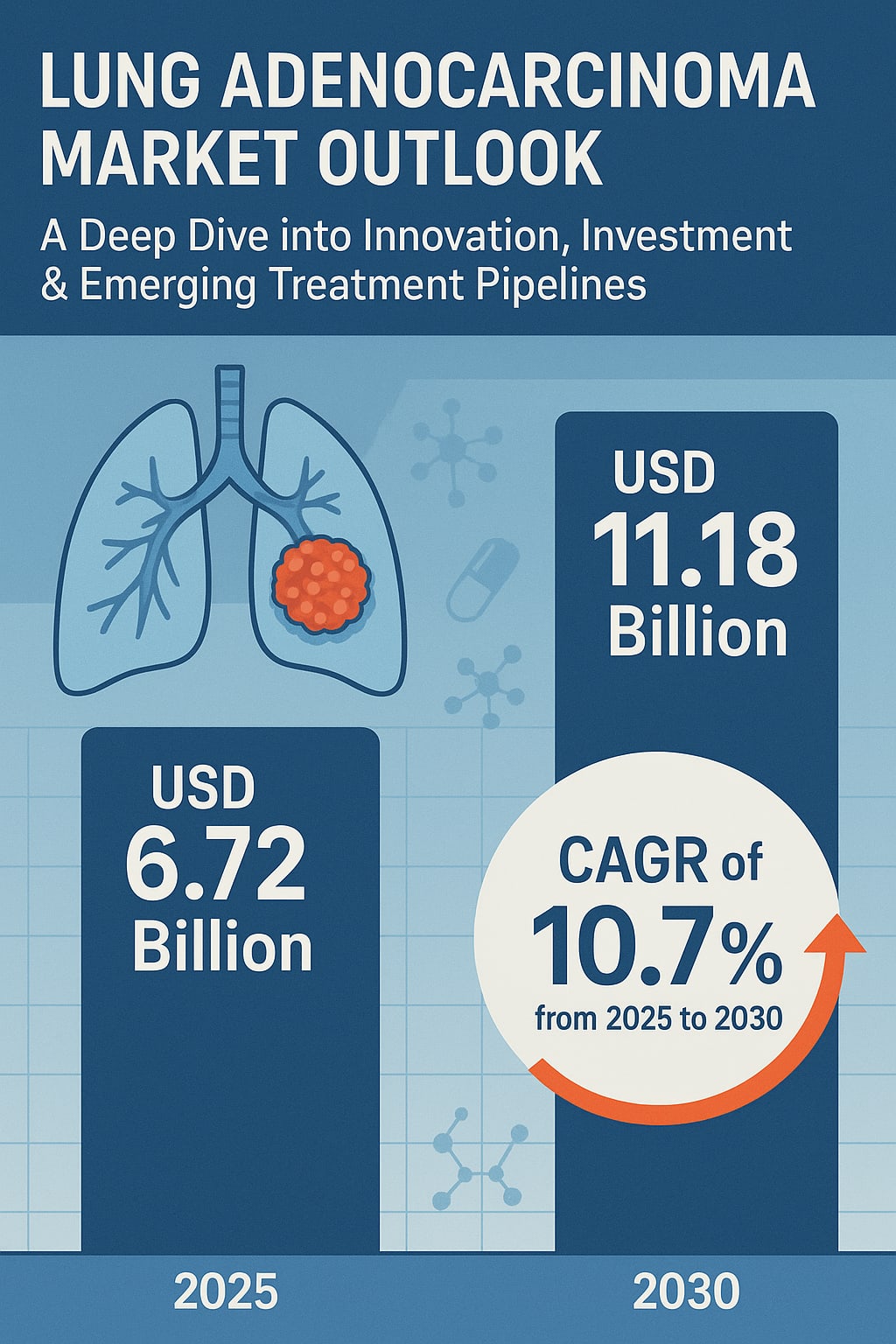
This document covers key market trends, investment opportunities, and growth drivers for the global lung adenocarcinoma treatment market, which we expect to be worth USD 11.18 billion, expanding at a CAGR of 10.7% over the next decade on the back of several innovation, policy, and demographic tailwinds.
Tagrisso, Alecensa, or Rybrevant. These are just some of the drugs radically changing the treatment of lung adenocarcinoma, once associated with poor survival rates and limited treatment options. From biomarker-driven therapies and immunotherapy to mRNA treatments and real-world evidence (RWE), the lung adenocarcinoma treatment market is evolving rapidly, with early adopters and new innovators ready to invest billions in the fight against a malignancy that affects over 40% of all non-small cell lung cancer (NSCLC) patients.
Understanding the Landscape: Global Lung Cancer Burden and Unmet Needs
Lung cancer is the leading cause of cancer-related mortality worldwide, with adenocarcinoma (AD) representing the most common histological subtype, accounting for over 40% of all lung cancer diagnoses.
We know that:
AD is diagnosed in both smokers and non-smokers and is often diagnosed at an advanced stage.
Global burden is rising, particularly in high-growth regions such as Asia-Pacific, Eastern Europe, and certain Latin American markets (urban pollution, smoking, aging).
These factors and others fuel an unmet need for improved survival, personalized, and accessible treatment for patients living with this aggressive form of cancer.
Innovation at the Forefront: Lung Cancer Treatment Advances That Are Changing the Game
From improved and more accessible genetic testing, to longer-lasting drugs and even mRNA cancer vaccines, a host of technology and scientific breakthroughs have changed the standard of care for adenocarcinoma in a relatively short time.
Newly Approved and Pipeline Therapies by Mechanism
The therapeutic landscape of lung adenocarcinoma has been transformed by the approval of biomarker-driven treatments, such as:
🧬 Biomarker-Driven Therapies
Next-generation genomic testing for actionable mutations such as:
- EGFR (Epidermal Growth Factor Receptor)
- ALK (Anaplastic Lymphoma Kinase)
- ROS1, KRAS, RET, BRAF, and more
Has resulted in targeted drugs such as Tagrisso (osimertinib), Alecensa (alectinib), and Rybrevant (amivantamab) altering first-line treatment paradigms for the better in mutation-positive patients. These drugs are now credited with better progression-free survival rates, a longer duration of response, and improved quality of life.
🛡️ Checkpoint Inhibitors & Immunotherapy
Checkpoint inhibitors such as Keytruda (pembrolizumab) and Opdivo (nivolumab) are now available with sustained efficacy data, particularly in the setting of high PD-L1 expression. We are also seeing an increase in combination treatment regimens (chemo, targeted, immunotherapy) that create durable clinical responses in advanced disease.
💉 ADCs and mRNA Therapies
Platforms like ADCs and mRNA-based cancer vaccines are currently in clinical trials with an aim to precisely target tumors while sparing healthy cells and organs. These products are expected to have a greater role to play in refractory or mutation-negative disease in the years to come.
Investment Trends in the Lung Adenocarcinoma Market: Pharma, Biotech & Collaborations
The lung adenocarcinoma market is witnessing significant investment and commercial interest from global biopharmaceutical companies such as AstraZeneca, Roche/Genentech, Merck & Co., Bristol Myers Squibb, Novartis, and Takeda, as well as new players in the space.
Strategic partnerships and alliances between established pharma giants and biotech innovators (ex: Guardant Health, Foundation Medicine, Tempus) are also driving biomarker-driven innovation and drug commercialization at an accelerated pace.
Emerging and Recent Trends, Technologies & Opportunities in the Lung Adenocarcinoma Treatment Market
Companion Diagnostics: The Integration of diagnostic testing platforms (liquid biopsy, NGS panels) with drug therapy is increasingly becoming standard-of-care in lung cancer treatment.
Rising Demand in Emerging Markets: Expanding access to cancer care and national lung cancer programs in countries like India, China, Brazil, and Southeast Asia are also expected to drive therapy uptake.
Patient-Centric Care Models: Home-based infusion services, oral targeted agents, remote monitoring are some of the factors and treatments shaping the next generation of cancer care.
Key Challenges, Uncertainties, Barriers to Adoption in the Lung Adenocarcinoma Treatment Market
Access to Care: High treatment costs and diagnostics (testing kits, genetic profiling) and limited access to advanced testing in low- and middle-income countries are key challenges to adoption of new care models and technologies.
Resistance Mutations: Resistance mutations (ex: T790M for EGFR) that limit the effectiveness of existing targeted therapies, require additional treatment lines.
Precision Oncology: Greater need for real-world evidence of companion diagnostics and FDA-approved molecular tests.
The Future of Lung Cancer Treatment: Beyond 2024
Beyond 2024, here’s what we’re likely to see more of:
• Expansion of biomarker-driven combination regimens into first line.
• Greater application of AI-driven analytics to both diagnostics and treatment plans.
• RWE data to support treatment reimbursement and greater adoption.
• Growth in the digital therapeutic market (mHealth) and patient support infrastructure.
Closing Thoughts: The Changing Lung Cancer Treatment Market in a Nutshell
Once synonymous with bleak outcomes, the lung adenocarcinoma treatment market is changing fast with the help of molecular biomarkers, newer treatment modalities, and greater industry investment.
We are moving past a time when the industry was largely reactive and response-driven. Today’s players and new entrants into the field are developing solutions that are predictive and even preventive in nature. As technology and innovation continue to converge, key growth drivers in the lung cancer treatment market will be the scalability of R&D, the precision of molecular and AI-driven diagnostics, as well as continued disruption of patient support and home-based treatment models.
In short, the adenocarcinoma treatment space presents an enormous opportunity for life sciences companies, pharmaceutical investors, and healthcare systems to not just change the future of cancer care, but to save lives.
Get Sample Brochure at https://www.theresearchinsights.com/request_sample?id=164
About the Creator
Paxton Templeton
I’m a storyteller at heart with a passion for turning data into compelling narratives. With a focus on industry trends, market insights, and growth statistics, I bring clarity to complexity
Keep reading
More stories from Paxton Templeton and writers in Journal and other communities.
$21.28 Billion Neurology Devices Market by 2030: Latest Outlook
The global neurology devices market is projected to reach $21.28 billion by 2030, rising from an estimated $13.90 billion in 2025, at a CAGR of 8.90% during the forecast period. This growth is attributed to the increasing number of neurological disorder cases, the development of innovative brain monitoring and neurostimulation technologies, and the global trend of performing minimally invasive neurosurgical procedures.
By Paxton Templeton9 months ago in Journal
Author’s Advice
If you would’ve asked me 20 years ago did I know I’d become a writer and an author, I would’ve said “nope, ain’t happening”. As fate would have it I did become an author and I can honestly say I’m loving it so far. It really does feel good to be a writer. I’ve learned a lot on this journey and I feel like with even me being as new to this world as I am, there’s some wisdom I need to share with every other aspiring author.
By Joe Patterson5 days ago in Journal
Why Didn't Anyone Tell Us
Men, move along. This is not for you. This is for the women. I was forty-five when I began menopause. It is pretty young for that to be going on in a woman’s life, but I had undiagnosed PCOS, my entire life. Thank you to all the gynecologists I had seen my entire life. That in itself should encourage women to keep seeking second opinions, especially when you are not getting correct answers or any at all.
By Alexandra Grant6 days ago in Humans




Comments
There are no comments for this story
Be the first to respond and start the conversation.