
Digital Babel Tower: How AI Could Unite — or Scatter — Humanity
Faith and algorithms collide as technology threatens to build a tower higher than humanity can control.
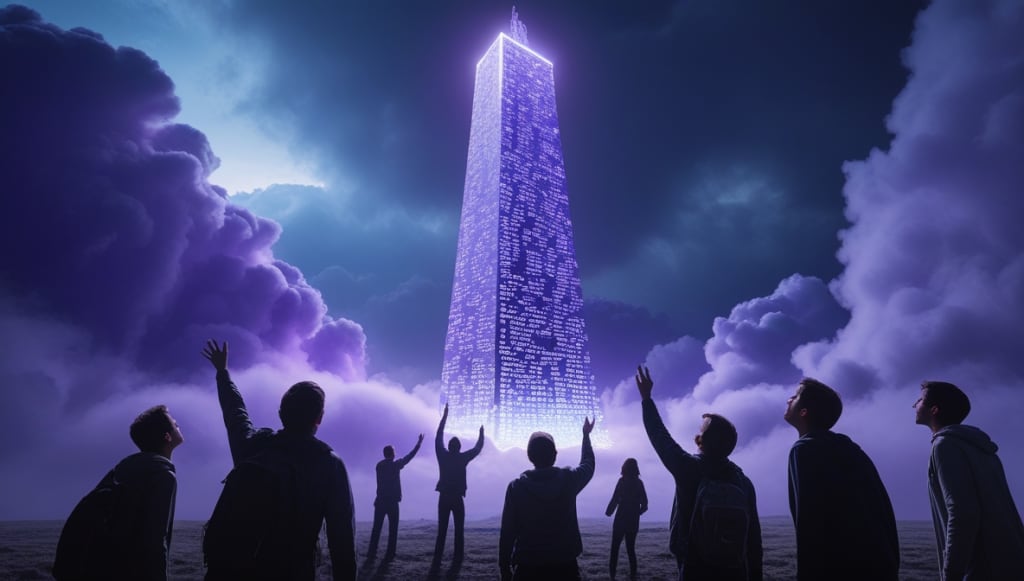
In the Book of Genesis, humanity came together for its first great project: the Tower of Babel. They dreamed of building a monument so tall it would reach the heavens, a symbol of unity and limitless ambition. But their unity proved dangerous. To stop them, God scattered their languages, ensuring that humanity could no longer speak with one voice.
Centuries later, some believe history may be repeating itself — but this time, our tower is not made of stone. It is built of data, algorithms, and Artificial Intelligence. In 2025, the “Digital Babel Tower” rises higher each day, reshaping not only economies and politics but the very meaning of what it is to be human.
One Language, Again?
At first glance, AI looks like a reversal of Babel. Machine translation apps now let people from opposite ends of the earth speak effortlessly. Algorithms break down language barriers in real time, making commerce, diplomacy, and even friendships possible across cultures. What once divided us — speech itself — seems to be disappearing.
But this “universal language” comes with a paradox. AI doesn’t just translate; it interprets. When you speak into a device, you aren’t just heard — you’re filtered. Words pass through hidden layers of code that decide not only what’s said, but how it’s said. Tone, context, even cultural nuance may be bent to match the values of whoever programmed the AI.
In other words: AI doesn’t simply unify us. It rewrites us.
A New Kind of Confusion
The Tower of Babel ended with human voices scattered. Today, the danger may be reversed: voices collapsing into sameness. Social media algorithms don’t unite diverse perspectives — they silo people into echo chambers. Instead of hearing new ideas, we are fed what the AI believes will keep us scrolling.
Consider global politics. Two people may read about the same event but see entirely different realities because algorithms show them conflicting “truths.” It’s not a failure of technology. It’s its design. Where Babel divided languages, AI creates digital dialects — realities that exist only for specific groups of people.
Is that unity, or is it confusion on a scale Babel never imagined?
Building Too High, Too Fast
The ancient Babel story wasn’t just about language. It was about ambition unchecked. The builders wanted to reach the heavens, not because they could, but because they believed they should.
AI carries the same danger. In medicine, it diagnoses faster than doctors. In finance, it predicts markets more accurately than analysts. In art, it paints, writes, and composes as if it had soul. Every sector now looks to AI as savior. The race isn’t about whether we can build it, but how fast.
But what if, like Babel, the danger is in how high we build before asking whether the foundation can hold? Do we understand the risks of AI weapons making decisions without human oversight? Or the moral weight of machines that “choose” who gets medical treatment first? If algorithms outpace our wisdom, we may find ourselves staring up at a tower that threatens to collapse on us all.
Unity or Collapse?
Still, there is hope. Unlike the Babel story, where God shattered human ambition, we have choices today. AI has the potential to become a true bridge, not a tower: a way to share knowledge, heal divides, and help humanity face global crises.
Imagine a world where AI translators help peace negotiators bypass cultural misunderstandings, where global climate data is shared instantly across languages, and where healthcare insights are distributed equally to poor and rich nations alike. The promise is staggering — a new kind of unity Babel never achieved.
But unity will only come if AI is built with humility. A tower built for pride will always collapse. A bridge built for service may endure.
Lessons From Babel
The Digital Babel Tower is rising, whether we want it or not. Every new algorithm, every smarter machine, every AI breakthrough adds another layer. The question is whether we are repeating Babel’s mistake: building for power without asking what it means to be human.
Perhaps the lesson of Genesis isn’t simply that humanity should never unite in ambition. Perhaps it’s that unity without wisdom leads to collapse. The builders of Babel spoke one language but lacked one conscience. Today, AI may give us one language again — but do we have the conscience to guide it?
The tower we are building is invisible, silent, coded in lines of logic instead of stone. Yet like the one at Babel, it could either elevate us toward heaven or scatter us once more into confusion.
The choice is ours, but time is running out.
About the Creator
Keep reading
More stories from Shahjahan Kabir Khan and writers in Journal and other communities.
Full Moon October 2025: When to See the ‘Harvest Supermoon’ Rise
Sometimes, the skies create a moment that seems enormous, reminding us of our tiny in a large and mysterious world. That remarkable moment comes this October with the Harvest Supermoon, a breathtaking full moon resting low and bright in the nighttime sky providing Among the most amazing stellar spectacles of the year.
By Shahjahan Kabir Khan4 months ago in Journal
The goals I did not achieve
Every writing goal I made for the year is a wash. It has been this way for a while, but I think it's important to be open about my failures and the reality of how life can get in the way. This is especially true considering the several times I have posted on Vocal about my writing goals, how I was changing my approach, and where I was hoping to be for the upcoming year. I will probably do that again in a couple months, but for now, it is time to acknowledge where I am today.
By Kay Husnick23 days ago in Journal
The Invisible Hand That Rules
In the heart of the city, there’s a building that no one notices. Its glass walls reflect the sun, its elevators glide silently, and its corridors smell of polished ambition. Decisions are made here that shape millions of lives, yet outside, the city breathes, unaware. The air hums with traffic, the chatter of cafes, the distant wail of sirens, and life moves on as though the building’s influence is nothing more than an echo.
By Jhon smith4 days ago in Journal




Comments
There are no comments for this story
Be the first to respond and start the conversation.