
Professor Fred Ogolla Calls for Justice Amid Critique of 2025 Finance Bill at Bunge la Mwananchi
A Critical Reflection on Government’s Neglect of the Common Mwananchi’s Welfare
By Emmanuel Busera-Mohammed
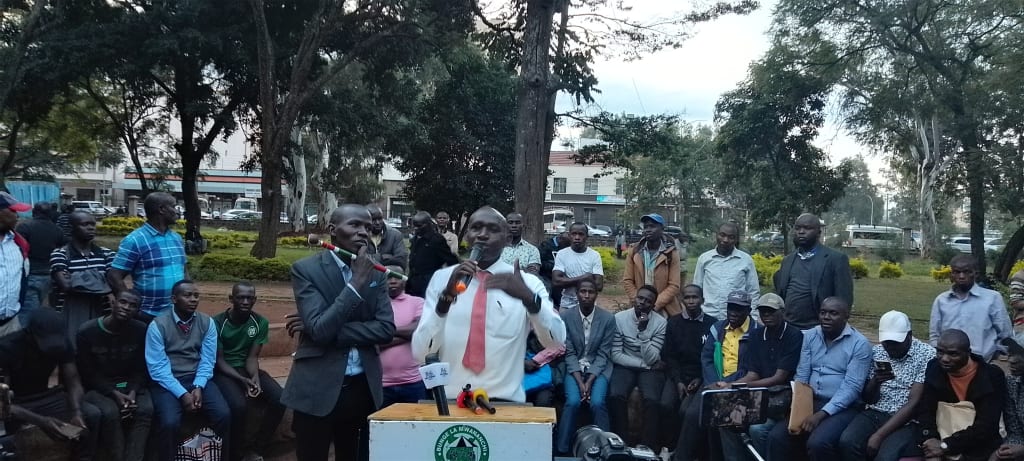
Jivanjee Gardens—Thursday afternoon saw a surge of passionate voices gathered under the banners of Bunge la Mwananchi, a grassroots movement dedicated to social justice, participatory governance, and ensuring that the voices of ordinary Kenyans are heard and respected in national policymaking. The atmosphere was charged with anticipation and a collective sense of purpose as the crowd, comprising farmers, teachers, small entrepreneurs, students, and workers from various sectors, waited eagerly for Professor Fred Ogolla, a renowned scholar, human rights advocate, and a staunch defender of social justice, to address the pressing issues facing the nation, particularly in relation to the proposed 2025 Finance Bill.
As Professor Ogolla stepped onto the makeshift podium—an improvised stage surrounded by a sea of attentive faces—his calm, measured demeanor, coupled with a commanding presence, immediately drew the crowd’s attention. His reputation as a fierce advocate for justice and his deep understanding of Kenya’s legal and socio-economic landscape lent authority to his words. With clarity and purpose, he began addressing the gathering, emphasizing that this was more than just a discussion on policies; it was a critical examination of the very principles underpinning governance and economic planning in Kenya.
“Today, we are not merely discussing policies,” Ogolla stated firmly, “but scrutinizing the very fabric of our governance—particularly the 2025 Finance Bill, which, in its current form, threatens to deepen societal inequalities and marginalize the most vulnerable among us.” His words resonated deeply, striking a chord with the crowd that had gathered with hopes of advocating for their rights and fair treatment.
He proceeded to critically analyze the provisions of the Finance Bill, highlighting how it appears to overlook the needs of the common mwananchi—the everyday Kenyan who struggles to make ends meet. “The proposed hikes in VAT and excise duties will disproportionately impact ordinary citizens relying on basic commodities like unga (maize flour), fuel, and medicines,” Ogolla explained. “Increasing taxes on essential goods is not just a financial matter; it’s an assault on the daily survival of our people. It threatens to push millions deeper into poverty, making it harder for families to access basic necessities that are fundamental to their well-being.”
Ogolla underscored that economic policies must be rooted in principles of social justice and fairness. “A just society is one where economic growth benefits everyone, not just the wealthy few. Yet, this bill seems to silence the voices of those who wake up each day burdened by poverty, struggling to put food on their tables, and yearning for a better life.”
The legal scholar did not shy away from criticizing the government’s allocation of resources, pointing out the glaring disparity between national spending priorities and the actual needs of ordinary Kenyans. “Billions allocated to defense and infrastructure development often benefit the elite and multinational corporations, while crucial sectors such as agriculture, education, health, and small business development remain underfunded. This imbalance perpetuates cycles of poverty and inequality, tearing at the social fabric of our nation and undermining social cohesion.”
He also condemned the opaque and closed-door nature of the policy-making process surrounding the Finance Bill. “When policies like the Finance Bill are drafted behind closed doors, without genuine consultation with the citizens they will affect most, the very democratic principles upon which Kenya was founded are undermined. Citizens must be involved in decision-making processes that impact their lives; otherwise, policies risk being detached from reality and lacking legitimacy.”
The crowd responded enthusiastically, erupting into applause and cheers as Ogolla called for urgent reforms and a shift towards more inclusive governance. “We must demand transparency, accountability, and policies rooted in social justice. The voices of the mwananchi—those most affected by economic decisions—must be heard and considered at every stage of policy formulation.”
Concluding his speech with a rallying cry, Ogolla urged Kenyans to unite and actively participate in civic engagement. “We have the power to effect change—through peaceful protests, advocacy, civic education, and holding our leaders accountable. Kenya’s future depends on our collective commitment to fairness, justice, and equitable development. We must ensure that governance serves the people, not just a select few.”
About the Creator
Keep reading
More stories from Emmanuel Busera and writers in Journal and other communities.
Professor Fred Ogolla Calls for Justice Amid Critique of 2025 Finance Bill at Bunge la Mwananchi
By Emmanuel Busera-Mohammed Jivanjee Gardens—Thursday afternoon saw a surge of passionate voices gathered under the banners of Bunge la Mwananchi, a grassroots movement dedicated to social justice, participatory governance, and ensuring that the voices of ordinary Kenyans are heard and respected in national policymaking. The atmosphere was charged with anticipation and a collective sense of purpose as the crowd, comprising farmers, teachers, small entrepreneurs, students, and workers from various sectors, waited eagerly for Professor Fred Ogolla, a renowned scholar, human rights advocate, and a staunch defender of social justice, to address the pressing issues facing the nation, particularly in relation to the proposed 2025 Finance Bill.
By Emmanuel Busera9 months ago in Journal
How Much Does It Cost to Start an Outpatient Rehab Treatment Facility
Introduction to Outpatient Rehab Facility Costs Establishing an outpatient rehabilitation treatment facility requires a nuanced understanding of both healthcare delivery and business economics. Unlike residential centers, outpatient programs typically involve lower capital intensity, yet they still demand substantial upfront investment. Costs vary widely based on geography, service scope, and regulatory rigor. A modest facility may require a few hundred thousand dollars to launch, while a comprehensive center offering multiple therapies can exceed seven figures. Prudent financial forecasting at the outset reduces fiscal turbulence later and creates a foundation for sustainable operations.
By Fida Hassain5 days ago in Journal
Wild Card Weekend Recap: What Happens Now?
I think I figured out why I love Wild Card Weekend so much. It's because it's the first playoff anything of the calendar year. The NFL season starts in the fall, and once upon a time, the champion was crowned either on or slightly before New Year's. The evolution of the NFL schedule has resulted in the playoffs starting just into the New Year, and currently, the final week of the season falls on the first weekend of the New Year, with Wild Card Weekend coming a week after that. So yes, chronologically, the NFL's Wild Card Weekend serves as the first playoff anything of the calendar year.
By Clyde E. Dawkins7 days ago in Unbalanced




Comments
There are no comments for this story
Be the first to respond and start the conversation.