
Powering Cleaner Floors: Why LiFePO4 Batteries Are the New Standard for Commercial Sweepers
Lighter, safer, and built for uptime — how modern lithium-iron-phosphate systems are reshaping the floor-care industry and what buyers need to know

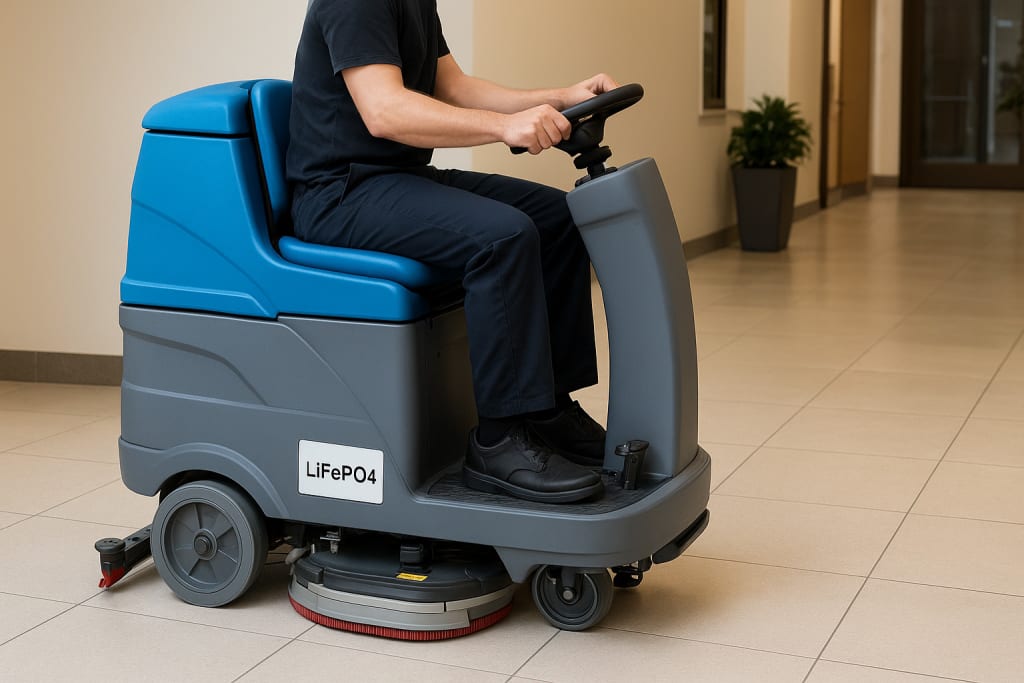
The quiet revolution beneath today’s commercial sweepers and floor scrubbers is not a new brush or detergent — it is the battery. Over the past several years operation teams have migrated away from heavy, maintenance-intensive lead-acid packs toward purpose-designed LiFePO4 (lithium-iron-phosphate) systems. For facilities that measure value in cleaning cycles, labor hours and predictable uptime, battery performance has become a core productivity lever rather than an afterthought.
Advantages LiFePO4 delivers on the job
LiFePO4 chemistry combines long cycle life with stable thermal behavior and a tolerance for opportunity charging. These characteristics translate into materially longer service life, far lower routine maintenance, and the flexibility to top-charge during breaks or shift changes — reducing or eliminating battery swaps and the labor that accompanies them. In many applications, the usable daily range increases alongside a marked reduction in machine downtime.
Market dynamics and supply maturity
Adoption of LiFePO4 in the commercial cleaning sector reflects a maturing market: procurement teams encounter more suppliers, retrofit solutions, and purpose-built battery families than were available only a few years ago. As fleets modernize, economies of scale are improving availability and service options, enabling more predictable lead times and broader regional support networks. This maturation makes lithium options easier to specify and manage at scale.
Operational benefits beyond specifications
Facilities commonly realize three practical gains after adopting LiFePO4 systems: reduced downtime, lower total cost of ownership, and improved on-site safety. Weight savings versus lead-acid packs improve machine maneuverability and reduce wear on drive components. Faster charging and higher usable capacity during shifts increase daily coverage and, for many operations, permit a reduction in fleet size or expansion of service without additional staff.
Emerging technology trends in cleaning batteries
Two trends are defining the next generation of batteries for cleaning equipment. First, battery management systems (BMS) are evolving from basic protection circuits to fleet management platforms offering cell balancing, state-of-health metrics and over-the-air firmware updates. Second, charging technology is becoming more opportunity-friendly: chargers matched to LiFePO4 profiles allow fast, safe top-ups between runs. The combination of advanced BMS and better chargers reduces unplanned maintenance and integrates batteries more tightly with facility operations.
Environmental and end-of-life considerations
LiFePO4 cells are often regarded as a more environmentally benign option among lithium chemistries because they do not contain cobalt and exhibit chemical stability. Nonetheless, the broader challenge of lithium-ion recycling and material recovery remains a work in progress: recycling technologies are improving, but collection networks and the economics of material recovery continue to develop. Organizations with sustainability mandates should prioritize vendors that offer transparent take-back programs and demonstrate design choices that facilitate eventual recycling.
Supplier evaluation criteria
When selecting a battery supplier for sweepers or scrubbers, procurement should assess concrete technical and commercial attributes rather than marketing claims. Critical criteria include certified compatibility with original equipment or verified retrofit kits, clear cycle-life specifications with performance data at realistic depths of discharge and operating temperatures, and a warranty that defines both duration and performance guarantees. Equally important are the supplier’s provisions for integrated BMS and telematics, regional service capacity, and documented policies for responsible end-of-life handling. These factors convert product claims into reliable field performance.
Fleet economics and lifecycle cost analysis
Although LiFePO4 systems typically carry a higher upfront cost than lead-acid alternatives, the total cost picture over a typical 7–10 year lifecycle frequently favors lithium for busy operations. Savings accrue from eliminated watering and equalization, reduced replacement frequency, lower energy losses, and decreased labor associated with battery swaps and maintenance. A straightforward lifecycle model that includes purchase price, energy costs, maintenance labor, replacement cadence and residual value will usually show that lithium reduces the total cost of ownership for multi-shift or high-utilization fleets.
Safety, training and deployment practices
LiFePO4 batteries are inherently stable, but safe operation requires correct charging practices, proper storage and basic operator training. Effective deployments include documented charging and maintenance procedures, thermal protections and BMS fault reporting that can automatically isolate unsafe conditions. Investing in modest staff training and clear operational checklists ensures facilities capture the reliability advantages without introducing avoidable risks.
Practical checklist for procurement teams
Prepare a short checklist to guide procurement and operations teams through selection and deployment: confirm voltage and connector compatibility with existing machines; request expected cycle counts under real operating conditions; verify charger compatibility and required charging profiles; evaluate the BMS and telematics options for remote monitoring; and confirm the supplier’s service footprint and end-of-life program. Suppliers that provide comprehensive documentation and field references reduce integration friction and speed time to steady-state operation.
Conclusion — matching technology to operational needs
LiFePO4 batteries have transitioned from a promising alternative to the pragmatic standard for many commercial cleaning applications. They deliver a combination of safety, runtime flexibility and lifecycle economy that aligns with the priorities of busy facilities. The critical decision is not simply choosing the newest cell chemistry but selecting a complete system and a supplier that translate chemistry-level advantages into predictable uptime, manageable operating procedures and a lower long-term cost. When specified and supported correctly, modern lithium systems enable cleaner floors with fewer service headaches and a more efficient, resilient cleaning operation.
About the Creator
Richye Power
Discover RICHYE Battery, a leading lithium battery manufacturer renowned for excellence in performance and quality. Experience superior reliability and innovative solutions tailored to meet your specific needs.
Keep reading
More stories from Richye Power and writers in Journal and other communities.
How Next-Generation Battery Systems Are Rewriting AGV Performance
Automated Guided Vehicles (AGVs) and Autonomous Mobile Robots (AMRs) are now central to modern warehousing, distribution and manufacturing. As navigation, perception and control systems have matured, the primary operational constraint has moved to the energy layer: the batteries, chargers and management systems that determine uptime, reliability, and total cost of ownership. Updating power strategy — not merely replacing cells — unlocks disproportionate gains in throughput, safety and lifecycle economics. This article synthesizes recent technology advances and industry practice to present a concise, implementable perspective for IT, operations and procurement leaders.
By Richye Power3 months ago in Journal
How AI Tools for SEO Changed the Way I Create Content and Rankings
I still remember the first time I heard someone say that artificial intelligence would replace SEO writers. At that time, I was already struggling to balance keyword research, content planning, optimization, and the constant pressure to rank higher on search engines. SEO felt less like creativity and more like a never-ending checklist. That was the moment when I decided to give AI tools for SEO a serious try, not as a shortcut, but as a support system.
By Anthony Rodgers3 days ago in Journal
Center Stage with Paul Stewart
*** I'm keen to republish the interviews I did for my series with Vocal creators. It's been a few years and I thought it might be nice to revisit these wonderful conversations. I'll be releasing them one at a time for a few weeks/months.
By Heather Hubler4 days ago in Interview




Comments
There are no comments for this story
Be the first to respond and start the conversation.