
Powerful earthquake kills more than 140 in Myanmar, death toll likely to rise
More than 140 dead in Myanmar, state media say
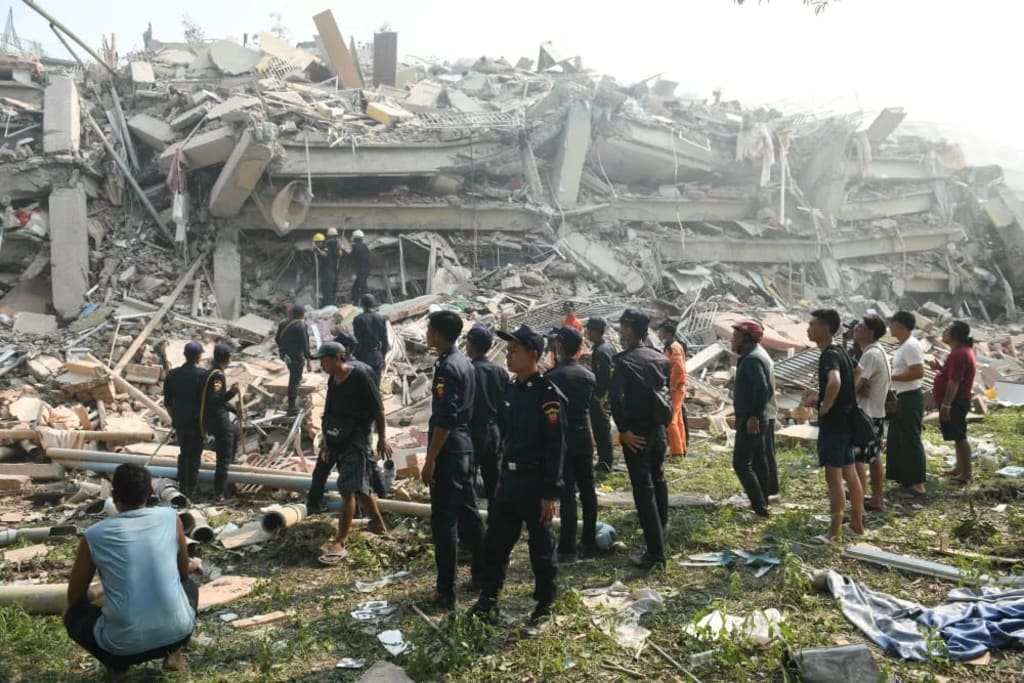
More than 140 dead in Myanmar, state media say
Earthquake was of 7.7 magnitude, USGS reports
Skyscraper toppled in Bangkok
Buildings and bridges in Myanmar collapse
Trump says US will be providing assistance
BANGKOK, March 28 (Reuters) - A powerful earthquake killed more than
140 people in Myanmar on Friday, authorities said, toppling buildings and wrecking infrastructure across a wide area, including a skyscraper under construction in neighbouring Thailand.
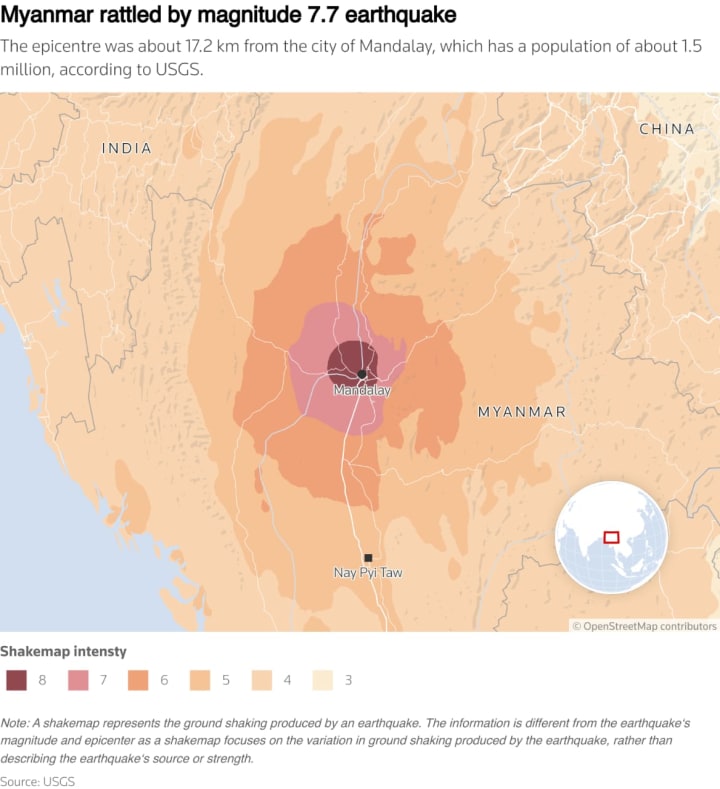
Much of the devastation was in Myanmar's second-largest city, Mandalay, which lies close to the epicentre of the 7.7 magnitude quake that struck at lunchtime and was followed by a powerful aftershock and several more moderate ones.
The Reuters Tariff Watch newsletter is your daily guide to the latest global trade and tariff news. Sign up here.
A rescue worker from Amarapura, an ancient city and now a township of Mandalay, said the bodies of 30 people had been recovered from collapsed multi-story apartment blocks.
"I have never experienced anything like this before - our town looks like a collapsed city," he said, estimating that about a fifth of the buildings had been destroyed.
"We received calls for help from people from the inside, but we cannot help because we do not have enough manpower and machines to remove the debris, but we will not stop working".
General Min Aung Hlaing, leader of Myanmar's military junta, said there would be more deaths and casualties and invited "any country" to provide help and donations.
Speaking at the White House later on Friday, U.S. President Donald Trump said he had spoken with officials in Myanmar and that his administration would be providing some form of assistance. "We're going to be helping," he told reporters.
Despite the administration's push to shut the U.S. Agency for International Development and cut nearly all remaining jobs, State Department spokesperson Tammy Bruce said USAID disaster experts were ready to help, including with items such as food and potable water.
"USAID has maintained a team of disaster experts with the capacity to respond if disaster strikes," she told a press briefing. "We are ready to move now. There has been no impact on our ability to perform those duties, those requests for aid, if and when they come in.
"
magnitude 7.7 earthquake in Myanmar caused widespread shaking and likely considerable damage because of a lack of buildings built to withstand temblors
By Robin George Andrews edited by Andrea Thompson
Resident carrying belongings out of a building damaged by an earthquake
A resident carries belongings over debris next to a damaged building in Naypyidaw on March 28, 2025, after an earthquake in central Myanmar. Sai Aung MAIN/AFP via Getty Images
Natural Disasters
On March 28, at around midday local time, tens of millions of people in Southeast Asia felt the earth below their feet violently rupture. A magnitude 7.7 earthquake, centered just 12 miles away from Mandalay, Myanmar, shook the region—causing streets to buckle, ancient pagodas to crumble, bridges to shatter and houses to collapse. Entire neighborhoods were devastated in a matter of seconds.
The earthquake’s energy release was comparable to that of several hundred nuclear weapon explosions. “The magnitude of this event was so high that it was felt in neighboring countries,” says Amilcar Carrera-Cevallos, an earthquake scientist at the Vicente Rocafuerte Secular University of Guayaquil in Ecuador. A 30-story skyscraper under construction in Bangkok—600 miles from the quake’s epicenter—disintegrated. According to estimates by the U.S. Geological Survey, there will be thousands, if not tens of thousands, of casualties, as well as tens of billions of dollars of economic damage.
Many factors conspired to make this earthquake a disaster, including a lack of quake-proofing measures in buildings across the region. Few of the structures could withstand this monster of a temblor, which was “a really big, shallow earthquake”—meaning it occurred relatively close to the Earth’s surface, says Judith Hubbard, an earthquake scientist at Cornell University.
About the Creator
The goals I did not achieve
Every writing goal I made for the year is a wash. It has been this way for a while, but I think it's important to be open about my failures and the reality of how life can get in the way. This is especially true considering the several times I have posted on Vocal about my writing goals, how I was changing my approach, and where I was hoping to be for the upcoming year. I will probably do that again in a couple months, but for now, it is time to acknowledge where I am today.
By Kay Husnick24 days ago in Journal


Comments
There are no comments for this story
Be the first to respond and start the conversation.