
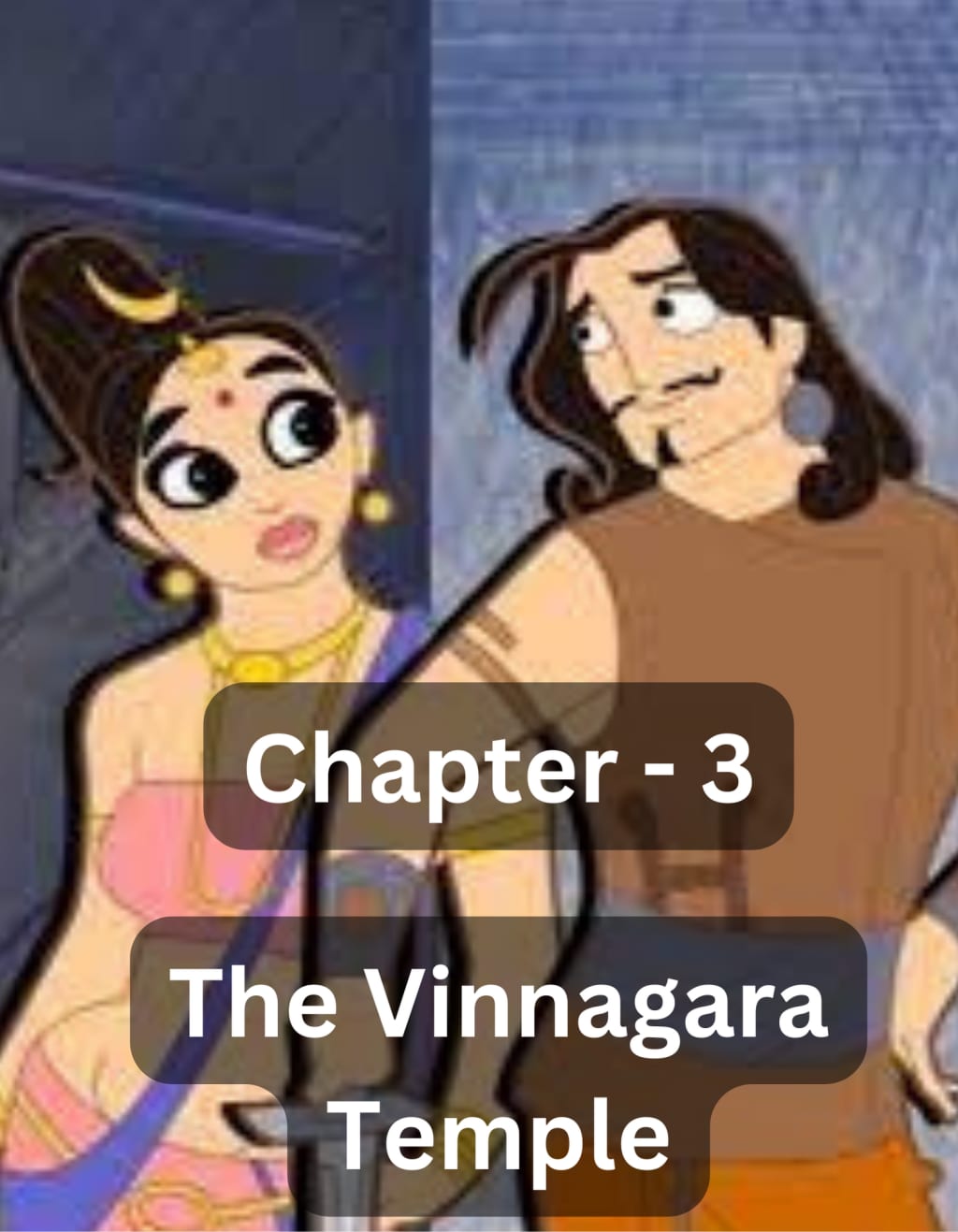
Ponniyin Selvan | Fresh Floods |Chapter - 3 | The Vinnagara Temple
Chapter - 3 : The Vinnagara Temple

They say that life is an unpredictable journey that surprises one
at every turn. That trivial incidents are often the catalysts to
significant, life-altering events that turn the world upside down.
Such an experience occurred to Vandhiyathevan, at that moment.
He had been staring, slack-jawed, at the Pazhuvettarayar
procession as it wound its way through the crowd; his horse had
been standing just a little further away.
The last of Pazhuvettarayar’s cavalcade, marching behind their
mates, caught sight of it. “Adei,” exclaimed one. “Look at that
kurudhai!”
“That’s a horse, not a mule, dimwit,” corrected another.
An acid comment intercepted them. “Will you two scholars kindly
set aside grammar lessons and find out if that animal is a horse or
an ass?”
“Now this is a mission more to my liking,” agreed a third. He
promptly set off towards the steed and attempted to clamber on its
back. That intelligent animal, realizing instinctively, that the
newcomer was not his master, shook him off. It flounced away,
obviously distressed.
“Well, well, would you believe the temper of this one!” chuckled
the soldier who had taken a tumble to the ground. “The mule won’t
let me mount. It’s a respectable animal, you see—wants a member
of an ancient royal clan for its master.” He appeared to ponder this
deeply. “In that case, no one less than a prince of the Thanjavur
Mutharayar dynasty would do!” he quipped—and the soldiers around
him cackled appreciatively.
There was reason for their derisive laughter: the Mutharayar
dynasty of Thanjavur had been crushed out of existence a hundred
years ago; the Chozha Empire’s tiger flag fluttered triumphantly, in its
place.
“Who cares what the horse thinks?” put in one. “I’d say that our
Thandavaraayan right here is a thousand times better than some
descendent of long-dead Thanjavur Mutharayars!”
“Thandavaraayaa, you’d better make sure this animal really is a
horse and not a false-legged prop for the temple festivities,” mocked
another soldier. “After all, it refused to let you mount, didn’t it?”
“An excellent idea,” agreed Thandavaraayan, and proceeded to
put this to the test. He approached the horse and this time, caught its
tail—giving it a vicious twist. That much-afflicted animal decided
enough was enough, kicked its hind legs three or four times, and
galloped away.
“Ah, look at it run! It really is a mule, then—how wrong we were!”
yelled the soldiers, carried away by what was, to them, a hilarious
sight. They whistled and screeched “Ui! Ui!” and crashed behind the
horse as it stumbled through the festival crowd.
People milling about tried to get away from the terrified animal as
it ploughed through them. Most managed to escape, but some were
still caught under its thundering hooves, and suffered injuries. The
horse galloped on, meanwhile, maddened out of its senses.
All of this had happened in moments, before Vandhiyathevan
could gather himself and take any action. Azhwarkkadiyaan, who
had caught sight of the young man’s expression, guessed that the
stallion was his.
“Saw the antics of those Pazhuvoor oafs, Thambi?” His voice
was suave. “Why couldn’t you teach them the lesson you promised
me?”
The smoothly delivered taunt found its mark; Vandhiyathevan’s
face turned crimson with fury. He grit his teeth, however, and forced
himself to keep calm. The Pazhuvoor men had turned out in full
force; there was no point in trying to take on hundreds of them in a
fight. They had not stayed behind to look for a quarrel with the
horse’s owner either, marching away after cackling at the animal for
a while.
Vandhiyathevan chose, instead, to go after his stallion, which had
slowed to a stop after a while. He had not been much worried about
it; the horse was well-trained, he knew, and would not wander away
too far. No, what he was itching to do was teach those arrogant
Pazhuvoor idiots a lesson—but now was not the time. He would
have to wait.
The horse had come to a halt in a tamarind grove, away from the
milling throngs. Sorrow practically dripped off its drooping mien, and
it neighed a little when Vandhiyathevan approached. Why did you
leave me alone, among those louts? It seemed to ask, and
Vandhiyathevan applied himself to the task of soothing its lacerated
nerves. He patted its back, and managed to calm it down enough to
walk it back to the thoroughfare. The crowd caught sight of him, and
impaled him with criticism. “Why did you bring this unruly animal to
the festivities, boy?” They complained. “Look at the number of
innocent people who have suffered its kicks!”
Others were slightly more charitable. “Not the poor boy’s fault at
all. What could he do? What could the horse do, for that matter? It
was just the mad, vulgar antics of those Pazhuvoor men.”
Azhwarkkadiyaan stood waiting as Vandhiyathevan returned with
the horse, and the young man’s face narrowed with irritation. Why
won’t this quarrelling idiot leave me alone?
“What’s your direction, Thambi?” asked the Vaishnavite.
“Er—ah—well, I fully intend to travel to the west and then turn
south and then, perhaps, take a stroll to the east and double back to
the south-west,” Vandhiyathevan rattled off.
“That wasn’t what I meant. Where do you intend to stay, tonight?”
“Why do you wish to know?”
“If you were, perhaps, intending to lodge at the
KadamburSambuvaraiyar Palace, I have a commission for you.”
“Well! Are you an expert in the black arts or magic? How on earth
did you know where I was headed?”
“Hardly something that warrants the expertise of a magician.
Dozens of visitors will arrive today from all over the country, and stay
at the palace.”
“Is that so?” murmured Vandhiyathevan, surprise colouring his
voice.
“Indeed. Don’t tell me you didn’t know this—to whom else could
the palanquin, royal umbrellas, elephants, horses, drums, conches
and trumpets belong, but the Kadambur royal family? They were
here to welcome and escort Pazhuvettarayar to the Palace. He
would expect, and settle for nothing less.”
This was news indeed. Opportunities to stay in the same place as
Chozha Nadu’s greatest warrior would not be easy to come by; who
knew? He might even chance upon a God-given excuse to actually
meet him, and introduce himself, perhaps. All this was highly
tempting—but recent experience with Pazhuvettarayar’s brutes had
soured his expectations, a little.
Lost in reverie, Vandhiyathevan came to himself at
Azhwarkkadiyaan’s voice.
“Thambi—will you do me a favour?” Azhwarkkadiyaan’s tone was
filled with pleading.
“What sort of favour could I offer you? I’m a stranger to these
parts, myself.”
“I wouldn’t ask you anything beyond your means. Take me to the
Kadambur palace with you, tonight.”
“Whatever for? Do you expect to meet a Saivite, there? Perhaps
you’re eager to debate with him about the respective merits of Siva
and Thirumaal?”
“Of course not. Did you really think I picked quarrels for a living?
See, my lad, the palace will resound with celebrations tonight—they
are sure to hold an enormous feast which will be followed by
kaliyaattam, saamiyattam, a delightful kuravaikoothu, dances and
songs. I’ve never seen a koothu—and this would be a perfect
chance.”
“Be that as it may—how would I be able to escort you?”
“You could introduce me as your servant.”
Every suspicion that Vandhiyathevan had entertained some time
ago returned in full force, and grew in strength. “Look, you’d better
play off your petty tricks on someone else. I’m not the man to fall for
them. The last thing I want is someone like you as my servant—and
who do you think will believe such a thing? No one would, even if I
were stupid enough to take you with me. Besides, judging by
everything you say—I doubt if even I will find a place to stay there,
tonight.”
“Then—you’re not traveling to Kadambur by invitation?”
“I am, in a way. Sambuvaraiyar’s son Kandan Maaravel is a very
dear friend of mine, and has often insisted that I visit him if I’m ever
in these parts.”
“Is that all? You won’t find it an easy circumstance to enter the
palace tonight, then!”
They walked together in silence, for a while.
“Why do you follow me?” asked Vandhiyathevan, finally.
“I could ask you the same thing. Why don’t you go your own
way?”
“Because I don’t know my way around, of course. Nambi, do you
go to Kadambur, as well?”
“No—you’ve refused to take me along, haven’t you? I’m on my
way to the Vinnagara temple.”
“To the Veera Narayana Perumal Temple, you mean?”
“Yes.”
“I would like to visit, too.”
“Would you, now? I wondered if you might object to entering
Vishnu temples. This one has an excellent history and is worthy of
worship, as well. There’s a Battar, a priest here, by name
EswaraMunigal, who serves at the temple. A great man, indeed.”
“I’ve heard of him too—but the shrine’s so crowded today! Is it
some sort of auspicious occasion?”
“Of course—today is the birth star of the lady Andal, one among
the twelve Azhwars, the chief of Thirumaal’s devotees. And then, it’s
Aadi Perukku as well, which explains the teeming crowds. Hardly
surprising, is it?” Azhwarkkadiyaan changed tack. “Thambi, have you
ever listened to any of Andal’s songs?”
“No.”
“Don’t. Never, never make even the attempt!”
“Why this hatred?”
“I cherish neither hatred nor loathing for her pasurams—all I
wanted was to warn you about their fatal charm. My lad, if you ever
had the misfortune of listening to her exquisite poems, you’d throw
away your spear and sword; swear off your military lifestyle and
wander away on a pilgrimage through all the Vinnagara temples in
the land!”
“Do you know any? Can you sing them?”
“A few. I’ve learnt some of Nammazhwar’s divine verses as well. I
intend to sing them at the temple; you may listen, if you wish,”
answered Nambi. “Ah, here we are!”
And, in truth, they had arrived at the Veera Narayanapura
Temple.
-
ParanthakaChozhar the First, the grandson of
VijayalayaChozhar, carried the magnificent title of “The
Kopparakesari Who Conquered Madurai and Eezham” —and it was
he who laid the foundations for the empire, the Chozha kingdom
would later become. Paranthakar was also the bearer of other, grand
titles: he it was who had fitted ThillaiChitrambalam, or the
Chidambaram temple with a golden roof; he possessed the titles of
ChozhaSigamani, SooraSigamaniamong others— not to mention
Veera Narayanan, as well.
The Rashtrakuta kings of the RettaiMandalam kingdom in the
north wielded considerable power during his time; Paranthakar
suspected that they might cherish designs on the Chozha territories
as well and stationed his firstborn, Prince Rajadithyar, in the
Thirumunaippaadi country, with a large army at his disposal.
Rajadithyar was loath to let hundreds of thousands of warriors
lounge about with nothing to do, and hit upon a plan: they would
work towards something that benefited a large swathe of the local
population. Well aware that copious amounts of water overflowed the
banks of the Vada Kaveri, or Kollidam and drained into the sea with
no use to anyone, he made arrangements for his men to dig a
massive lake, to collect it. He named it the Veera Narayana Eri in
honour of his beloved father, and raised a Vinnagara Temple, as well
—it was common for Vishnu Temples or Vishnu Grihas, to be known
in Thamizh as Vinnagaram, in those days.
Thirumaal, or to address Him by another name, Sriman
Narayanan Murthy was the Protector, the Supreme Guardian of all
life as he lay on his snake-bed, in a sea of milk. It was only
appropriate that temples in his name were often raised on the banks
of lakes; this was also the reason for the presence of the Veera
Narayana Temple, on the banks of this one, too.
Azhwarkkadiyaan and Vandhiyathevan entered the sacred
precincts of such a hoary temple; once they approached the
sanctum, the Vaishnavite cleared his voice, and began to sing. He
worked through a few of Andal’s divine pasurams or songs, and
finally touched upon Nammazhwar’s work, commonly referred to as
the ThamizhVedham:
“Poligapoligapoliga
Poyitruvalluyirchaabam
Naliyumnaragamumnaindha
Namanukinguyaathonrumillai
Kaliyumkedumkandukolmin
Kadalvannanboothangalmanmel
Maliyappugundhuisaipaadi
Aadiuzhitharakkandom!
Kandomkandomkandom
Kannukkiniyanakandom
Thondeerelleerumvaareer
Thozhuthuthozhuthuninraarthum
Vandaarthannanthuzhaayaan
Maadhavanboothangalmanmel
Pandaanpaadininraadip
Parandhuthirigindranavae!
[Behold, behold, the shining grace of the Lord who redeems us of
our curses; Behold the light that banishes the darkness of hell; that
releases us from the yoke of death; the age of kali is at an end, and
those who worship Lord Vishnu will rise again, upon this earth; sing
and dance, to glory! Behold, behold, the sight that gladdens our
hearts; to see the prayers of His servants rise to reach Him; we, who
sing His praises are lost in the ecstasy of His grace, as bees drunk
on the nectar of His thulasi garland!]
Tears gathered in Azhwarkkadiyaan’s eyes, rolling slowly down
his cheeks as he gave himself up to the beauty of the divine.
Vandhiyathevan listened carefully as well, and though he shed none,
his heart melted at the simple beauty and pure emotions that were
their essence.
His sentiments towards Azhwarkkadiyaan underwent a change,
as well. This man, he thought, is a true servant of God.
Others besides the young man, immersed themselves in the
songs: the mudhalimaar, the temple authorities lost themselves in it,
as did the priest, EswaraBattar, who stood by the sanctorum, tears
brimming in his eyes. By him stood a fresh-faced youngster, his
attention entirely on the singing Vaishnavite.
Azhwarkkadiyaan sang ten pasurams with the utmost feeling,
and finished with one more:
“Kalivayalthennankurugoor
Kaarimaaransadagopan
Oli pugazhaayirathuippathum
Ullathaimaasarukkume!”
[Sing these songs, devout ones, composed by Kari Mara
Sadagopan of Kurugoor in the divine lord’s honour—and thy heart
will be cleansed of every blemish!]
When he finished, the youngster leant towards his father and
whispered something into his ears. The Battar, who had bent down,
straightened and wiped his eyes. “Ayya, hasn’t the revered
Nammazhwar, Sadagopan of Kurugoor sung a thousand songs in
praise of our Lord? Do you know them all?”
“This servant hasn’t had that good fortune,” answered Nambi. “I
am acquainted with a few, though.”
“Pray, teach this youngster of mine whatever you know,”
requested the Battar.
-
Veera Narayanapuram was to be honoured with a great many
more accolades in the coming years: the young Battar’s son who
now stands beside his father, listening to the chaste pasurams of
Nammazhwar, his face a picture of innocence and the radiance of
youth, would grow up to become Naadamunigal, the first and most
illustrious of many Vaishnava Acharyas; later, he would journey to
Kurugoor, also known as AzhwarThirunagari, and gather all
thousand of Nammazhwar’s beautiful verses, adding even more
acclaim to the great devotee who had composed
theThamizhVedham. Naadamunigal’s many disciples would
painstakingly catalogue these verses, memorize them, and sing
them all over the country.
His noble work would not stop there: Naadamunigal’s grandson
Alavandhaar would lead a life rich with destiny and far more
miraculous events than even his grandfather.
More praise would pour in: Udayavar Sri Ramanujar himself
would visit this, the birthplace of such greatness, and stare in
astonishment at the Veera Narayanapuram Lake and its seventy-four
gushing canals. He would ponder upon the endless grace and
compassion of Thirumaal who showered his blessings upon his
devotees, just as the canals that poured water into the lake. This
would lead the saint to conceive of setting up seventy-four Acharya
peedams or Vaishnavite centres for devotees; these would, one day,
lead to the establishment of seventy-four Simmasanadhipathigal or
Vaishnavite leaders, who would dispense knowledge and grace to
devotees in their turn, and begin a rich tradition that would continue
over centuries.
But such things do not come under the purview of this tale; we
shall let the richly compiled tomes of Vaishnava Guru Parambarai to
recount their lives, and return to Vandhiyathevan.
Once they had completed their worship and walked out of the
temple, the Vaanar warrior turned to Azhwarkkadiyaan. “Nambi, I
must beg your forgiveness. I had no idea that you were such a
devout man, or that you were so well learned. You won’t hold my
ignorant words against me, will you?”
“By all means, you have my forgiveness, but tell me—will you do
me a favour?”
“I said that I couldn’t do what you wanted—and you agreed, didn’t
you?”
“Ah, but what I wish you to do now is something else altogether. I
shall give you a tiny note. Should you have the opportunity to stay in
the Kadambur palace tonight, you must deliver it into the hands of a
certain person.”
“Oh? To whom?”
“The woman who followed Pazhuvettarayar, in her closed
palanquin.”
“Nambi, what sort of a man do you take me for? Do I really seem
like the kind that delivers notes to women? Had it been anyone but
you who asked this of me—”
“If you’re unwilling, Thambi, leave, by all means. There’s
absolutely no need to fly into a passion. The thing is—if you’d helped
me with this, I might have lent you my assistance at some point.
Never mind.”
Vandhiyathevan lingered no more. He leapt on his horse and
galloped towards Kadambur.
About the Creator
Jeevanantham S
Hi Friends !!!.
Keep reading
More stories from Jeevanantham S and writers in Journal and other communities.
Pet Calming Products Market: The $2B Anxiety Solution
The thunder rolls across the sky. Your dog’s ears flatten instantly. Within seconds, the pacing begins — nails tapping anxiously across the floor, tail tucked, eyes wide with confusion. You kneel beside them, whisper reassurance, but the storm outside isn’t the only trigger. Fireworks, travel, separation, loud noises — modern life can overwhelm even the most loyal companion.
By Harvey Specter3 days ago in Journal




Comments
There are no comments for this story
Be the first to respond and start the conversation.