
Ponniyin Selvan - 1 | Fresh Floods |Chapter - 8 | Who is in the Palanquin?
Chapter - 8 : Who is in the Palanquin?

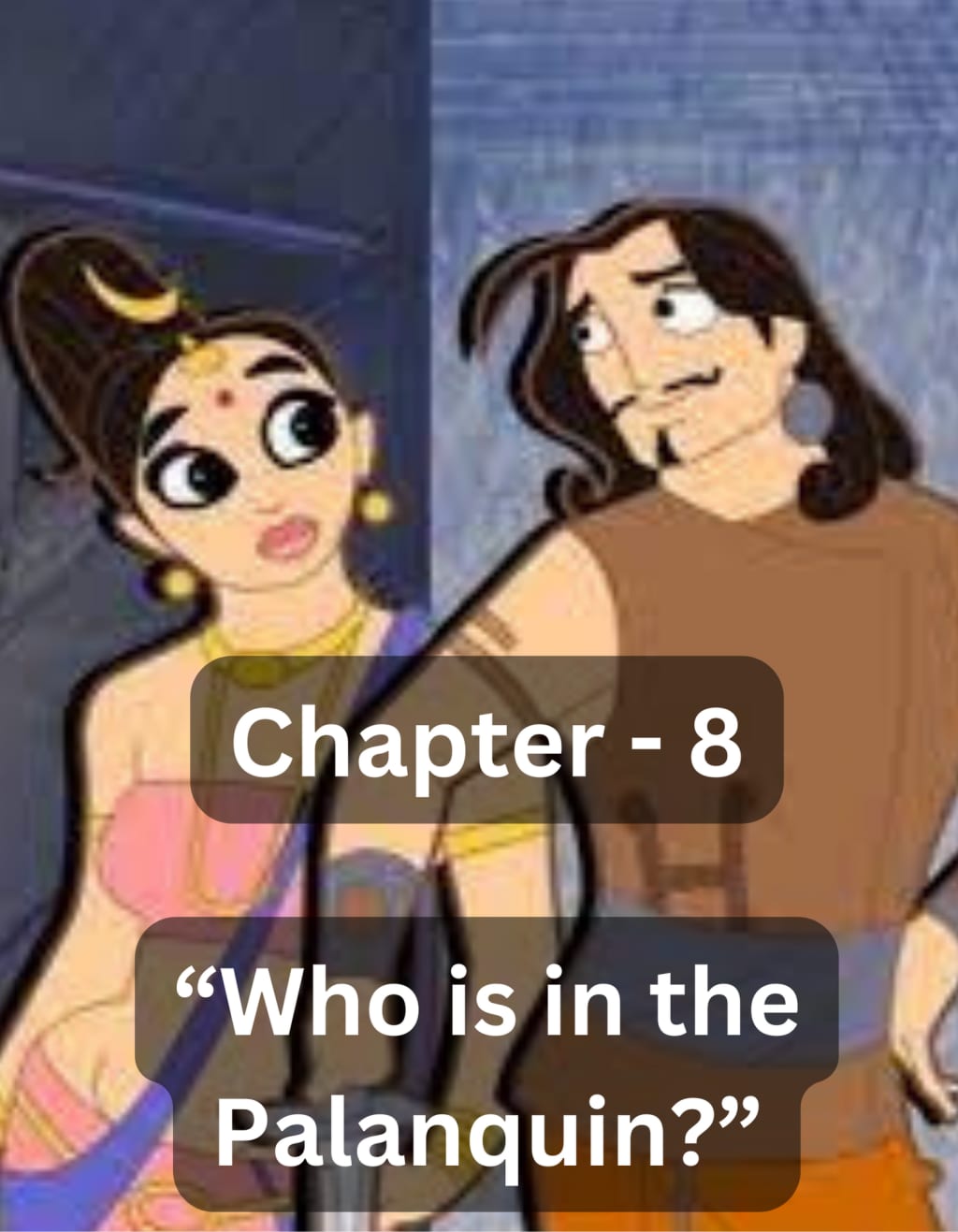
Ponniyin Selvan - 1
Fresh Floods |Chapter - 8 | Who is in the Palanquin?
A confused babble of voices arose from the men gathered in the
courtyard, as everyone seemed to speak at once. Discussions,
opinions and arguments erupted in a dozen corners and for a while,
Vandhiyathevan was hard put to understand a single word or
recognize the man who uttered it.
Sambuvaraiyar, who seemed to come to his senses first, spoke
up. “Aren’t we required to furnish Pazhuvettarayar with some sort of
answer?” His voice rang in strident tones around the courtyard.
“What is the purpose of arguing endlessly amongst ourselves? The
night is into its third jaamam as it is; the moon swims in the night sky.
We must come to a decision—quickly.”
“I am plagued, if you will pardon me, with a doubt. Perhaps
others harbour the same sentiments as I,” came the hoarse voice
that had spoken earlier. “Should the Lord of Pazhuvoor not object, I
should like to voice it and seek clarification.”
“It is Vanangamudiyaar who speaks, is it not?” said
Pazhuvettarayar, in a tone that brooked no argument. “Let him rise
and come to the light.”
“It is I, indeed. And here I am.”
“I reserve my fury for battlefields and enemies—not those I
consider my allies and friends. You may speak your mind without any
scruple.”
“I believe I will. The King of Pazhuvoor lists certain crimes against
King SundaraChozha Maharaja, but is it not true that some level the
same charges against Pazhuvettarayar, as well?” asked
Vanangamudiyaar. “I do not say I believe it—indeed, I do not—but I
should like to know the truth, in any case.”
“Pray, enlighten me: what is the truth that you wish to know?”
“This assembly is well aware of the fact that the Lord of
Pazhuvoor married a young woman a few years ago—”
Sambuvaraiyar’s voice cut in at this point, burning with anger.
“This is outrageous—I am sure I speak for everyone here when I say
that we object to Vanangamudiyaar’s tactless comment. To address
our peerless leader in such a way—to level such an accusation
against our general, our leader who has our best interests at heart is
akin to blasphemy! In short—”
“Much as I appreciate the sentiment, I entreat Sambuvaraiyar to
remain patient, and allow Vanangamudiyaar to ask his questions.
There is nothing more poisonous than a mind riddled with suspicion;
far better to lance the boil and relieve oneself of unending doubts. I
did, at the late age of fifty-five and more years, marry a young
woman—I admit this with no qualms whatsoever. But when, my
friends, have I ever declared myself an incarnation of Lord Rama, in
this Kali Yuga? Neither have I claimed to be an EkapathniViradhan;
bound to one wife. I fell in love with her and she with me; we found
our hearts united, and wedded each other according to ancient
Thamizh customs. Pray, is this a crime?”
“No—not at all!” rose several voices in unison.
“It was never my intention to accuse you of matrimony, My Lord.
Who, amongst us, has bound himself to merely one wife, after all?
And yet—yet—”
“Yes? There is no reason to hesitate. Ask what you will.”
“There is talk that Pazhuvettarayar listens far too much to his
young queen, the Ilaiya Rani. Worse—that he consults her even
regarding affairs of state and royalty. That he takes her with him
where he goes.”
A mocking cackle erupted in the crowd.
“Stop!” Sambuvaraiyar sprang up again, voice shaking with fury.
“Who dared to laugh, just now? Show yourself! What gives you the
right to jeer at our leader?” He unsheathed his sword, almost
growling.
“If it is any consolation, it was I,” admitted Pazhuvettarayar. Then,
he turned to Vanangamudiyaar. “Tell me—is it such a crime to take
my lawfully wedded wife, who bears my thaali around her neck,
wherever I go? It is true that I rarely stay away from her—but to
accuse me of consulting her regarding state affairs is unjust. I have
not done so, and never will.”
“If that be the case, I pray that Pazhuvettarayar answers just one
more question—and I shall pronounce myself satisfied. What does a
closed palanquin, meant to stay within the walls of an anthappuram,
do here? What is its place among those who are involved in
discussing such serious matters as the succession? Is there anyone
within? If not, whose are the bangles that clinked a while ago—or the
throat that cleared itself?”
A strange, uneasy hush settled over the courtyard. Since
everyone present had entertained Vanangamudiyaar’s suspicions at
one point or the other during the meeting, no ringing protest rose
against him. Sambuvaraiyar’s lips did, in fact, mumble a few words,
but they were too indistinct for anyone to understand.
Pazhuvettarayar it was, who chose to cleave the stifling silence
with his strong, confident voice. “An excellent question, and one that
deserves an explanation. Be sure that I shall give it when this
meeting is at an end. May I have half a naazhigai more? Surely my
esteemed friends trust me enough to grant me this favour?”
“We do, we do!” exclaimed many voices. “We have complete faith
in you!”
“I assure you that I cherish as much regard for Pazhuvettarayar,
as anyone assembled here,” explained Vanangamudiyaar. “I posed
these questions only because he bade me clear my mind. I swear,
here and now, that his every wish is my command, and I am
prepared to do anything to carry it out. Should I be required to
sacrifice my life in his service, so be it!”
“I have the greatest faith in Vanangamudiyaar’s loyalty; in fact, I
am aware of every one of your trustworthiness, and I cherish your
regard. For that very reason, it becomes all the more important for us
to remember why we chose to meet, and come to a decision about
several important affairs. King SundaraChozhar may live long and
rule his Empire as he wishes—but we are here to consider the
possibility that that rosy future may not come to pass. If the royal
physicians were to be proven right—if the comet in the sky proves to
be a portent omen—it behooves us to decide on the rightful
successor to the Chozha throne.”
“We request Pazhuvettarayar to give us his honoured opinion, on
these matters. None of us would venture a word against yours.”
“On the contrary—at no other time has it been so important for all
of you to speak up, and inform me of your views. At this juncture, I
should like to take the opportunity to remind ourselves of certain
events in the past. Twenty four years ago, the great warrior, saint
and pious ruler, King Kandaradhithar ascended the heavenly abode;
his son, Madhuranthaka Thevar was a mere infant, a year old, at that
time. It was for this reason that Kandaradhithar wished to place his
brother Arinjaya Thevar on the Chozha throne and rule after him; we
were informed of his sentiments by his devoted wife, Empress
SembianMaadevi. And it was loyalty to our king that made us agree
to such an arrangement. Unfortunately, cruel destiny did not allow
Arinjayar to rule for more than a year. His son
ParanthakaSundaraChozhar was a strapping young man of twenty
years; we, the empire’s pillars, the ministers, aides, chieftains, lords,
kottam and kootram officials gathered, discussed the best interests
of the country, and crowned him king. There is no doubt that this was
an excellent decision; until two years ago, SundaraChozhar gave us
no cause to doubt his rule. He consulted us upon royal matters and
events prospered as ever before. Now however, his health is
deteriorating—and that circumstance leaves us with certain
questions. Kandaradhithar’s honoured son, Madhuranthaka Thevar
is now an extremely capable prince; his piety, accomplishments,
intelligence and character make him an eligible contender for the
throne. In the meanwhile, AdithaKarikalar, SundaraChozhar’s
firstborn is stationed in Kanchi as the Commander of the Northern
Chozha Forces. My friends—who, among these two men, is worthy
of being the heir? I ask you to consider royal tradition and practice,
thus far; to consult what Manu Needhi tells us. What, according to
the dictates of fairness and justice, would be your decision? Would
you choose Madhuranthaka Thevar, son of the elder
Kandaradhithar? Or AdithaKarikalar, the grandson of the younger
ArinjayaChozhar? Think—think carefully; search your mind, and give
me your opinion …”
“Kandaradhithar’s son Madhuranthaka Thevar is the rightful heir
to the throne,” answered Sambuvaraiyar promptly. “That decision,
my lord, is according to the dictates of justice, fairness, and
righteousness.”
“True!” “This is my decision as well,” “I agree!” murmured the
others, one by one.
“Your opinion is mine; the Chozha throne does, indeed, belong to
Madhuranthaka Thevar. But such a decision, although easy to make,
will entail enormous difficulty if it must be enforced. Tell me—is
everyone here prepared to undergo any hardship, to make it so? Do
we swear to sacrifice our body, soul and wealth in fighting for
Madhuranthakar’s rights, and to restore them to him? Do I have your
assurance that you will all pledge yourselves to this noble cause at
the sacred feet of Goddess Durga?” Pazhuvettarayar’s voice fairly
rang with a new fervour.
Silence descended on the gathering again.
“We are prepared to swear, in the presence of God, that we shall
sacrifice anything to uphold Madhuranthaka Thevar’s rights,”
Sambuvaraiyar, finally, spoke up. “All of us do wish, however, to ask
you something before we do: what are the Prince’s own sentiments?
Is he prepared and willing to ascend the throne? Many are the tales
of the piety of Kandaradhithar’s son—that he takes no joy in worldly
pleasures and devotes himself completely to the worship of Siva
Peruman. We have heard, too, that nothing could be farther from his
desire than to rule this empire. In addition, his mother Sembian
Mahadevi does not wish it either. We should like to know the truth of
such statements, if you please.”
“An excellent question—asked at the right time too. I shall answer
it in a way satisfactory to everyone. In point of fact, it ought to have
been answered much before. I beg your pardon for not doing so,”
Pazhuvettarayar began, with a preamble. “The whole country knows
that Sembian Mahadevi has done everything in her power to turn her
son from thoughts of the throne and towards worship of the divine.
What neither the country, nor its people know, are her reasons for
doing so. Should it ever become known that Madhuranthakar wished
to ascend the throne, PeriyaPiratti feared that such knowledge would
put a period to his existence—”
“Ah! Is that so?” exclaimed several voices.
“Indeed. Any mother worth the title would wish her son alive and
uncrowned, rather than see him rule and be assassinated.
Madhuranthaka Thevar, to whom his mother’s words are as sacred
as the Vedhas, duly devoted himself completely to God, spurned all
worldly pleasures and spent his time in worship of Siva Peruman.
For some time, though, his sentiments have been undergoing a
steady change. He has begun to feel that he has a right to ascend
the throne, and to wish to govern the country in the best way
possible. He is prepared to voice his sentiments in public, once he is
secure in the knowledge of your fealty to him—”
“And what is the proof of this?”
“Certainly, I am prepared to provide as much and more proof, as
you wish. But if I do—will you all swear to pledge yourselves to his
cause and rule?”
“We will! We will!” The gathering assented vociferously.
“I hope no one entertains any further doubts?”
“No, none at all!”
“In that case, there is no reason to delay—here is the proof you
have all been waiting for. And I have an opportunity to clear
Vanangamudiyaar’s suspicions as well.” Pazhuvettarayar rose,
walked majestically towards the palanquin in a corner, and stopped
beside it.
“My Prince—we require your presence amongst us,” he said, in
his humblest voice. “Do step out of the palanquin and cast your eyes
on these warriors, these pillars of strength who are prepared to lay
down their lives to uphold your noble cause!”
Vandhiyathevan, who had been listening to the courtyard
conversation with all his ears from behind his pillar above-stairs, now
leant forward carefully, and peered down.
A slender golden hand—the same, delicate, rose-leaf
complexioned limb he had seen that evening—crept out of the
palanquin, and gently pushed aside the screen. Except that, what he
had believed to be a woman’s bangle was in fact a kanganam, an
ornament usually worn by princes. The next instant, that face, the
one that resembled the golden fullness of a radiant moon, appeared
from behind the screen. A man with a form that rivaled the beauty of
Manmadhan himself stepped out, smiling at the warriors in the
courtyard.
Ah—wasn’t this Prince Madhuranthakar, the son of King
Kandaradhithar? His presence within a palanquin had made
Vandhiyathevan mistake him for a woman. He threw a swift glance at
the fort wall—was Azhwarkkadiyaan, who had committed the same
error, still eavesdropping on the scene?
Tree branches shadowed that section of the fort wall, however,
and nothing could be seen.
By this time, the courtyard below was resounding with ferocious
shouts and chants: “Long live Madhuranthaka Thevar! Long live the
Crown Prince!” Men unsheathed their swords, raised their spears,
and their voices to the heavens. “Vetrivel! Veera vel!”
To remain here anymore would lead to complications;
Vandhiyathevan slipped away from the pillar, returned to his bed in
the isolated balcony, and lay down.
About the Creator
Jeevanantham S
Hi Friends !!!.
Keep reading
More stories from Jeevanantham S and writers in Journal and other communities.
The goals I did not achieve
Every writing goal I made for the year is a wash. It has been this way for a while, but I think it's important to be open about my failures and the reality of how life can get in the way. This is especially true considering the several times I have posted on Vocal about my writing goals, how I was changing my approach, and where I was hoping to be for the upcoming year. I will probably do that again in a couple months, but for now, it is time to acknowledge where I am today.
By Kay Husnick23 days ago in Journal



Comments
There are no comments for this story
Be the first to respond and start the conversation.