
Phillis Wheatley: America’s First Black Literary Voice
From stolen childhood to literary triumph the true story behind Wheatley’s rise from slavery to the heights of American letters

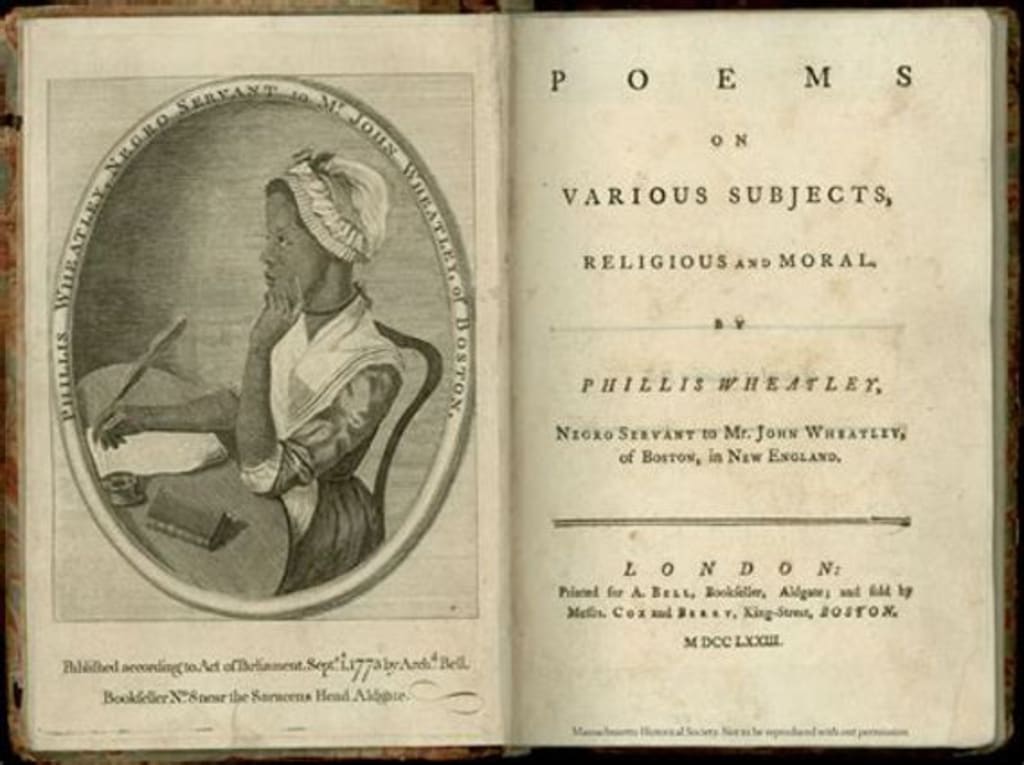
In the summer of 1773, a slim volume of poetry appeared in London under the title Poems on Various Subjects, Religious and Moral. The author was Phillis Wheatley, a young Black woman from Boston who had never known freedom. Her name alone stirred curiosity. Her words left an impression that has endured for centuries.
Phillis Wheatley’s life began in West Africa around 1753. At the age of seven, she was taken from her home, forced aboard a slave ship, and transported across the Atlantic. She arrived in Boston in 1761 and was sold to the Wheatley family. She was small, frail, and sickly. Her survival alone defied expectations.
The Wheatley family named her after the ship that carried her the Phillis. They soon noticed her intelligence and, in an unusual decision for enslavers, allowed her to learn alongside their children. Within sixteen months, she had mastered English. Soon after, she began reading Latin and Greek. She studied the Bible, astronomy, and classical literature. By her teenage years, Phillis Wheatley was writing verse that rivaled many educated poets of her time.
Her first known poem, To the University of Cambridge in New England, was written before she turned fifteen. Addressed to students at one of the most prestigious institutions in the colonies, the poem urges moral and spiritual responsibility. It speaks with both the humility of a believer and the confidence of a mind aware of its strength.
She writes:
“Students, to you ’tis given to scan the heights
Above, to traverse the ethereal plain,
And mark the systems of revolving worlds.”
These lines came from a girl born free in Africa, sold as property, and writing in a tongue not her own. Her message challenged the very structure that allowed her to be enslaved. She had no wealth, no liberty, and no standing in the world only the clarity of thought and the precision of her words.
Publishing a book in the 18th century required money and influence. As a Black enslaved teenager in colonial America, Wheatley had neither. Her supporters largely white elites in Boston failed to find a publisher in the colonies willing to print her poems. They turned to London, where she became something of a literary sensation. Her 1773 publication made her the first Black woman in America, and the first person of African descent in the colonies, to publish a book of literature.
Wheatley’s rise caused unease. Many questioned whether she had written her poems herself. In response, she was forced to defend her authorship before a panel of eighteen men, including John Hancock. Only after they verified her talents did her work reach print.
Her fame spread quickly. George Washington received a poem from her in 1775. He responded with praise, inviting her to visit him at his camp in Cambridge. Voltaire and other European intellectuals took note of her. For a brief moment, Wheatley’s name stood alongside the great minds of her age.
Despite this acclaim, she lived in near-constant isolation. Her status as an enslaved woman in a white household meant she occupied a space of silence. She had no peers, no real allies, and no family of her own. Her poetry reflected this solitude of elegies, spiritual reflections, and distant praises of liberty.
After her return from London, Phillis Wheatley was freed by the Wheatley family. Freedom, however, offered little security. She struggled to find patronage. Her second manuscript of poetry vanished without publication. Her former supporters faded away. She married a free Black man, John Peters. Their life together was marked by poverty and instability.
Wheatley gave birth to three children. All died in infancy. She worked as a laundress to survive, still writing poems no one would publish. On December 5, 1784, she died in a boarding house, alone and nearly forgotten, at approximately thirty-one years old. Her last surviving child died the same day.
The tragedy of Phillis Wheatley’s life lies not only in the hardships she endured but in how her brilliance was ignored once it no longer served the interests of the powerful. Her story reflects fleeting recognition and quiet erasure. Yet her voice never disappeared.
In her poems, the reader finds more than talent. They find defiance. She wrote during a time when literacy among enslaved people was feared. Expression was rebellion. Poetry, for her, became a means of reclaiming identity and asserting intellect in a society that denied her humanity.
Wheatley’s legacy today carries more weight than it did during her life. Schools teach her work. Scholars study her influence. Writers of all backgrounds cite her as a foundational figure. She stands as a symbol of what can be achieved in the face of oppression and as a reminder of how often greatness is overlooked when it doesn’t wear the expected face.
The solitude of Phillis Wheatley was not only personal. It was historical. She wrote alone, lived among strangers, and died unseen. Her words, however, survived. In them, she left behind not a cry for pity, but a call to witness. Her poems demand acknowledgment not only of her genius, but of the silence that surrounded it.
Phillis Wheatley wrote:
“In every human breast,
God has implanted a principle which we call Love of Freedom.”
That line, penned by an enslaved teenager in a colonial world built on bondage, rings louder today than it did two centuries ago. Her life, brief and full of obstacles, stands as one of the earliest chapters in the ongoing story of Black American literature. She was the first voice, a solitary one that still remains.
On Being Brought from Africa to America
by Phillis Wheatley
’Twas mercy brought me from my Pagan land,
Taught my benighted soul to understand
That there’s a God, that there’s a Saviour too:
Once I redemption neither sought nor knew.
Some view our sable race with scornful eye,
“Their colour is a diabolic die.”
Remember, Christians, Negroes, black as Cain,
May be refin’d, and join th’ angelic train.
About the Creator
Tim Carmichael
I am an Appalachian poet and cookbook author. I write about rural life, family, and the places I grew up around. My poetry and essays have appeared in Beautiful and Brutal Things, My latest book. Check it out on Amazon
Keep reading
More stories from Tim Carmichael and writers in Journal and other communities.
The Pale Eye of Bethel Moor. Honorable Mention in Leave the Light On Challenge.
By the time I got to Bethel the sun was already gone, and the place felt cold. Nothing moved out there. Nothing grew. It wasn’t dead, more like it had stopped living. Some places just carry a kind of sadness in them, like the land itself had just given up. Bethel was one of those places.
By Tim Carmichael8 months ago in Fiction
Author’s Advice
If you would’ve asked me 20 years ago did I know I’d become a writer and an author, I would’ve said “nope, ain’t happening”. As fate would have it I did become an author and I can honestly say I’m loving it so far. It really does feel good to be a writer. I’ve learned a lot on this journey and I feel like with even me being as new to this world as I am, there’s some wisdom I need to share with every other aspiring author.
By Joe Patterson3 days ago in Journal
5 Methods to Make Money with Pinterest — Passive Income
If you search on YouTube or the internet, you will find how people use Pinterest and make thousands of bucks every month. You might be familiar with Pinterest, or you might use it to scroll down and get ideas. But Pinterest is much more than what you think.
By makelivingonlineabout 18 hours ago in Journal





Comments
There are no comments for this story
Be the first to respond and start the conversation.