
Overhead Crane Design for Multi-Bay and Multi-Runway Installations
Optimizing Overhead Crane Systems for Complex Facility Layouts

In modern industrial facilities, maximizing floor space, optimizing load handling efficiency, and improving workflow often require overhead crane systems that go beyond single-bay, single-runway installations. Multi-bay and multi-runway overhead crane configurations provide solutions for handling heavy materials across wider, more complex layouts - such as manufacturing plants, steel mills, heavy equipment factories, and aerospace assembly lines.
This article explores the essential considerations, design principles, challenges, and solutions involved in overhead crane design for multi-bay and multi-runway installations, offering insight into how to ensure structural integrity, operational flexibility, and high performance in these sophisticated systems.
Understanding Multi-Bay and Multi-Runway Installations
What is a Multi-Bay Installation?
A multi-bay overhead crane installation involves multiple adjacent work zones or building bays, each of which may contain its own runway system and cranes. These bays are typically separated by columns but are functionally connected to allow material handling across a broader footprint. The design allows overhead bridge cranes to work in tandem or independently across adjacent bays.
What is a Multi-Runway Installation?
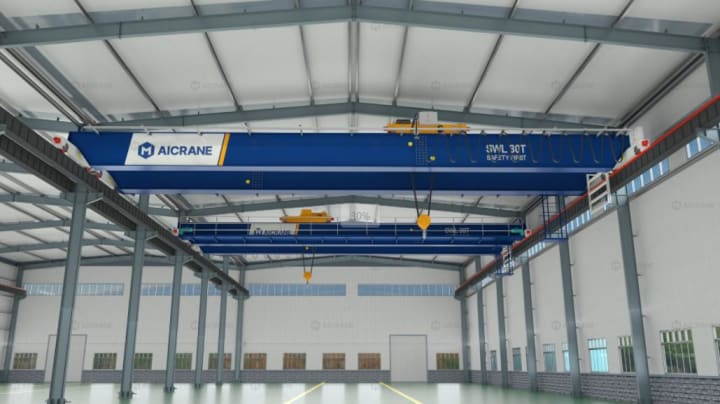
A multi-runway setup refers to configurations where two or more sets of runways are installed within a single bay or across multiple bays. Each runway may support individual cranes or trolley systems, allowing simultaneous or coordinated lifting operations.
These configurations are common in industries where high throughput, flexible logistics, and synchronized material handling operations are critical.
Key Design Considerations
1. Structural Load Distribution
In multi-bay and multi-runway systems, the structural loads on the runway beams, columns, and foundations increase significantly due to:
Multiple cranes operating simultaneously
Lateral and vertical loads due to crane movement
Impact forces from acceleration/deceleration of trolleys and bridges
Designers must ensure that runway girders, support columns, and foundations are engineered to bear the combined loads. Use of finite element analysis (FEA) and simulation software can help model load distribution across all axes.
2. Synchronization and Interlock Systems
When cranes operate across adjacent bays or runways, especially in transfer zones, synchronization becomes critical. Interlocking systems prevent two cranes from colliding when transferring loads across runways or entering shared spaces. Options include:
Mechanical interlocks: Physically restrict crane movement unless conditions are met.
Electronic interlocks and PLCs: Automatically coordinate crane movement based on position sensors.
Zoning systems: Divide crane tracks into zones to ensure only one crane operates in a specific area at a time.
3. Crane Transfer Mechanisms
In many multi-bay systems, it’s necessary to transfer cranes or trolleys from one bay to another. This can be achieved by:
Transfer bridges: Special sections of the structure that allow cranes to travel from one bay to the next.
Rotating girders or turntables: Especially in aerospace or large assembly applications.
Shared runway beams: Enable cranes to span both bays and move across as needed.
These systems require precise design to maintain rail alignment, structural stability, and safety.
4. Control Systems and Operator Interface
In complex layouts, radio remote control and automated control systems are preferred over traditional pendant controls. Advanced systems include:
Load sensing and anti-sway mechanisms
Collision avoidance
Operator visualization via HMI panels or mobile apps
Crane fleet management systems for multi-crane scheduling
Crane controls must be intuitive and responsive to reduce operator fatigue and improve safety in multi-crane environments.
5. Maintenance Access and Safety
With multiple cranes operating in shared spaces, maintenance access becomes more complicated. Design features should include:
Dedicated maintenance walkways
Platforms and ladders for safe inspection of runways and girders
Clearly marked maintenance zones
Power isolation for individual cranes
Safety systems such as emergency stop zones, load monitoring, and overload protection are also vital in multi-crane environments.
Common Configurations and Applications
1. Steel Production and Processing Plants
Facilities often have parallel bays where ladle cranes, charging cranes, and slab handling cranes operate. The cranes must frequently move across bays for various production stages, requiring high-performance transfer mechanisms and heavy-duty structures.
2. Precast Concrete Plants
Multiple bays are used for mold preparation, casting, and storage. Overhead cranes transfer molds or components between bays, with synchronization and precise load handling being crucial.
3. Aircraft and Aerospace Assembly Halls
These large-scale structures use multiple overhead cranes spanning wide bays to position aircraft components. Cranes are often required to perform synchronized lifts across runways and bays, using automated control and anti-sway systems.
4. Shipbuilding Facilities
Overhead gantry cranes operate in large drydock areas with multiple bays. Loads such as engine blocks, hull sections, or steel plates are transferred across bays. These often use tandem lifts, requiring electronic interlock and synchronized lifting.
Challenges in Multi-Bay and Multi-Runway Design
1. Crane-to-Crane Interference
With many cranes working in proximity, the risk of collisions increases. Sophisticated collision detection systems and zoning logic must be implemented to mitigate this risk.
2. Complex Electrical Routing
Power and control cables must be routed across multiple bays and runways. Designers must ensure:
Adequate cable festoon or conductor bar systems
Safe and reliable grounding
Surge protection, especially in outdoor or heavy-duty environments
3. Expansion and Scalability
As businesses grow, they may need to expand crane coverage. Multi-bay systems must be designed with future expansion in mind, including:
Scalable runway length
Modular control systems
Reserved space for new transfer bridges or cranes
Engineering Best Practices
Use Modular Design: Allows for easier expansion, repair, and reconfiguration.
Incorporate Simulation and 3D Modeling: Helps identify structural conflicts and optimize crane movement paths.
Design for Redundancy: Especially in critical applications, dual motors or backup systems prevent downtime.
Consult Multi-Disciplinary Teams: Collaboration between civil, mechanical, and electrical engineers ensures comprehensive design solutions.
Apply Relevant Standards: Follow guidelines from FEM, CMAA, or ISO to ensure safety and compliance.
Conclusion
Overhead crane systems designed for multi-bay and multi-runway installations are key to enabling flexible, high-efficiency material handling in complex industrial environments. By carefully addressing structural demands, synchronized control, safety systems, and scalability, such designs empower companies to streamline production, reduce downtime, and adapt to future growth.
Whether you're constructing a new manufacturing plant or upgrading an existing one, choosing a capable overhead crane design partner with experience in multi-bay and multi-runway solutions is crucial. With the right system in place, your facility can achieve both operational excellence and long-term adaptability.
About the Creator
Aicrane01
Welcome to the Aicrane Blog, your practical guide to lifting solutions. Discover articles covering overhead cranes, gantry cranes, winches, steel structures, boat lifts, and more.
Website: https://steelmillcranes.com/
Risk Management in General Practice vs. Hospital Settings: Accreditation's Role in Mitigation
Risk management is the systematic approach to identifying, assessing, and reducing risks that could impact the safety, quality, and effectiveness of healthcare services. The primary goals are to protect patients and staff, ensure compliance with regulations, and maintain organisational sustainability.
By Angelo Ean5 days ago in Journal
I was in a Toxic Relationship, with my Workplace
“You got that?” My ex yelled. His hands were balled into fists at his side. At six foot three, he towered over me. A normal person would have been afraid, but I looked up a video of George Lopez repeatedly saying, “I got this,” and showed it to him. I had grown used to this treatment, so much so that I didn’t blink when he ripped the phone from my hand and threw it across the room.
By Jade M.5 days ago in Confessions



Comments
There are no comments for this story
Be the first to respond and start the conversation.