
Key Design Parameters That Affect Overhead Crane Performance
How Critical Design Choices Influence Efficiency, Safety, and Longevity

Overhead cranes play a vital role in material handling across various industries such as manufacturing, construction, steel fabrication, and warehousing. These cranes are used to lift and transport heavy loads across a defined path and workspace. However, the performance, safety, and efficiency of an overhead crane are significantly influenced by its design parameters. Understanding these design factors is essential for crane manufacturers, engineers, and end-users to ensure optimal crane performance and longevity.
In this article, we will explore the key design parameters that directly affect overhead crane performance, including span, lifting capacity, duty cycle, lifting height, crane speed, hoist mechanism, bridge design, and structural considerations.
1. Lifting Capacity
Definition
Lifting capacity is the maximum load an overhead crane for sale can safely lift. It is the most fundamental design parameter that defines the crane’s operational limits.
Impact on Performance
Undersizing the lifting capacity can lead to overloading, increasing the risk of accidents and reducing the equipment's lifespan.
Oversizing, on the other hand, may result in unnecessary capital investment and structural reinforcement.
The crane’s capacity also determines the type of hoist and trolley system used, as well as the dimensions of structural elements like girders and end trucks.

2. Span (Crane Width)
Definition
Span refers to the horizontal distance between the centers of the runway rails on which the crane travels. It determines how wide the bridge of the crane needs to be.
Impact on Performance
A wider span requires a more robust structural design to prevent deflection and ensure stability.
Excessive span without appropriate engineering may lead to increased stress on girders, trolley misalignment, and wear on wheels and rails.
The span also affects the layout of the building and the runway beam installation requirements.
3. Lifting Height
Definition
Lifting height is the vertical distance between the ground (or floor) and the hook when it is at its highest position.
Impact on Performance
Determines how deep into a work zone or container the crane can reach.
Important for applications requiring lifting loads from pits, storage racks, or tall machinery.
Affects the size of the building, including clearance and headroom requirements.
4. Duty Cycle (Work Duty / FEM Classification / CMAA Class)
Definition
The duty cycle refers to how frequently the crane is used and the nature of its lifting tasks. Commonly classified using FEM standards or CMAA classes (e.g., CMAA Class C for moderate service, Class D for heavy-duty).
Impact on Performance
Determines the design of motors, brakes, gearboxes, and hoists.
Heavier duty cycles require stronger components, better cooling, and longer service intervals.
A mismatch between actual usage and the crane’s duty rating can cause premature failures and maintenance issues.
5. Crane Speed and Acceleration
Definition
This includes hoisting speed, trolley speed, and bridge travel speed. These determine how fast a load can be lifted and moved across the workspace.
Impact on Performance
High speeds increase productivity but require precision control systems to prevent load swing or misplacement.
Speed affects motor selection, braking system, and the control system (such as VFD – Variable Frequency Drives).
In environments with tight spaces or delicate loads, slower speeds may be more appropriate for safety.
6. Type of Hoist and Trolley Mechanism
Definition
The hoisting system includes the motor, gearbox, drum, wire rope (or chain), and trolley that carries the hoist.
Impact on Performance
Determines lifting speed, smoothness of operation, and load control.
For higher capacities or duty cycles, open winch hoists with separate motors may be preferable over standard wire rope hoists.
Double girder systems can support top-running trolleys, offering increased hook height compared to underslung or single girder setups.
7. Crane Bridge Design (Single vs. Double Girder)
Definition
Overhead cranes can have either one or two main girders supporting the hoist and trolley.
Impact on Performance
Single girder cranes are simpler, lighter, and cost-effective for lower capacity applications.
Double girder cranes are suitable for higher capacities, longer spans, and frequent operation, and offer better hook height.
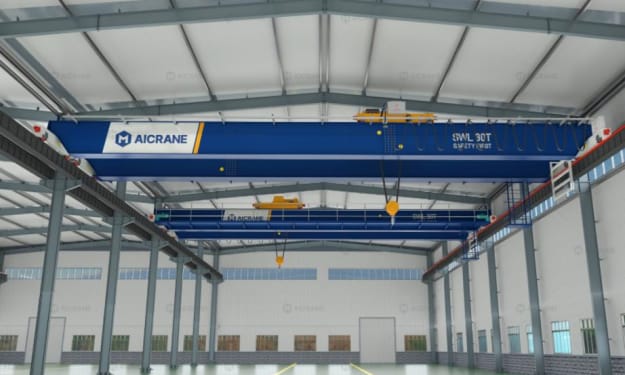
The girder eot crane design impacts the overall crane weight, structural load, and installation requirements.
8. Structural Considerations
Definition
These include material selection, girder dimensions, end truck configuration, runway beam design, and supporting building structure.
Impact on Performance
Material strength (usually steel grade) directly affects load-bearing ability and resistance to fatigue.
Structural rigidity and deflection control ensure that the crane doesn’t bend excessively under load.
Proper support from the building structure or runway beams is essential for long-term stability and safety.
9. Power Supply System
Definition
The power system supplies energy to the crane’s motors. Common systems include conductor bars, festoon systems, or cable reels.
Impact on Performance
A poorly designed power system can cause voltage drops, sparks, or power interruptions, leading to performance issues.
The system must also allow for safe movement and be protected against environmental hazards like dust, moisture, or heat.
10. Control Mode
Definition
Crane control can be handled via pendant control, radio remote control, or a cabin (for large or complex cranes).
Impact on Performance
Remote control allows greater flexibility and safety, especially in hazardous environments.
Cabin control provides the best visibility for the operator in high-capacity operations.
A good control system ensures smooth operation, precise load positioning, and enhanced safety.
11. Environmental and Site-Specific Conditions
Definition
This refers to factors such as ambient temperature, humidity, dust, corrosive atmosphere, and seismic activity.
Impact on Performance
Outdoor cranes or those in corrosive environments (e.g., steel mills, chemical plants) require special protection coatings and sealed components.
Cranes in cold environments may need low-temperature motors and grease to maintain reliability.
Environmental conditions influence both equipment longevity and safety systems.
12. Safety Systems and Standards Compliance
Definition
Incorporating fail-safes like overload limiters, emergency stop systems, anti-collision sensors, and load monitoring devices.
Impact on Performance
Boosts safety and protects both the equipment and operators.
A crane equipped with smart safety features can reduce downtime, prevent accidents, and comply with international standards (e.g., OSHA, ISO, EN).
Conclusion
The performance of an overhead crane is not determined by a single factor but by a carefully balanced combination of design parameters. From lifting capacity and span to control modes and environmental considerations, each parameter must be tailored to the specific application and working environment. When designing or selecting an overhead crane, working closely with an experienced crane manufacturer can ensure these parameters are optimized for long-term safety, efficiency, and performance.
Choosing the right overhead crane design is not only about meeting today’s lifting requirements but also about planning for future scalability, minimizing maintenance costs, and maximizing operational uptime. Whether for light-duty manufacturing or heavy industrial lifting, a properly designed crane is a long-term investment in productivity and workplace safety.
About the Creator
Aicrane01
Welcome to the Aicrane Blog, your practical guide to lifting solutions. Discover articles covering overhead cranes, gantry cranes, winches, steel structures, boat lifts, and more.
Website: https://steelmillcranes.com/
~ Fired ~
— Ai Intrusion ~ Are you Next ~ Is Ai Evolution after your job? — Few workplaces haven't been affected. Ai is in supermarkets, at doctors' offices, and even monitoring farms. I just can't think of anything this machine is not getting into, can you? For instance: Education ~ Law and Tech jobs will one day have a major influence or be taken over by these inanimate machines, with accuracy and vigor. From mechanics' diagnoses to a wide variety of everyday jobs, including fast food workers, with this input having the ability to cut their unnecessary work hours. I'm certain all of us have been touched by this with our short stories and colorful headings, have you? Even comments are very questionable 'Non-Robot' insertions.
By Jay Kantor28 days ago in Journal


Comments
There are no comments for this story
Be the first to respond and start the conversation.