
Non-Invasive Intracranial Pressure Monitoring Device Market on the Rise Through 2030 | Breaking the Skull Barrier
The future of intracranial pressure diagnostics is here, where accuracy meets non-invasiveness. Join us in revolutionizing patient care by leading the charge in adopting non-invasive ICP monitoring devices.

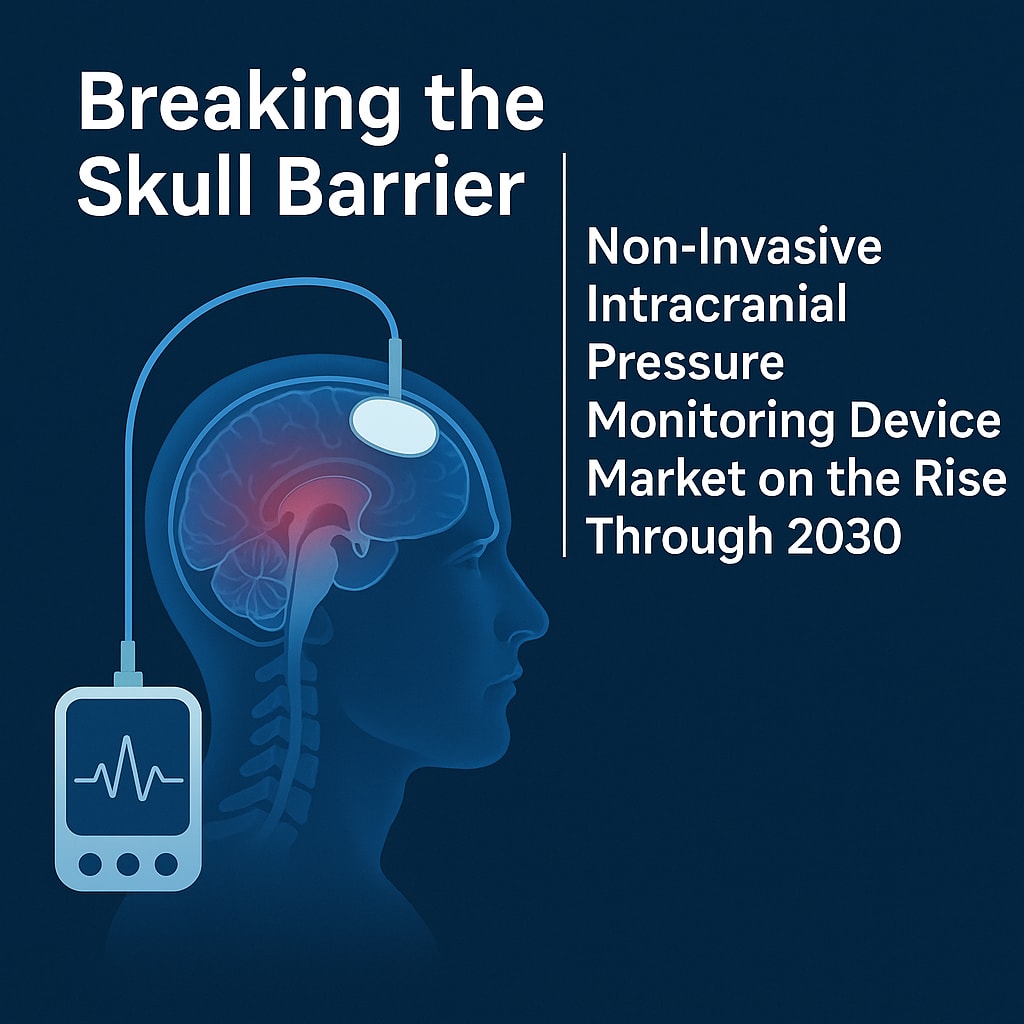
The Non-Invasive Intracranial Pressure (ICP) Monitoring Device Market is experiencing a surge on a global scale. This technology offers a non-invasive alternative for clinicians to measure ICP in patients, where blood vessels, tissues, or cerebrospinal fluid pressurize the brain. Rising awareness, improving accessibility, and digital innovations are driving its demand.
The Global Non-Invasive Intracranial Pressure (ICP) Monitoring Device Market is experiencing a significant surge in recent years. These technologies provide an alternative to the “gold-standard” of brain pressure assessment, which requires invasive catheters in the brain. Driven by an unmet need for safe, fast, and cost-effective neurodiagnostics, this technology is set to redefine critical care and neurodiagnostics for clinicians worldwide.
A Breakthrough in Brain Pressure Monitoring
Clinicians have had only two options for measuring intracranial pressure (ICP), which is a critical parameter for conditions like TBI, hydrocephalus, stroke, or cerebral edema, until recently. Both of these required direct access to the brain through either external ventricular drainage (EVD) or an intraparenchymal catheter.
Non-Invasive ICP Monitoring Devices work by using transcranial Doppler ultrasonography, optic nerve sheath diameter (ONSD), tympanic membrane displacement, or MRI to assess ICP through algorithms or expert-derived cut-offs. These methods are non-invasive, risk-free, repeatable, and patient-friendly. In particular, they have significantly widened the use-cases of ICP monitoring outside the ICU to the outpatient clinic or the Emergency Department for repeated measurements or risk stratification.
Key Factors Driving Market Growth
1. Growing Prevalence of Neurological Disorders
Traumatic brain injury (TBI) and stroke are the top contributors to morbidity and mortality worldwide. Consistent ICP monitoring is critical to optimize the care for these patients, and non-invasive methods allow for rapid screening for elevated pressures.
2. Need for Safer ICP Monitoring Technologies
Hospital systems and payers are holding providers to stricter standards of fewer complications and ICU days. Catheter-related infections or bleeding are serious concerns with ICP monitoring, and non-invasive methods mitigate these risks. This is particularly relevant for high-risk populations, such as pediatric, geriatric, or immunocompromised populations.
3. Digital and AI-powered Innovations
Recent innovations in the field are allowing for less risk of errors and higher clinical validation for non-invasive ICP monitoring. AI-powered algorithms can be used to provide real-time trend analysis or intracranial hypertension (ICH) prediction to support data-driven clinical decisions.
4. Diversification into Sports Medicine and Military Medicine
The clinical use cases of non-invasive ICP monitoring are expanding to other industries, such as battlefield and combat readiness or concussion management in high-risk athletes. Portable systems for out-of-hospital measurement and analysis of ICP are becoming a vital part of field medicine and sports performance protocols.
Regional Analysis
The Non-Invasive Intracranial Pressure (ICP) Monitoring Device Market size is growing at a CAGR of over 7% from 2024 to 2027. North America and Europe are the largest markets in terms of revenue share, due to a strong presence of companies and clinical research, as well as an established healthcare infrastructure and regulatory approvals for these technologies.
Asia Pacific is growing the fastest, due to a higher awareness of TBI and other causes of secondary ICH, as well as greater access to advanced neuroimaging platforms. Additionally, national government initiatives are improving digital healthcare and the availability of portable medical devices.
Market Trends
Integration with Advanced Neuroimaging: Non-invasive ICP monitoring technologies can often be integrated with neuroimaging platforms to allow for easy in-room ICP screening without changing workflows.
Focus on Miniaturization and Portability: Compact, lightweight designs are allowing these technologies to be used more easily in both emergency room and field medicine settings.
Challenges and Key Opportunities
Validation against Invasive ICP Standards: Non-invasive measurements will need to continue to increase their accuracy to gain greater trust from clinicians compared to invasive tools.
Streamlining Regulatory Approvals: Obtaining the necessary regulatory approvals for new technologies can take time and limit the number of regions where they can be sold.
Clinical Training and Adoption: Gaining the trust of clinicians and training them on how to correctly use non-invasive ICP methods and interpret results will be vital for greater adoption.
Competitive Landscape
Key companies include Vittamed, Raumedic AG, HeadSense Medical, InfraScan Inc., and NeMo Devices. Companies are investing in the clinical development of their technologies, such as through conducting clinical trials, and expanding into digital AI-powered analysis platforms and miniaturized sensors for improved device performance and usability.
Future Prospects and Conclusion
The Future of non-invasive ICP monitoring from 2025 to 2030 is likely to see a breakthrough in how clinicians measure brain pressure in both clinical and out-of-hospital settings. Clinicians have had only two options for measuring intracranial pressure (ICP), which is a critical parameter for conditions like TBI, hydrocephalus, stroke, or cerebral edema, until recently. Both of these required direct access to the brain through either external ventricular drainage (EVD) or an intraparenchymal catheter. The market for Non-Invasive ICP Monitoring Devices is set to boom, with increasing penetration in emergency rooms, ICUs, and even in-home or rural settings, as these technologies become more affordable and interoperable.
Conclusion
“Cracking the Skull” has now become a thing of the past. Non-Invasive ICP Monitoring Devices are seeing a surge in the market through 2027. These technologies are gaining ground due to improvements in ease-of-use and diagnostic accuracy, which have made them safer, faster, and more widely accepted as a standard neurocritical care measure for patients with TBI and other neurological disorders. As medical innovations continue to make care more accessible, the market is projected to grow further to 2030, redefining the standards of neurocritical care for clinicians worldwide.
About the Creator
Silvie Karson
Passionate storyteller exploring the world of trends. With a background in digital marketing, I craft compelling narratives that inform and inspire. Whether diving into deep-dive features, growth analysis, or trend analysis.
Keep reading
More stories from Silvie Karson and writers in Journal and other communities.
Draining Pressure, Saving Lives | Acute External Ventricular Drain Market Anticipates Robust Growth Through 2030
The global Acute External Ventricular Drain (EVD) market is set for a healthy growth rate until the year 2030. Factors such as an increase in the burden of neurological disorders, a growing focus on minimally invasive neurosurgical procedures, and greater awareness about intracranial pressure (ICP) management in the intensive care setting are responsible for this market growth.
By Silvie Karson6 months ago in Journal
Why Did the Demogorgon Take Will Byers?
In Stranger Things Season 1, one of the most dramatic and surprising moments is Will Byers' disappearance. This unexpected act not only triggers the narrative but also creates a mystery about the reason for the selection of the fearful Demogorgon to be the victim.
By Lightbringer 5 days ago in Journal




Comments
There are no comments for this story
Be the first to respond and start the conversation.