
NASA astronauts prep ISS for new solar arrays on 5th-ever all-female spacewalk
The two women carried tools and equipment out to the port

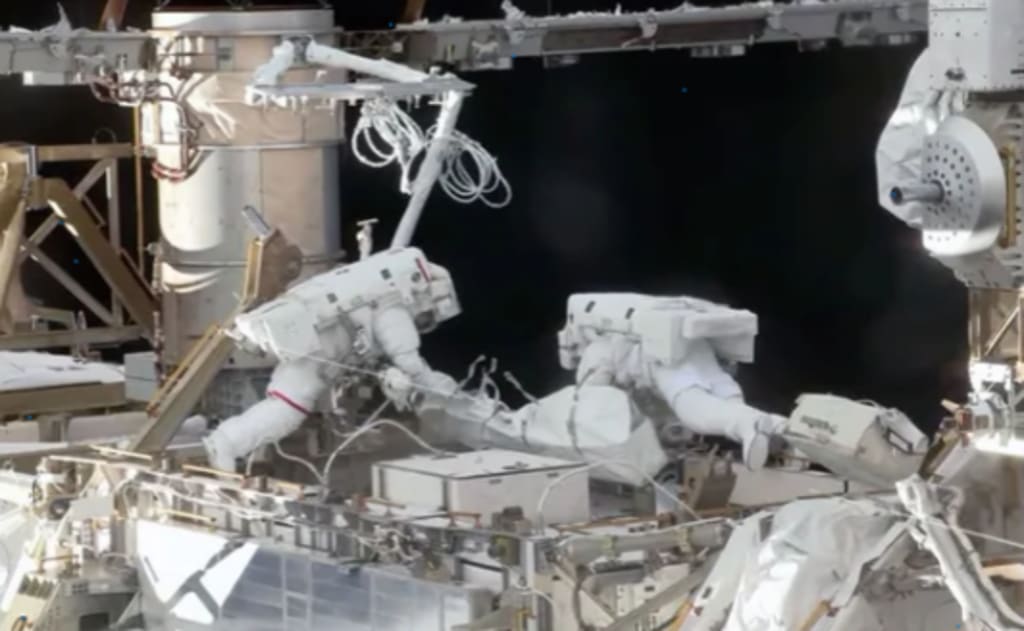
Anne McClain and Nichole Ayers achieved most of their planned tasks on today's (May 1) 5-hour, 44-minute extravehicular activity.
Two NASA astronauts performed history's fifth all-female spacewalk today (May 1), moving an antenna and partially preparing the International Space Station for a new set of solar arrays. Getting started at 9:05 a.m. EDT (1305 GMT), the two women carried tools and equipment out to the port (or left) side of the space station's backbone truss, where they got to work assembling the attachment hardware for the seventh pair of International Space Station Rollout Solar Arrays, or IROSA, which will be installed after they arrive on a SpaceX Dragon commercial resupply services mission later this year. When complete, the new smaller, but more efficient, solar arrays will boost electricity generation capability by up to 30%, increasing the station's total available power from 160 to up to 215 kilowatts. McClain and Ayers built and mounted the upper triangle of the mast canister modification kit, as well as the right struts, but then were instructed to clean up their workstations and move on to the next, higher priority task.
"We have reached the min config and have decided to clean up and prioritize the C2V2 [Common Communications for Visiting Vehicles]," mission control at NASA's Johnson Space Center in Houston advised the two spacewalkers. Expedition 73 crewmates Anne McClain and Nichole Ayers competed a 5-hour, 44-minute extravehicular activity (EVA, or spacewalk) at 2:49 p.m. EDT (1849 GMT) today, after they reentered the station's Quest airlock and it began to be re-pressurized. McClain and Ayers accomplished most of what they set out achieve today, but running late on their timeline and with limited consumables, they had to defer some of the tasks to a later spacewalk.
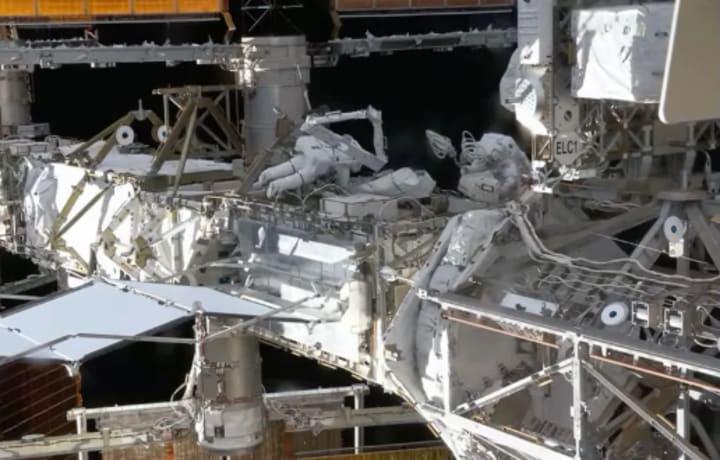
The astronauts stowed their equipment and McClain repositioned a foot restraint. She and Ayers then met at the P3 truss segment, also on the left side of the International Space Station. There they relocated an antenna used by Northrop Grumman's Cygnus cargo vehicles when they come to resupply the space station. With the limited time remaining in the EVA, the astronauts wrapped up their work by tackling a couple of "get ahead" tasks. While Ayers ran and attached a jumper cable to convert DC power from the U.S. operating segment's P6 truss to the Russian segment of the space station, McClain worked on releasing bolts on a micro-meteoroid debris cover to prep it for future work.
"With this year being the 25th anniversary of a continuous human presence in space, it seems fitting that we are continuing to upgrade the ISS to keep it alive through 2030," Ayers radioed to mission control after she was back inside the airlock. "We're honored to be a small part of a much larger team that facilitates the ground-breaking science that we perform on the national lab that is the International Space Station."
"What we accomplish here not only furthers our efforts to return to the moon and go on to Mars, but informs how we do life on Earth," said Ayers.
*#**This spacewalk was McClain's third and the first for Ayers. McClain has now logged a total of 18 hours and 52 minutes outside the space station. This was the 93rd EVA to be staged from the U.S. Quest airlock and the 275th overall in support of the assembly, maintenance and upgrade of the ISS, which has been continuously occupied by rotating astronaut crews since November 2000.
The first all-female EVA was performed by NASA astronauts Christina Koch and Jessica Meir in October 2019. That duo conducted two more spacewalks together in January 2020, and NASA's Jasmin Moghbeli and LoraNASA astronauts Anne McClain and Nichole Ayers concluded their spacewalk at 2:49 p.m. EDT. The total time was 5 hours and 44 minutes. It was the third spacewalk for McClain and the first for Ayers, and the 275th spacewalk in support of space station assembly, maintenance, and upgrades. Launched on March 11, NASA’s SPHEREx space observatory has spent the last six weeks undergoing checkouts, calibrations, and other activities to ensure it is working as it should. Now it’s mapping the entire sky — not just a large part of it — to chart the positions of hundreds of millions of galaxies in 3D to answer some big questions about the universe. On May 1, the spacecraft began regular science operations, which consist of taking about 3,600 images per day for the next two years to provide new insights about the origins of the universe, galaxies, and the ingredients for life in the Milky Way.
Thanks to the hard work of teams across NASA, industry, and academia that built this mission, SPHEREx is operating just as we’d expected and will produce maps of the full sky unlike any we’ve had before,” said Shawn Domagal-Goldman, acting director of the Astrophysics Division at NASA Headquarters in Washington. “This new observatory is adding to the suite of space-based astrophysics survey missions leading up to the launch of NASA’s Nancy Grace Roman Space Telescope. Together with these other missions, SPHEREx will play a key role in answering the big questions about the universe we tackle at NASA every day.”
McClain and Ayers completed their primary objectives, including relocating a space station communications antenna and the initial mounting bracket installation steps for an IROSA that will arrive on a future SpaceX commercial resupply services mission. Additionally, the astronaut pair completed a pair of get ahead tasks, including installing a jumper cable to provide power from the P6 truss to the International Space Station’s Russian segment and another to remove bolts from a micrometeoroid cover. “We’re going to study what happened on the smallest size scales in the universe’s earliest moments by looking at the modern universe on the largest scales,” said Jim Fanson, the mission’s project manager at NASA’s Jet Propulsion Laboratory in Southern California. “I think there’s a poetic arc to that.” From its perch in Earth orbit, SPHEREx peers into the darkness, pointing away from the planet and the Sun. The observatory will complete more than 11,000 orbits over its 25 months of planned survey operations, circling Earth about 14½ times a day. It orbits Earth from north to south, passing over the poles, and each day it takes images along one circular strip of the sky. As the days pass and the planet moves around the Sun, SPHEREx’s field of view shifts as well so that after six months, the observatory will have looked out into space in every direction. Cosmic inflation subtly influenced the distribution of matter in the universe, and clues about how such an event could happen are written into the positions of galaxies across the universe. When cosmic inflation began, the universe was smaller than the size of an atom, but the properties of that early universe were stretched out and influence what we see today. No other known event or process involves the amount of energy that would have been required to drive cosmic inflation, so studying it presents a unique opportunity to understand more deeply how our universe works. When SPHEREx takes a picture of the sky, the light is sent to six detectors that each produces a unique image capturing different wavelengths of light. These groups of six images are called an exposure, and SPHEREx takes about 600 exposures per day. When it’s done with one exposure, the whole observatory shifts position — the mirrors and detectors don’t move as they do on some other telescopes. Rather than using thrusters, SPHEREx relies on a system of reaction wheels, which spin inside the spacecraft to control its orientation. Hundreds of thousands of SPHEREx’s images will be digitally woven together to create four all-sky maps in two years. By mapping the entire sky, the mission will provide new insights about what happened in the first fraction of a second after the big bang. In that brief instant, an event called cosmic inflation caused the universe to expand a trillion-trillionfold.
**Some of us have been working toward this goal for 12 years,” said Jamie Bock, the mission’s principal investigator at Caltech and JPL. “The performance of the instrument is as good as we hoped. That means we’re going to be able to do all the amazing science we planned on and perhaps even get some unexpected discoveries.**
About the Creator
Keep reading
More stories from Md. Rasel Ahmed and writers in Journal and other communities.
India Pakistan News: LOC heated up, Indus Treaty suspended and war looms
India Pakistan News: LOC heated up, Indus Treaty suspended and war looms Tensions between India and Pakistan continue to escalate, with the Line of Control (LoC) in Kashmir witnessing a third consecutive night of clashes. The tension has spilled over into political, diplomatic and water-related issues. The situation has become more dire after 26 people were killed in an attack on tourists in Pahalgam, Kashmir. India-Pakistan relations are currently facing a new crisis.
By Md. Rasel Ahmed9 months ago in Journal
The goals I did not achieve
Every writing goal I made for the year is a wash. It has been this way for a while, but I think it's important to be open about my failures and the reality of how life can get in the way. This is especially true considering the several times I have posted on Vocal about my writing goals, how I was changing my approach, and where I was hoping to be for the upcoming year. I will probably do that again in a couple months, but for now, it is time to acknowledge where I am today.
By Kay Husnick23 days ago in Journal
The Councils of the Church and Why They Were Important
The Catholic Church has faced countless challenges since its founding, from doctrinal disputes to external persecution. One of the most important ways the Church has maintained unity, clarified its teachings, and preserved the faith is through ecumenical and local councils. Church councils are formal gatherings of bishops and Church leaders to deliberate on matters of doctrine, discipline, and practice. These gatherings have shaped Christianity as we know it today, ensuring that the Church remains faithful to the teachings of Christ and the apostles.
By Sound and Spirit5 days ago in Journal
Ludacris and Nelly draw backlash over bookings at MAGA-coded music festival
Ludacris and Nelly headlining a mostly right-wing event is good for them. It’s also great for the genre of hip hop. The two rap veterans have showcased their talents on other stages. Why can’t they perform for mostly MAGA folks and grab that bag?
By Skyler Saunders3 days ago in Beat


Comments
There are no comments for this story
Be the first to respond and start the conversation.