
Motor Protection Circuit Breakers vs. Overload Relays: Key Differences Explained
MPCB vs Overload Relay

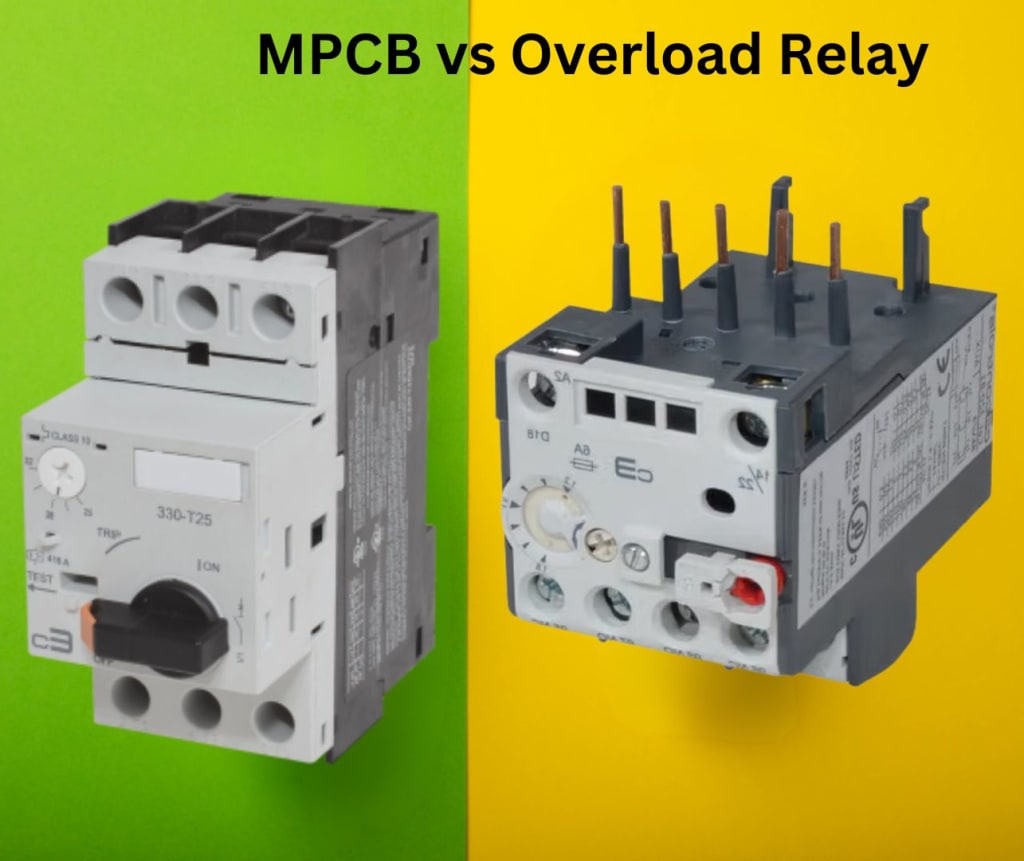
When it comes to protecting electric motors from potential damage caused by faults or overloads, two of the most commonly used devices are Motor Protection Circuit Breakers (MPCBs) and Overload Relays. Both are essential in ensuring the longevity and safe operation of motors, but they function differently and serve distinct purposes. In this guide, we will explore the key differences between these two devices, helping you choose the right solution for your motor protection needs.
Understanding Motor Protection Requirements
Before diving into the specifics of Motor Protection Circuit Breakers and Overload Relays, it’s important to understand the basic requirements for motor protection. Electric motors are integral components in many industries, powering machines, pumps, fans, compressors, and more. However, these motors are susceptible to various forms of damage, such as overloads, short circuits, and phase failures, which can reduce their lifespan and lead to costly repairs.
Motor protection devices are used to safeguard the motor from such damage. They monitor the electrical parameters (such as current, voltage, and temperature) that indicate potential issues. By providing automatic disconnection or control, these devices prevent the motor from running under harmful conditions, ensuring both the protection of the motor and the overall system.
How Motor Protection Circuit Breakers Work?
Motor Protection Circuit Breakers (MPCBs) are designed to protect motors from short circuits, overloads, and other electrical faults. These devices combine the functions of a circuit breaker and a motor protection relay into one compact unit, offering both protection and control for the motor.
Short Circuit Protection: MPCBs are designed to detect short circuits, which occur when there is a direct connection between two conductors at different potentials. This can cause a surge of current that can damage the motor or electrical components. When a short circuit is detected, the MPCB automatically trips, cutting off power to the motor and preventing further damage.
Overload Protection: MPCBs also protect the motor from excessive current draw due to overloads. Overloads occur when the motor is required to perform more work than its rated capacity, leading to increased current flow. The MPCB monitors the current drawn by the motor and trips if it exceeds the preset value for a certain amount of time.
Phase Failure Protection: Another important feature of MPCBs is phase failure protection. If the motor experiences a loss of one phase in a three-phase system, the MPCB will disconnect the motor to prevent it from running in an unbalanced state, which could cause overheating and damage.
Thermal Protection: MPCBs include thermal overload protection, which is crucial for preventing motor overheating. If the motor runs at an excessive current level for an extended period, the device will trip to avoid thermal damage.
Advantages of Motor Protection Circuit Breakers
MPCBs offer several advantages that make them the preferred choice in many motor protection applications:
Comprehensive Protection: MPCBs provide protection against multiple fault conditions, including short circuits, overloads, phase failure, and thermal overloads, all in one device. This comprehensive protection reduces the need for multiple protection devices and simplifies the overall system design.
Adjustable Settings: Many MPCBs come with adjustable settings that allow you to customize the protection parameters, such as the overload trip point and time delay. This makes it easier to tailor the device to the specific motor requirements, ensuring optimal protection.
Easy Installation and Maintenance: MPCBs are generally easy to install and require minimal maintenance. Their compact design and integration of multiple protection functions make them a convenient solution for motor protection.
Cost-Effective: Since MPCBs combine the functionality of both a circuit breaker and a motor protection relay, they can be a cost-effective solution, as you only need to purchase one device instead of two separate ones.
Enhanced Motor Lifespan: By providing reliable protection, MPCBs help extend the life of the motor by preventing it from running in potentially damaging conditions. This results in fewer repairs and replacements, leading to long-term savings.
Limitations of Motor Protection Circuit Breakers
Despite their many advantages, MPCBs do have a few limitations that should be considered:
- Slow Response to Temporary Overloads: MPCBs have a time-delay feature that allows them to ignore brief overload conditions that might occur during normal motor startup or operation. However, if these overloads are prolonged beyond the time delay, the motor may still be at risk before the MPCB trips.
- Potential for Incorrect Setting: If the overload settings on the MPCB are not correctly adjusted for the motor's rating or specific application, the motor could be either overprotected (tripping unnecessarily) or underprotected (allowing damage to occur). Proper calibration is crucial.
- Limited Adjustment for Complex Motor Types: While MPCBs offer adjustable settings, they might not provide the fine-tuned customization needed for specialized or non-standard motor applications. For example, highly sensitive or precision motors might need more specific protections than what a standard MPCB can offer.
- Higher Initial Cost: Although MPCBs are cost-effective in the long run due to their all-in-one functionality, their initial purchase cost is often higher than that of simpler devices like overload relays or basic circuit breakers.
- Limited Protection Against Electrical Surges: MPCBs are designed to protect against overloads and short circuits, but they may not offer adequate protection against electrical surges, spikes, or transient voltage events that could harm the motor or associated equipment. Additional surge protection devices might be necessary.
- Size and Bulk: Some MPCBs, especially those rated for larger motors, can be bulky and may not fit into space-constrained control panels. For some applications, this may be a disadvantage compared to smaller protection devices like overload relays.
- Not Suitable for All Motor Types: MPCBs are often optimized for standard industrial motors, but they may not provide optimal protection for specialized motor types like servo motors or variable frequency drive (VFD) motors, which may require more advanced or customized protection methods.
- Possible Reset Issues: In some cases, if the MPCB trips due to a fault, it may require manual intervention to reset. In an automated process, this could result in unnecessary downtime or production delays until the issue is resolved.
How do Overload Relays Work?
Overload relays, on the other hand, are designed specifically to protect motors from overload conditions. These devices are typically used in combination with a contactor to form a complete motor control and protection system.
- Monitoring Motor Current: Overload relays work by monitoring the current drawn by the motor. If the current exceeds the rated value for an extended period, the relay will trip, cutting off power to the motor.
- Thermal Sensing: The most common type of overload relay uses a thermal sensing element, such as a bimetallic strip, to detect temperature increases due to excessive current. As the motor operates under overload conditions, the current increases, causing the temperature to rise. The bimetallic strip bends when it reaches a certain temperature, triggering the relay to trip.
- Manual or Automatic Reset: Overload relays can be reset either manually or automatically, depending on the application. In some cases, the relay must be reset by an operator after the overload condition is resolved, while in others, the relay can reset itself once the motor cools down and returns to normal operation.
Advantages of Overload Relays
Overload relays are commonly used in motor protection for several reasons:
- Simple and Effective: Overload relays are simple devices that focus solely on protecting the motor from overload conditions. Their straightforward design makes them easy to install and maintain, offering a reliable solution for basic overload protection.
- Cost-Effective: Compared to MPCBs, overload relays are generally less expensive, making them a cost-effective solution for applications where only overload protection is required.
- Wide Compatibility: Overload relays can be used with a wide range of motors, including both AC and DC motors. They are highly adaptable and can be adjusted to accommodate different motor ratings and overload conditions.
- Reliability: Overload relays are generally very reliable, providing consistent performance under normal operating conditions. They can protect motors from prolonged overloads, which could otherwise lead to overheating and damage.
Limitations of Overload Relays
Although overload relays offer key benefits, they come with some limitations:
- Lack of Short Circuit Protection: Overload relays are designed specifically to protect motors from overheating due to prolonged overload conditions. They do not provide any protection against short circuits, which can lead to severe damage or even fire hazards. A separate short circuit protection device, such as a circuit breaker, is necessary.
- Limited Protection Scope: Overload relays focus primarily on motor overheating due to excessive current. They do not protect against other fault conditions like phase failure, voltage imbalance, or under-voltage conditions, which can also damage the motor.
- Susceptible to Environmental Conditions: Overload relays, particularly thermal-based ones with bimetallic strips, can be sensitive to environmental conditions such as temperature, humidity, and vibration. Extreme changes in temperature or moisture can affect the performance and accuracy of the thermal sensor, leading to false trips or failure to trip.
- Manual Reset Requirements: Overload relays typically require manual resetting after they trip. This can be inconvenient in systems where immediate reactivation is needed, or in automated environments where human intervention might not be readily available. This downtime could be costly, especially in critical applications.
- Temperature-Dependent Accuracy: The bimetallic strip used in many overload relays relies on thermal expansion to detect overloads. This method can be influenced by ambient temperature. In very hot or cold environments, the accuracy of the relay may be compromised, potentially leading to premature or delayed trips.
- Slower Response to Large Overloads: While overload relays protect against prolonged excess current, they may not respond quickly enough to large, sudden overloads or short-term current spikes, such as those caused by startup or unexpected mechanical failures.
- Not Suitable for High-Speed or Sensitive Motors: Overload relays are generally not suitable for protecting high-speed or sensitive motors where the motor's current draw changes rapidly, and precise protection is necessary. For such applications, more specialized protection methods, such as digital motor protection relays, might be more appropriate.
- No Built-in Phase Failure Protection: Unlike MPCBs, many overload relays do not have built-in phase failure protection. This means they cannot detect a loss of one phase in a three-phase system. Phase loss protection is essential for safeguarding motors from running in an unbalanced condition, which can cause overheating and damage.
- Potential for Nuisance Trips: Overload relays that rely on temperature-based sensing might trip even in situations where the overload is brief or transient. This could result in unnecessary shutdowns or operational interruptions, especially in motors that experience short-term overloads as part of normal startup procedures.
- Limited Flexibility for Motor Types: While overload relays can be used for many motors, they may not offer the flexibility needed for complex systems that require a high level of customization. Motors used in high-precision or high-power applications may need more advanced protection mechanisms.
Choosing Between Motor Protection Circuit Breakers and Overload Relays
When choosing between an MPCB and an overload relay, several factors should be considered:
- Motor Type and Application: If you need comprehensive protection for your motor against short circuits, overloads, and phase failures, an MPCB is the better choice. It is particularly suitable for motors in more complex or critical applications. On the other hand, if your primary concern is protecting the motor from overload conditions, a simple overload relay may suffice.
- Cost Considerations: If budget is a major consideration, overload relays are typically less expensive and can be used in situations where overload protection is the only requirement. However, if you need more robust protection, an MPCB may justify the higher initial cost due to its all-in-one functionality.
- Simplicity vs. Versatility: Overload relays offer a straightforward solution with fewer features, making them ideal for basic applications. However, MPCBs are more versatile, offering protection for a wide range of fault conditions and a more comprehensive approach to motor protection.
- Space and Integration: If space is limited or you want to minimize the number of components in your system, MPCBs are a good choice, as they combine several protection functions in one device. Overload relays may require additional components, such as circuit breakers, to provide full protection.
Both Motor Protection Circuit Breakers and Overload Relays play essential roles in safeguarding motors from damage, but they differ significantly in terms of functionality and scope of protection. MPCBs provide more comprehensive protection, including short circuit, overload, and phase failure protection, making them suitable for a wide range of applications. Overload relays, while simpler and more cost-effective, are primarily focused on protecting against overload conditions.
Ultimately, the choice between an MPCB and an overload relay depends on the specific motor protection requirements, budget, and application complexity. For those looking for a more all-encompassing solution with added safety features, an MPCB is the ideal choice. For basic overload protection, an overload relay can provide an effective, cost-efficient solution.
By understanding the key differences between these devices and evaluating the needs of your application, you can ensure the best protection for your motor and maximize its performance and lifespan.
About the Creator
Jason Sky
Hey, I am Jason Sky, and I'm an electrical engineer with over a decade of experience in the field. I'm proud to say that I've played a key role in many significant projects over the years.
The Truth Behind the Earnings of Cross - border Sales Champions
A cross - border e - commerce sales champion once put it bluntly: Sales is never simply about selling products. Instead, it involves precisely providing emotional value and continuously delivering tangible benefits. Mastering this field not only enables rapid monetisation but also accumulates the most crucial confidence for entrepreneurship. Most people only focus on the surface of successful transactions, failing to understand the underlying logic.
By Lady Alkaid2 days ago in Journal




Comments
There are no comments for this story
Be the first to respond and start the conversation.