
Mexican Crude Exports Fall to Record Low, Domestic Refining Holds: Government Data
Shifting energy priorities, refinery upgrades, and production constraints reshape Mexico’s oil balance amid global market uncertainty
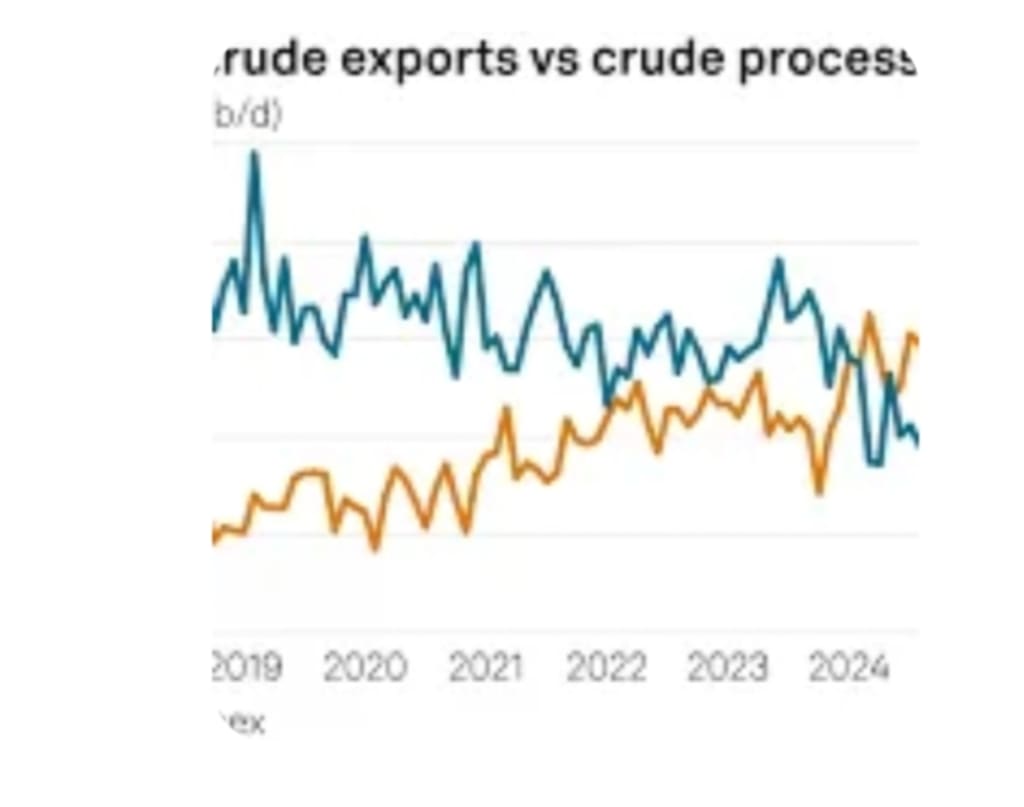
Mexico’s crude oil exports have fallen to a record low, according to newly released government data, signaling a major shift in the country’s energy strategy. While shipments abroad decline, domestic refining activity has held steady — a development officials say reflects a deliberate pivot toward energy self-sufficiency rather than export dependency.
The figures, released by Petróleos Mexicanos (Pemex) and Mexico’s Energy Ministry, reveal a significant rebalancing of crude flows. For decades, Mexico relied heavily on exporting crude — particularly to the United States — while importing refined fuels such as gasoline and diesel. That model now appears to be undergoing structural change.
Exports at Historic Lows
Government statistics show crude exports dropping to their lowest recorded monthly level in modern tracking history. Analysts attribute the decline to several overlapping factors: reduced upstream production, increased domestic refinery intake, and evolving policy priorities under the administration of Andrés Manuel López Obrador.
During his tenure, López Obrador repeatedly emphasized strengthening Mexico’s refining capacity to reduce fuel imports and insulate the country from global supply shocks. Although critics questioned the economic feasibility of this strategy, recent data suggests that more crude is indeed being processed at home rather than shipped overseas.
Historically, Mexico exported well over one million barrels per day at its peak. Today, that figure has fallen dramatically, with shipments to the United States — once Mexico’s primary customer — shrinking in tandem.
Domestic Refining: Holding Steady
While exports decline, domestic refining throughput has remained comparatively stable. Pemex reports that refinery utilization rates have improved relative to previous years, following maintenance programs and operational adjustments at key facilities.
Mexico operates six primary refineries within its National Refining System, including the large complex in Tula. In addition, the government has heavily promoted the Olmeca refinery at Dos Bocas in Paraíso, a flagship project aimed at boosting national processing capacity.
Although full operational output at Dos Bocas has progressed more gradually than initially projected, officials maintain that increased domestic refining has helped offset declining export volumes.
Energy authorities argue that prioritizing domestic processing enhances fuel security, particularly during periods of international price volatility or geopolitical tension.
Production Constraints Remain a Challenge
Despite the refining shift, Mexico’s overall crude production remains constrained. Pemex has faced declining output for years due to aging offshore fields in the Gulf of Mexico and underinvestment in exploration during previous administrations.
Efforts to stabilize production through new field development have produced mixed results. While some shallow-water projects have delivered incremental gains, output has not returned to historic highs.
The combination of lower production and higher domestic refinery intake naturally reduces exportable surplus. For international buyers, this shift alters regional supply flows, particularly in the U.S. Gulf Coast market where Mexican heavy crude has traditionally played a crucial role.
Market Implications
Mexico’s crude exports — especially its Maya heavy blend — have long been a staple feedstock for U.S. refiners configured to process heavier grades. A sustained reduction in Mexican supply could encourage U.S. refiners to seek alternative sources, including Canada, Colombia, or Middle Eastern producers.
At the same time, global oil markets remain sensitive to supply disruptions. Reduced Mexican exports, while modest relative to total global output, contribute to tightening heavy crude availability in certain regions.
Energy analysts note that Mexico’s pivot mirrors broader debates worldwide about resource nationalism versus export-driven strategies. Countries rich in natural resources increasingly face pressure to balance domestic economic goals with global market participation.
The Self-Sufficiency Argument
The Mexican government frames the export decline not as a weakness but as evidence of strategic realignment. By refining more crude domestically, officials argue, Mexico reduces its reliance on imported fuels and retains greater value within its borders.
For decades, Mexico exported crude at international prices only to import gasoline at higher refined-product costs — a trade structure critics described as economically inefficient. Expanding refining capacity, in theory, keeps more of the value chain within the national economy.
However, economists remain divided. Refining margins fluctuate, and large state-run refinery investments require sustained efficiency to remain competitive. Some analysts caution that if domestic refining proves less profitable than exporting crude, the fiscal impact on Pemex — already one of the world’s most indebted oil companies — could be significant.
Financial Pressures on Pemex
Petróleos Mexicanos continues to navigate heavy debt burdens while balancing production goals and refinery upgrades. The company has received repeated financial support from the federal government, including tax relief and capital injections.
Declining exports may reduce foreign currency earnings, adding pressure to the company’s financial structure. However, if domestic fuel sales increase and import costs decline, some of that impact could be offset.
Credit rating agencies are closely monitoring how sustained lower export volumes affect cash flow, especially in a global oil market characterized by fluctuating prices and energy transition pressures.
Energy Transition Context
Mexico’s oil policy developments occur against the backdrop of a global energy transition. While many countries are accelerating renewable energy investment, oil remains a major revenue source for Mexico’s public finances.
Balancing hydrocarbon development with climate commitments presents an ongoing policy tension. Critics argue that heavy investment in refining may conflict with long-term decarbonization goals. Supporters counter that energy sovereignty remains essential during transitional decades.
For now, crude oil continues to play a central role in Mexico’s economic strategy.
Regional and Political Dimensions
Energy policy in Mexico is deeply intertwined with national identity and political discourse. Oil was nationalized in 1938, forming the foundation of Pemex and symbolizing economic independence.
Current policies emphasize restoring state control and reducing private-sector influence in energy markets. This ideological framework informs decisions about exports, refinery construction, and upstream investment priorities.
As Mexico approaches new political cycles, future administrations may revisit aspects of the strategy, particularly if market dynamics shift or fiscal pressures intensify.
What Comes Next?
Several key questions will determine whether the export decline represents a temporary dip or a structural transformation:
Can Pemex stabilize or grow crude production?
Will domestic refineries consistently operate at higher efficiency levels?
How will global oil prices influence export incentives?
Will fuel import reductions offset export revenue losses?
If refining capacity continues to expand and production remains stable, Mexico could permanently reposition itself as a more domestically oriented oil economy.
However, if output declines further, both exports and refinery utilization could face constraints.
A Structural Shift in Progress
The record low in crude exports marks a significant milestone in Mexico’s energy evolution. Whether viewed as strategic recalibration or economic risk, the data reflects a nation actively redefining its oil balance.
Domestic refining is holding — at least for now — even as exports shrink. For policymakers, the challenge lies in sustaining operational efficiency, managing financial risks, and navigating a volatile global market.
Mexico’s oil story has always been one of transformation. The latest government data suggests another chapter is unfolding — one that could reshape not only export statistics, but the country’s long-term energy trajectory.
About the Creator
Jobs in Antarctica 2026: Work at British and US Research Stations – Chefs, Carpenters, Electricians Wanted No Science Degree Needed
Britain and the United States are both looking for new employees for their research stations in Antarctica. You don’t have to be a scientist to get a job there, as they also need carpenters, electricians, chefs, and even barbers.
By Real content5 days ago in Journal



Comments
There are no comments for this story
Be the first to respond and start the conversation.