
Mental Health in Focus: Anxiety and Depression Treatment Market Grows to $19.28 Billion – Driven by SSRIs, Therapy Tech, and Major Players Like Johnson & Johnson and AbbVie
Anxiety disorders and depressive disorders are among the most common mental health conditions, with over 280 million affected individuals globally.

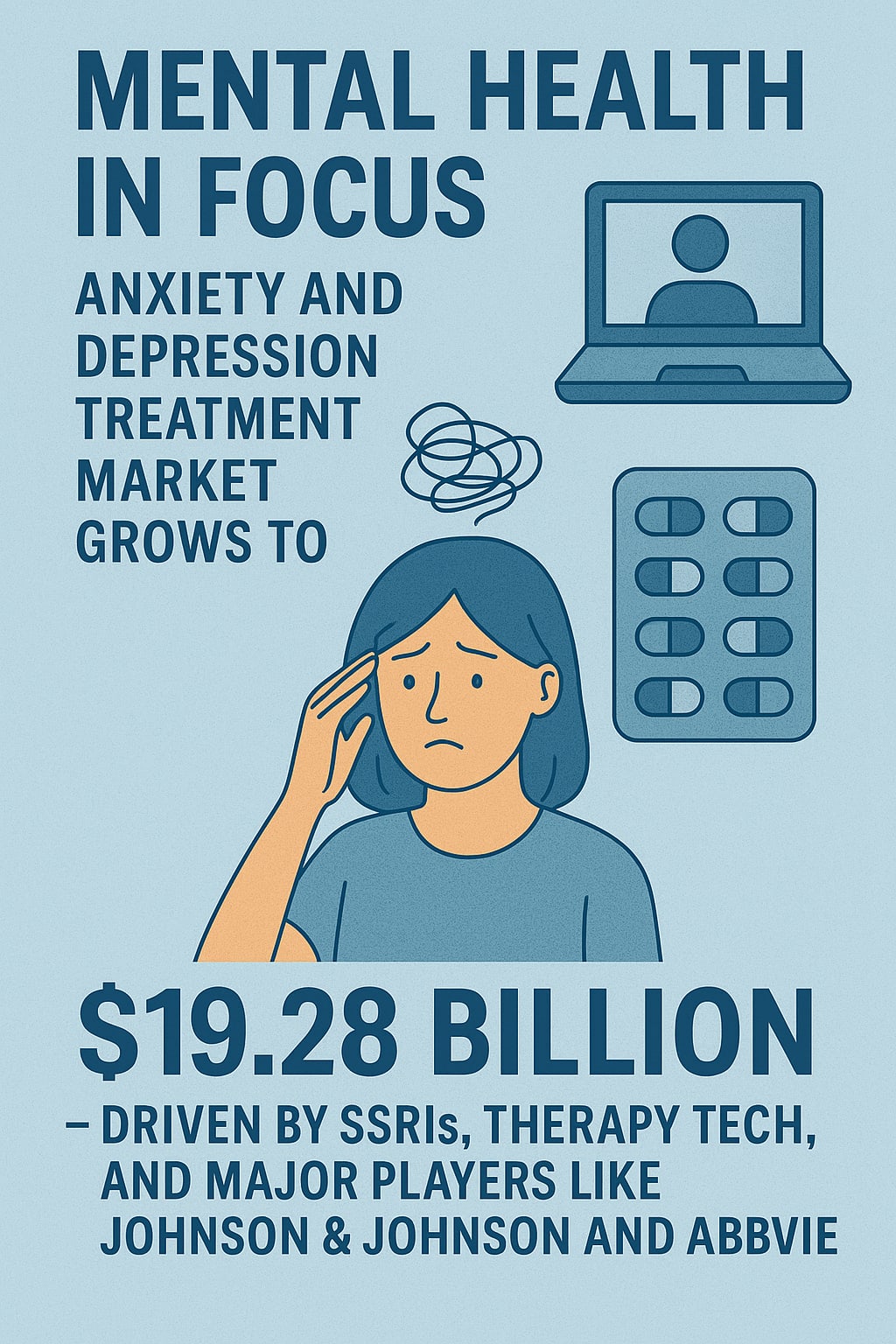
The global anxiety and depression treatment market size is now at $19.28 billion by 2030 as mental health is increasingly recognized as a priority for public health. Demand is growing as a result of rising diagnoses, changing attitudes, and access to digital therapy platforms. Selective serotonin reuptake inhibitors, cognitive behavioral therapies, and new treatment modalities are leading the way. Companies such as Johnson & Johnson and AbbVie are actively pursuing drug launches, innovation pipelines, and investments.
Big Issues. Big Opportunities.
The number of anxiety and depression diagnoses are growing worldwide
The pandemic has increased mental health awareness and prevalence due to social isolation, economic uncertainty, and lifestyle stress.
Governments, employers, and healthcare systems are ramping up investments in screening, access to treatment, and integration into overall healthcare, further increasing demand for both pharmaceutical and non-pharmaceutical interventions.
Drivers:
Diagnosis and Awareness
With less stigma and greater public education, more people are seeking treatment for mental health conditions, leading to a larger market for prescription drugs as well as digital therapy platforms.
Strong demand for SSRIs and SNRIs
Selective serotonin reuptake inhibitors (SSRIs: sertraline, fluoxetine, escitalopram) and serotonin/norepinephrine reuptake inhibitors (SNRIs: duloxetine, venlafaxine) remain the first line of pharmacological defense. They are generally safe and effective for moderate to severe anxiety and depression.
Therapy Goes Digital
Telepsychiatry and mental wellness platforms are being adopted at a rapid rate. BetterHelp, Talkspace, and Headspace are popular apps that make therapy affordable and convenient, and they can be combined with medication delivery, reshaping access to care.
New Treatment Modalities
The market is seeing interest in psychedelic-assisted therapy (psilocybin, ketamine) and neuromodulation (transcranial magnetic stimulation, vagus nerve stimulation) for treatment-resistant depression.
Employers are Offering Mental Health Programs
Companies are starting to include employee mental health services in benefits packages. This includes access to apps-based therapy, resilience training programs, and subsidized medications.
Segments:
Pharmaceuticals: Continue to dominate the market, particularly SSRIs and atypical antidepressants. Long-term use and maintenance is common for recurrent or chronic conditions.
Psychotherapy Services: Delivering these via digital channels to expand reach and affordability.
Digital Therapeutics (DTx): App-based interventions are gaining FDA clearances and are increasingly being used to complement overall treatment plans.
Industry Leaders:
Johnson & Johnson is expanding its neuroscience business. Its esketamine nasal spray Spravato has been gaining momentum for treatment-resistant depression.
AbbVie, which acquired Allergan, has a strong antidepressant and anxiety portfolio. Vraylar (cariprazine) is used as adjunctive therapy for major depressive disorder and bipolar depression.
Pfizer and Eli Lilly remain major players with their legacy SSRI/SNRI products, as well as R&D pipelines for next generation compounds.
Axsome Therapeutics and Sage Therapeutics are biotech companies developing novel antidepressants, including NMDA receptor modulators and neuroactive steroid-based treatments.
Regional Analysis
North America is the largest market by share due to the highly developed healthcare system, high mental health awareness, and early adoption of telehealth technologies. Europe is second, supported by progressive mental health policies and reimbursement structures. Asia-Pacific is the fastest-growing market, where stigma around mental health is declining and digital health is being rapidly adopted. Countries like Japan, South Korea, and India are particularly important here.
Obstacles and Potential
Side Effects and Non-Response: The first line of antidepressants often have side effects and uneven efficacy, particularly in treatment-resistant depression. This is driving demand for more personalized and innovative treatments.
Access and Affordability: Access to treatment remains a challenge in underserved and low-income communities, presenting an opportunity for more scalable and affordable care delivery models.
Privacy and Data in Digital Therapy: As mental health apps play a bigger role in care, secure handling of sensitive data becomes increasingly important.
Conclusion
At $19.28 billion, the anxiety and depression treatment market is at a critical juncture. Science, technology, and society are aligning to reduce stigma and improve care for anxiety and depression. Leading companies like Johnson & Johnson and AbbVie are already part of this transformation, helping to drive better outcomes with new therapies and a holistic approach to care. The market is only going to get bigger in the coming years—and broader, better, and more inclusive.
About the Creator
Silvie Karson
Passionate storyteller exploring the world of trends. With a background in digital marketing, I craft compelling narratives that inform and inspire. Whether diving into deep-dive features, growth analysis, or trend analysis.
Keep reading
More stories from Silvie Karson and writers in Journal and other communities.
A $28.73 Billion Wellness Revolution: Personalized Testing & Supplements Market Rises with Leaders Like Viome, Rootine, and Persona
No longer satisfied with the old one-size-fits-all approach, today’s health seekers demand products that consider and react to their DNA, microbiome, daily activity, eating habits, and biochemistry. In this fast-changing, hyper-customized environment, the Personalized Testing & Supplements market, valued at $28.73 billion by 2030, is transforming from a trend to a core pillar of healthy living.
By Silvie Karson7 months ago in Journal
How Retrieval-Augmented Generation Services Are Transforming Enterprises at Scale
Not long ago, many AI initiatives inside large organizations struggled to move beyond pilot projects. The models looked impressive in demos, but once deployed, they often failed to deliver accurate, reliable, or up-to-date results. Hallucinations, outdated knowledge, and lack of transparency made decision-makers cautious about scaling AI across critical business functions.
By Kanak Appinventiv5 days ago in Journal



Comments
There are no comments for this story
Be the first to respond and start the conversation.