
Mame Khan: The Voice Carrying Rajasthan to the World
How a folk icon is blending heritage, innovation and global ambition

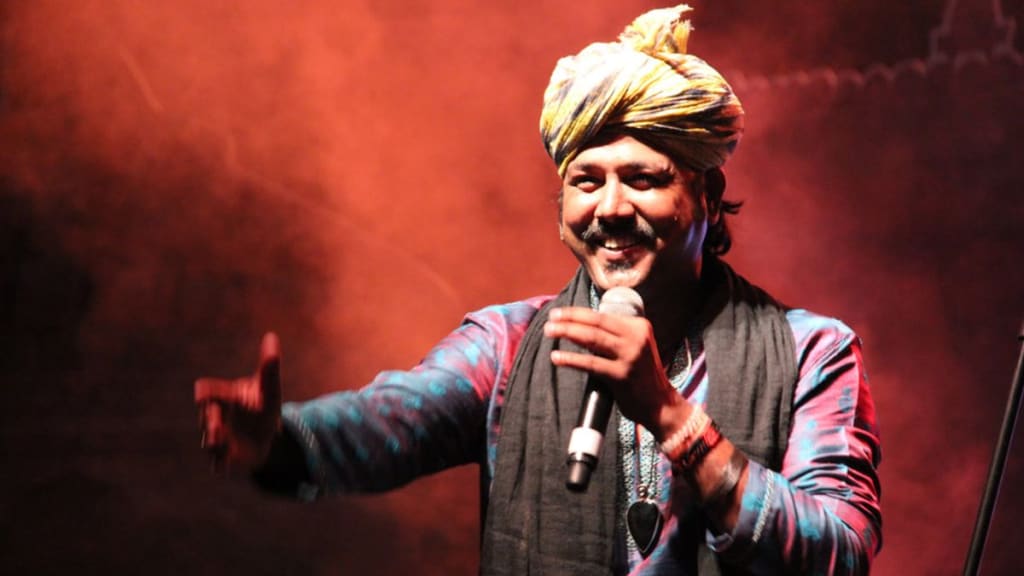
Mame Khan, one of the most recognisable voices of Rajasthani folk music, has spent years expanding the reach of India’s traditional sounds. His latest release, “Dama Dam Mast Kalandar 2.0,” signals another bold step in that direction. The track opens with shimmering electronic textures and rapid fire rap verses that collide with the earthy tones of the sarangi and harmonium. Over this blend floats Khan’s unmistakable voice, powerful and commanding. The song feels like a meeting point of old and new, a merging of sufi poetry, hip hop energy and folk heritage, all held together by Khan’s artistic vision.
A few weeks before the single was unveiled, Khan sat comfortably in a lounge at the St. Regis in Mumbai, radiating excitement. He spoke animatedly about the collaboration with rapper AJRaps and the creative spark behind blending two seemingly distant genres. For him, such experiments are not as modern as they appear. He describes rap as a contemporary form of chhand, the poetic metrical patterns long used in India’s devotional songs, epics and folk traditions. His belief that innovation can emerge from the roots of an ancient culture has guided much of his artistic journey.
Khan has a talent for picking up fragments of tradition that many may have forgotten and presenting them with renewed vitality. He speaks warmly and humorously, occasionally slipping into poetry or joking mid conversation. Music, he insists, is a lifelong pursuit. People may come and go, but the search for sound, expression and meaning never truly ends.
His rise to widespread recognition began years ago when his song “Chaudhary,” performed with composer Amit Trivedi on Coke Studio India in 2011, became a nationwide sensation. Audiences later heard him in “Baawre” from the film Luck By Chance and in several folk centric projects, including Shankar Mahadevan’s initiative My Country, My Music. One of his most celebrated roles has been as the lead vocalist in Roysten Abel’s theatrical production Manganiyar Seduction, which has introduced global audiences to the mesmerising music of Rajasthan since 2006. In 2022, Khan created history as the first Indian folk musician to walk the Cannes red carpet and perform at the Indian Pavilion, a moment he describes as emotional and transformative for the entire folk community. He also leads The Folk Orchestra of Rajasthan, an ensemble of more than fifty musicians that showcases the state’s traditional artistry on an epic scale.
Despite his international success, Khan’s grounding remains in his birthplace, the desert region of Jaisalmer. He belongs to the Manganiyar community, known for its rich musical heritage. His home in Satto village was filled with melody long before he became a performer. He recalls waking up to his father’s early morning riyaz, hearing his mother sing while cooking and listening to his sister hum to herself during chores. Although he initially trained on the dholak, he soon found himself absorbed in vocal practice, shaped by the musicians who often visited his father, the respected singer Ustad Rana Khan. His father eventually became his primary teacher, instilling in him the belief that real learning never stops. It is a lesson Khan still carries as he continues to reinvent folk music for new generations.

Today, his mission is to take Indian folk music to global heights. Partnering with Warner Music India and JetSynthesys’ Global Music Junction, he hopes to reach young listeners around the world. Folk music, he says, belongs to the people. It carries joy, rhythm and celebration, and the challenge lies in presenting those qualities in a way that resonates with modern audiences.
Khan has already experimented with global textures. His 2018 track “Lal Peeli Ankhiyan” pairs traditional Rajasthani instruments like the khartaal and sarangi with the saxophone, drawing from flamenco influences. The fusion felt natural to him because he sees parallels between the spirit of flamenco and the musical traditions of Rajasthan.
Although he embraces new sounds, Khan remains committed to maintaining the cultural heart of his music. He often repeats his personal mantra: fuse elements, do not confuse the core. He ensures that every song carries at least one signature element from his homeland, whether it is the rhythm of the ghoomar or the timbre of the sarangi. Visual storytelling is equally important to him. Music, he explains, becomes universal when the audience can see it, feel it and experience it beyond language through gestures, expressions and traditional attire. For him, performing is as much about presence as it is about melody.
Khan’s artistic path is a constant negotiation between preserving the roots of folk culture and pushing it toward unexplored soundscapes. And with each project, he continues to prove that tradition, when nurtured with curiosity and courage, can remain endlessly alive.
About the Creator
Aarohi Mehta
Aarohi is an independent journalist and art enthusiast who covers culture, creativity, and modern digital trends. She brings a fresh, expressive voice to her stories, blending clear reporting with a strong artistic perspective.
Keep reading
More stories from Aarohi Mehta and writers in Journal and other communities.
Araj: Youthful Energy Breathing New Life Into Hindustani Classical Music
For generations, Hindustani classical music was a world largely appreciated by serious listeners who were willing to immerse themselves in its intricate grammar, slow development and deeply meditative aesthetics. Although timeless in its appeal, the art form often seemed distant to younger audiences who were unfamiliar with its nuances. In recent years, however, a wave of young artists has begun bridging this gap by presenting classical music in ways that feel relatable, vibrant and emotionally accessible. Among the most striking examples of this shift is Araj, a collective of five Mumbai based musicians who are offering a fresh interpretation of the classical tradition.
By Aarohi Mehtaabout a month ago in Journal
Shell Scripting in 2026: Mastering System Automation with Claude Code
Shell scripting has undergone a radical transformation. The barrier between writing a script and orchestrating a system has dissolved. This is thanks to autonomous coding agents like Claude Code. Engineers no longer need to memorize obscure syntax like sed or awk. The challenge now is managing the logic of generated scripts. You must also ensure security and smooth integration for these tools. This guide is for intermediate to expert developers. It helps you adapt to the 2026 landscape of systems programming.
By Del Rosario3 days ago in Journal




Comments