
Machine Learning in Finance: Transforming the Future of Financial Services
Data-Driven Intelligence to Revolutionize Risk Management, Trading, and Customer Experience


The financial world is undergoing a massive transformation and machine learning in finance is one of the disruptive technologies transforming financial systems all over the world. Banks and fintech companies use ML to detect fraud, score credit, optimize their portfolios, and model risks more accurately and at an unprecedented rate. In this article, we will discuss how machine learning is bringing revolution to financial services- how it is transforming traditional banking, advanced risk management, fraud prevention, and customer experiences in the digital age.
Why Machine Learning Matters More Than Ever in Financial Services
The traditional financial systems are characterized by three primary issues, including volume, volatility, and data variety. ML algorithms are best suited to such circumstances, as they combine a continuous learning process of algorithms based on data patterns to make quicker and smarter decisions with the least errors.
Some of the most important applications of ML in the banking sector and the ways that it is reshaping the financial services environment are discussed below.
1. Machine Learning for Fraud Detection
ML models scan millions of transactions in real time to identify anomalies and flag suspicious behavior before there are losses. Through detection of latent patterns and anomalies, banks can minimize false positives and improve the effectiveness of fraud prevention systems.
2. Credit Scoring and Underwriting
Those days are gone when credit decisions were based on static information such as income or FICO scores. Contemporary ML algorithms assess alternative data sources, such as spending patterns and transaction histories to generate dynamic credit scores. This enhances financial inclusion without augmenting default risk.
3. Risk Management and Predictive Analytics in Finance
Through predictive analytics in finance, ML models assist institutions in assessing and handling various types of risks including credit, market, and operational. By running thousands of scenarios, the models allow companies to predict potential threats before they occur.
4. Customer Experience and AI in Wealth Management
Personalization is now a key to financial success. With ML-powered virtual assistants and robo-advisors, institutions provide personalized investment guidance, automate portfolio re-balancing, and drive greater client satisfaction at lower operating costs.
5. Compliance and Anti-Money Laundering (AML)
Compliance with regulations is the most overhead-rich function within finance. ML algorithms streamline KYC authentication, automate transaction surveillance, and identify anomalies, providing much greater accuracy while lowering overhead.
What’s Driving the Financial Sector Toward Machine Learning?
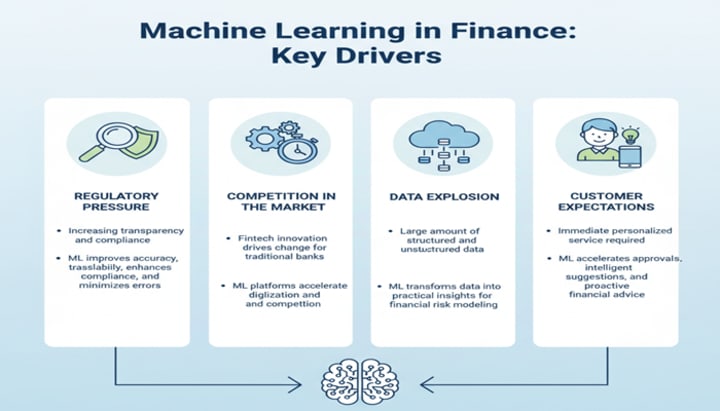
Implementation of machine learning in finance is not just a technology trend, but also an act of strategy change which is driven by a number of forces that are affecting the industry:
Regulatory Pressure: There is increasing transparency and compliance pressure on financial institutions. Machine learning in finance will improve accuracy and traceability, enhance compliance, and minimize errors.
Competition in the market: Traditional banks are being driven by the Fintech innovation to change. With the introduction of ML platforms for banking, organizations will be faster in their digitalization and competition.
Data Explosion: A large amount of structured and unstructured data is produced by the industry on a daily basis. ML platforms transform this into practical insights, which are used to model financial risks through AI.
Customer Expectations: The contemporary customers require immediate personalized service. ML helps accelerate approvals, make more intelligent suggestions, and gain proactive financial advice.
How Organizations Can Lead the ML Revolution
Embracing machine learning in finance is not merely adopting algorithms—it's about creating a holistic ecosystem that supports innovation, ethics, and scalability. This is how visionary financial institutions can drive this revolution:
1. Prioritize Explainability and Transparency
In regulated industries such as banking and insurance, trust is paramount. Institutions need to take ML models that are explainable and interpretable, with the ability to audit and justify decisions.
2. Invest in MLOps
Operating machine learning models throughout their lifespan is essential as it keeps ML models accurate, reliable, and scalable even when financial landscapes change.
3. Upskill the Workforce
Finance's future relies on hybrid professionals who bring domain knowledge coupled with data science. Upskilling teams in ML topics enables institutions to convert technical innovations into genuine business requirements.
4. Foster Collaboration and Innovation
Collaborations between startups, banks, and educational institutions propel ML innovation forward. Open experimentation and co-creation have the potential to develop innovative ML use cases in banking that spur the industry as a whole.
5. Embrace Ethical and Responsible AI
With ML at the forefront of decision-making, institutions will need to maintain ethical standards—making the processes fairer, minimizing bias, and ensuring accountability in all AI-based models.
Benefits of Machine Learning in Fintech
The benefits of machine learning in fintech are immediate and long-term. In addition to cost reduction and automation, ML opens up strategic advantages including:
Increased Accuracy: Predictions based on data eliminate lending, trading, & risk assessment errors.
Scalability: ML models easily handle & process large datasets without sacrificing speed.
Customer Retention: Custom financial solutions build better relationships and loyalty.
Operational Efficiency: Automation de-prioritizes tasks such as filling out forms, leaving staff to work on value-added activities.
Regulatory Compliance: Automated systems simplify reporting, auditing, and documentation.
Concluding Thoughts
Machine learning in finance is not a technological breakthrough, but rather the new financial intelligence of the future. With the adoption of AI-based financial services, companies have the ability to transform efficiency, transparency, and customer trust.
Thanks to this integration of technology with finance, individuals who leverage predictive analytics in finance and AI in wealth management will govern a smarter and more inclusive global economy. Fundamentally, this AI-driven financial revolution does not simply involve algorithms, but rather involves building a data-driven ecosystem, whereby all decisions, transactions and interactions are quicker, more equitable, and future proof!
About the Creator
Liza kosh
Liza Kosh is a senior content developer and blogger who loves to share her views on diverse topics. She is currently associated with Seasia Infotech, an enterprise software development company.
Revenue Planning For Treatment Services
Introduction Revenue planning is a critical aspect of managing treatment services, as it ensures that healthcare organizations remain financially stable while delivering high-quality care. Treatment centers, including behavioral health programs, addiction recovery services, and outpatient clinics, rely on consistent revenue streams to cover operational costs such as staffing, facilities, medical supplies, and program development. Without careful revenue planning, treatment services may face financial shortfalls, which can compromise patient care or limit program availability. Effective revenue planning involves analyzing potential income sources, estimating patient volume, forecasting insurance reimbursements, and exploring alternative funding opportunities. By implementing a structured revenue plan, treatment services can maintain operational sustainability and focus on providing effective care.
By Abdul Mueeda day ago in Journal
Chad Pratt and the Quiet Strength of Lifelong Running
Running is often portrayed as a competitive sport, a pursuit of speed, or a quest for medals. But for some, it becomes something more—a way to cultivate balance, clarity, and resilience. Chad Pratt exemplifies this philosophy. His lifelong commitment to running shows how steady movement, discipline, and focus can shape not only physical fitness but also emotional and spiritual well-being.
By Chad Pratt3 days ago in Journal




Comments
There are no comments for this story
Be the first to respond and start the conversation.