

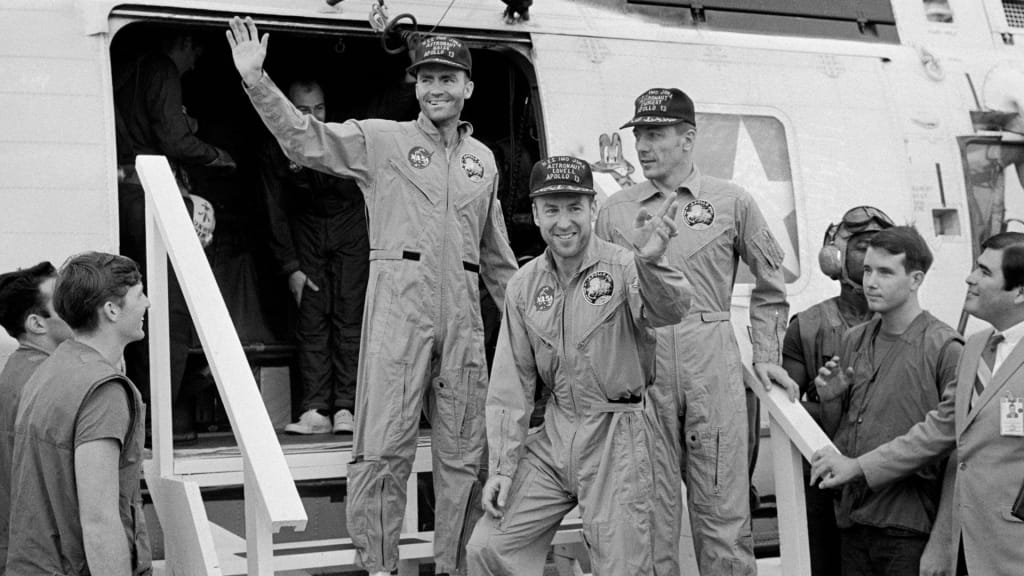
In April 1970, NASA's Apollo 13 mission was launched with the goal of landing two astronauts, Jim Lovell and Fred Haise, on the surface of the moon. However, just two days into the mission, an explosion occurred on the spacecraft, turning what was supposed to be a routine trip into a life-threatening crisis that captured the attention of the world. The story of Apollo 13 is one of incredible human ingenuity, perseverance, and bravery in the face of adversity.
The mission had begun smoothly enough. Lovell, Haise, and their crewmate Jack Swigert launched from the Kennedy Space Center in Florida on April 11, 1970, and spent the next two days in transit to the moon. But on the third day, while the crew was conducting a routine oxygen tank stir, an explosion occurred, causing the spacecraft's service module to rupture and lose all power.
The explosion also damaged the spacecraft's command module, which was the only part of the spacecraft designed to return to Earth. With the service module out of commission, the three astronauts were left with only the lunar module, which was designed to land on the moon and then take off again, but was not intended to support the crew for the entire journey home.
The situation was dire. The spacecraft was rapidly losing oxygen, water, and power, and the crew was forced to move into the lunar module to conserve resources. The lunar module, which was designed to hold two astronauts for just two days, now had to support three astronauts for four days.
NASA's mission control team in Houston faced a daunting challenge. They had to find a way to bring the crew back to Earth safely with the limited resources available on the spacecraft. The situation was made even more difficult by the fact that the explosion had occurred 200,000 miles from Earth, and the crew was now traveling at a high speed away from their destination.
The first step was to assess the damage to the spacecraft and determine how to conserve resources. The crew had to shut down all non-essential systems, including the guidance computer, and conserve power by turning off lights and other equipment. They also had to ration their food and water, and the temperature inside the spacecraft dropped to near-freezing levels.
NASA engineers on the ground began working around the clock to come up with a plan to bring the crew back to Earth. They quickly realized that they would need to use the lunar module's engines to make a course correction and get the spacecraft back on track towards Earth. This was a risky move, as the engines had never been tested in this way before and could potentially fail.
The course correction was successful, but the crew still faced several challenges. The spacecraft was now on a free-return trajectory, meaning it would automatically return to Earth if no further engine burns were made. However, the trajectory would take the spacecraft too close to the moon's surface, risking a crash or other complications. The crew had to make a series of engine burns to adjust the trajectory and ensure a safe return.
As the crew worked to conserve resources and make the necessary course corrections, the mission control team on the ground worked on developing a plan to get the crew back to Earth safely. They had to design a way to use the lunar module as a lifeboat, providing the crew with oxygen, water, and power for the duration of the trip. They also had to figure out how to jettison the damaged service module and ensure that the remaining parts of the spacecraft would withstand the intense heat of reentry into Earth's atmosphere.
One of the most critical challenges the crew faced was managing the levels of carbon dioxide inside the spacecraft. With the damaged command module unable to filter out carbon dioxide, the crew had to improvise a solution using materials available on board. They used duct tape, plastic bags, and other items to construct a makeshift filter that allowed them to remove the carbon dioxide from the air they were breathing.
The ingenuity of the crew and the mission control team on the ground was truly remarkable. They had to work with limited resources, make difficult decisions, and solve problems that had never been encountered before. Their tireless efforts and teamwork ultimately saved the lives of the crew and made the Apollo 13 mission one of NASA's most celebrated and iconic moments.
As the spacecraft made its way back to Earth, there was a collective sense of relief and pride around the world. The crew had faced impossible odds and had triumphed, thanks to their skill, bravery, and the unwavering support of the mission control team on the ground.
The crew splashed down safely in the Pacific Ocean on April 17, 1970, and were immediately taken to the USS Iwo Jima, where they received medical attention and were reunited with their families. The entire world breathed a sigh of relief and celebrated the incredible success of the Apollo 13 mission.
In the aftermath of the mission, NASA conducted an extensive investigation to determine the cause of the explosion and to identify any changes that could be made to prevent similar incidents in the future. As a result of this investigation, changes were made to the design and operation of the spacecraft, including the use of non-flammable materials in the oxygen tanks and improved safety procedures.
The legacy of the Apollo 13 mission lives on to this day. It is a testament to the incredible human spirit and the power of teamwork in the face of adversity. It reminds us that even in the most challenging of circumstances, we have the ability to overcome obstacles and achieve great things.
In conclusion, the Apollo 13 mission is one of the most remarkable stories in the history of space exploration. It is a story of human ingenuity, perseverance, and bravery in the face of impossible odds. The crew and the mission control team on the ground worked tirelessly to overcome the challenges they faced, and their efforts ultimately saved the lives of the crew and made the Apollo 13 mission one of NASA's most celebrated and iconic moments. The legacy of the Apollo 13 mission serves as a reminder of the incredible power of human determination and teamwork in the face of adversity, and inspires us to reach for the stars and achieve our greatest dreams.
About the Creator
Judith
I am a housewife with a passion for writing and a talent for creating interesting articles. With my talent for writing and my passion for sharing, I will sure to become one of your favorite article creators.
Review of 'Man on the Run'
My wife and I saw Man on the Run, a nearly 2-hour documentary on Amazon Prime, about Wings, Paul McCartney's group that flew around the world from shortly after The Beatles broke up in early 1970 to shortly after John Lennon was murdered at the end of 1980, making a Beatles reunion forever impossible.
By Paul Levinson7 days ago in Beat




Comments
There are no comments for this story
Be the first to respond and start the conversation.