
Lessons From a Wounded Deer
My takeaways from a humbling experience in the Maine woods with the biggest whitetail deer I've ever come across.
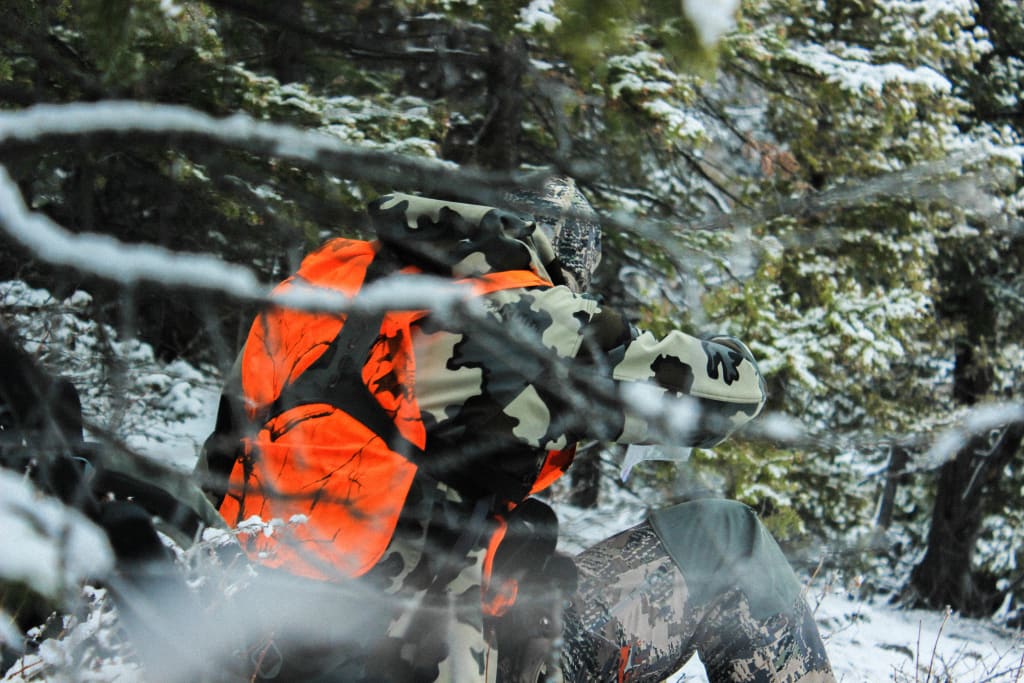
The mists descended on the woods, reducing what little visibility there was through the thick timber as I trudged along the old logging road back to the cabin. So far, day one of whitetail hunting in Maine had proved to be a humbling experience for this western hunter.
It would be one thing if we had an inch or two of snow on the ground to make tracking easier (not an unreasonable expectation for a mid-November hunt), but the weather had decided to be coy and left us no more than a few small patches.
To make matters more perplexing, the rut had started all over the country by this point...except for this one area in northwestern Maine, apparently. The deer were certainly getting ready for it; there were fresh scrapes everywhere, the doe tracks had urine in them, and the bucks were re-opening their scrapes on a nightly basis. But our trail cameras showed that they weren’t roaming much during the day. That last switch just hadn’t flipped yet...but it certainly would any day now.
These thoughts all swirled around in my head as I sulked through the haze back to our cabin. It had been a long day of stumbling through the claustrophobic woods with my buddy, Jammer. Aside from some scattered buck sign and a few moose, we weren’t seeing much.
This trip is always one of my highlights of the year. Our group usually includes 3 pairs of fathers and sons - my buddies Seth and Josh, their dads, Mike and Dale, and my dad.
Dad wasn’t able to make it this year unfortunately. Too much going on at home that he just couldn’t swing it. It felt odd going on this trip without him, but I looked forward to sharing the stories with him at Thanksgiving.
I’m about to turn left down a new mountain bike trail when a subtle movement to my right catches my eye. There, shrouded in fog like a ghost, stands a buck.
I freeze, not wanting to spook him off.
He’s standing in a turnout and seems to be within a hundred yards, but because of the mist I can’t tell whether or not he’s facing me.
Now I’m faced with a dilemma. I’m standing on a dirt road, so my options for a shooting rest are limited. I can’t kneel down and use my backpack because the turnout is elevated and he disappears from view. That also eliminates the possibility of going prone and using my bipod.
There’s a deep ditch between the road and the turnout with a short berm. I can creep down into the ditch and prop my gun on the berm to take a steady shot, but the ditch is full of old, dry branches that’ll crackle like fireworks when I step on them.
What I’m left with, then, is to take the shot offhand. 100 yards isn’t a far shot, so it seems like a reasonable idea to me. The problem is, of course, that I haven’t done much offhand shooting; and my heart is flooded with adrenaline.
The buck turns slightly, quartering away from me. I have to make a decision now before he wanders off.
With a bit of trepidation, I decide to take a risk and shoot off-hand. Breathing deep in an attempt to calm my nerves, I raise the rifle and peer through the scope. The crosshairs are doing the macarena all around the deer - I need to calm down and get the wiggle under control.
I wrap my left arm with the rifle sling for a little added stability and take a few more deep breaths. The wiggle begins to subside, now mostly contained in the deer’s body. Placing the crosshairs behind his shoulder, I flick the safety off.
One more deep breath and a quick prayer.
BANG!
The stillness of the forest is shattered by the crack of the rifle.
The next few moments exist in my memory like glimpses through windows on a passing train.
I immediately lose sight of the buck - completely convinced that I hit him and he’s down. Then a flash of movement as he bounds into the drainage ditch to the left and heads for the woods.
Panicked, I rack another round into the chamber and sprint to the top of the berm to take a follow-up shot. I hear a crash as I crest the berm and see a flash of his tail leaping into the woods. I run to the edge of the trees, rifle at the ready, desperate to get another shot off before he disappears for good.
I’m greeted by two angry snort-wheezes from within the labyrinth followed by a ruckus as the buck vanishes into the maze like a phantom.
It’s over.
I got down on my knees, frantically rummaging through the events in my head. Did I hit him? I don’t know - I totally jerked the trigger. But didn’t he look hurt as he climbed out of the ditch? Did he leap or fall into it? He seemed to run off just fine. I could’ve sworn he dropped to the ground; that’s what happened, right?
I decided to sit and let the jitters subside. I needed to wait a while anyway before I went looking for him. I figured I’d take a minute, examine his tracks in the mud, and scan for any sign of a blood trail.
And then it started to rain.
So much for that blood trail.
As the light faded and the darkness mixed with the rain and gloom I quickly realized that I was never going to find this deer by myself. It took a short hike to find cell service so I could call Jammer. He showed up with the truck a little while later and together we started searching for tracks.
It was a pleasant surprise that Jammer was able to join us this year. He and I have shared many adventures together while working at a summer camp in Maine and he’s as close as a brother to me. Most of our time together has involved the water in some way, from rafting to canoeing to fishing. So being able to hunt together was a cool experience for both of us.
We soon realized that we were going to need more eyes out here, so we made our way back to the cabin to grab a bite to eat and enlist the others in the search.
Night had fully set in when we returned, and it didn’t take much time stomping around blindly in the wet dark for us all to see that we weren’t making any progress. Disheartened, we called it a night.
I’m still fairly new to big game hunting. This is only my fifth year pursuing anything larger than the ducks and geese I grew up hunting with my dad. And in that time I’ve never wounded an animal and not recovered it. So to be in this situation where I may have just hit a deer and let it get away is difficult for me.
Contrary to public perception, most hunters actually really love animals. We have a unique respect for them - for their beauty, their tenacity in the face of the brutal wild, and how damn smart they are.
Whenever I kill an animal there is a flood of emotions. It’s a release of all the tension that builds up in those moments before the shot, euphoria in success, gratitude for the experience. But there’s also a small tinge of sadness; it’s never lost on me that a life has just ended, at my hand no less. So when I’m facing the possibility of having wounded an animal in vain, there is no euphoria; only that hint of sadness.
I knew it wouldn’t be ethical for me to just assume I missed and continue hunting the following day. I decided that in the morning I’d go back to that spot and see if I could find him. The rain wasn’t hard enough to wash away his tracks in the turnout, so I’d start there.
The morning was cold, much colder than the day before. I threw on my heavy jacket and tossed a couple hand warmers into the pockets. This was going to be a long day.
The tracks appeared normal at first, gentle in the soft ground, evenly spaced, then they abruptly changed to deep treads in the earth, much more spread out. This is where he was when I shot at him.
I took a minute to scour the ground for any indication that he fell and got back up, maybe some scrapes in the dirt off to the sides or even a subtle imprint of his body. But the tracks seemed to indicate that he went from standing to sprinting.
Okay, that’s one box checked.
The next step in the plan was to grid off the surrounding area and look for his body. I couldn’t assume that the signs I’d been looking for hadn’t been washed away in the rain.
I pulled out my GPS and created a 10-acre square on the satellite map. If I combed every inch of this area and didn’t find anything, then that in conjunction with the tracks was enough for me to reasonably conclude that I had missed and could go back to hunting the following day.
It took eight hours and forty minutes to cover the entire area. After trudging through thick brush in freezing temperatures covered in deer ticks, I found no sign of the buck from the night before. This, in conjunction with the story the tracks appeared to tell, gave me enough reason to believe that I had missed my shot and could go back to hunting the next day.
That night it snowed. Finally.
Seth, Mike, Jammer and I sat around the table after dinner pondering what to do the following morning. Josh and his dad, Dale, had left that morning, so it was just the four of us.
When I mentioned a scrape I’d found next to a large doe bedding area the guys all seemed to think that was a good place to start with the fresh snow on the ground.
In the morning, Seth and I set up downwind of the scrape as Jammer took a different approach and we moved in a pincer maneuver.
As I stalked toward the scrape, I came across a set of tracks in the snow. They appeared to be fresh, made within the last hour or so, and they clearly belonged to a large, mature buck.
And he was dragging his back left leg.
My heart jumped into my throat as I realized that I had, in fact, wounded that buck from the other night. In the midst of the hurricane of thoughts that swirled through my head, one thing I knew for sure - I was going to follow these tracks until last light.
Seth and Jammer approached following the same track and confirmed my suspicion. According to the tracks, he’d only roamed 300 yards the night before and had bedded 5 times, a clear indication that he was hurt. It was a sobering realization, but at least I had a chance to finish the job.
We set off together with Seth on the track and Jammer and I off to either side about 100 yards apart. Over the next few hours we chased him through swamps, timber, and fields, finding fresh beds along the way. We even heard him splash away from us in a large swamp. Clearly he knew we were following him.
We emerged onto a dirt road around midday and saw that the tracks continued into yet another dense thicket and woods beyond. Pulling up a satellite image of the terrain in front of us, Seth identified a swamp south of this stand of timber where he had seen two significant deer crossings. To the north, there was a logging road that also had signs of heavy deer traffic.
We theorized that he was going to bank to either of these travel corridors if we continued to press him, so we split up. Jammer went north to the logging road and Seth went south to the swamp while I stayed on the track.
I wasn’t entirely sure that I’d actually be able to follow his path since it was the afternoon and the snow had begun to melt in big patches. But I had wounded this buck and I was going to take the full responsibility of pursuing him to the end. We bid farewell and I struck out alone into the woods.
The footprints wove through the forest primarily in shaded areas where there was still snow, so following them wasn’t too tricky. A few times I had to stop and decipher large swaths of intersecting deer sign. But that tell-tale drag mark made it easy to distinguish which was his.
The tracks continued through more fields and timber until I came to a dark lodgepole forest.
Stepping into these trees felt...different. There had been a breeze all day and the sounds of birds and squirrels had been ever present. But now, as I entered this great wooded hall, the general hum of the forest went totally silent. It felt as if I’d crossed the threshold into a holy sanctuary.
The trees were only spaced about shoulder-width apart, so I removed my pack and marked its location so I could move quickly and make less noise. The sun hadn’t been able to melt the snow in this section, making the tracks easy to follow.
I knew I was getting close.
As I made my way through the trees I came across a bed in the path. Stopping to examine it for any traces of blood, I could see that this one was fresh enough to see the marks of his fur imprinted in the snow.
I kept moving, pausing every few feet to look ahead through the trees. 50 yards later I found another bed. And there was another one 50 yards after that.
He was losing steam.
I decided to sit for twenty minutes in hopes that he would let his guard down and possibly go to sleep. He may have been fatigued, but I wasn’t going to have a shot at him without approaching undetected.
I knelt and let the silence wrap itself around me. Not the slightest breath of wind disturbed a hair on my head. I spent this time thinking about how lucky I was to be in this beautiful place with some of my favorite people. Not everyone gets this kind of opportunity; even many hunters never experience being this deep in the middle of nowhere.
My twenty minutes was up and I began stalking forward. It was painful moving that slow, but I knew it was my best chance at getting a shot at him.
A short time later I came to a swamp churned up with multiple different tracks.
After a soul-sucking hour of backtracking my backtracks, I finally found my deer’s prints. They were so obvious now that I could see them; I cursed my incompetence. But that’s how it always is when we find the solution to any problem, and self deprecation never does us any good.
Just as I was about to move on I noticed something odd in the snow. There on the ground just to the left of that familiar drag mark was a single drop of blood.
I glanced at my watch: 4:00pm - 15 minutes to last light.
Screw stealth.
I started moving quickly, full of purpose. Soon there was another drop of blood. And another, bigger this time. Another, even bigger. I moved faster. His tracks were easy to spot now in the unbroken snow.
Finally, the woods opened into a large clearing with thick timber on all sides. On the opposite end, just inside the trees, there was a skidder trail moving perpendicular to my path.
As I stepped over a log into the clearing there was a large CRACK! My eyes shot up just in time to see a flash of the buck I’d been chasing for three days as he booked it along the skidder trail.
5 minutes to last light.
I started sprinting.
Crossing the clearing and reaching the trail, I banked left in pursuit. If I could see him just once more I could yell and possibly get him to stop for a second. It would be close, but it was the best chance I had.
Another crash came from a clearing off to my left and I dove in that direction. Pausing briefly to examine the ground, I saw his tracks circling back to where we’d come from. The snow ended, but now I had an idea of where he was headed. I shifted into another sprint, vaulting over downed trees and dodging branches.
When my lungs couldn’t take it anymore I slowed to a stop. The holy silence of the forest returned, broken only by my gasping breaths. I looked down at my watch - 4:30. Last light was 15 minutes ago.
Taking a deep breath, I let it out in a long, slow exhale. That was it. This was our last day; I’d missed my chance.
The glow of the evening sun was fading into the west as I looked up at the stars beginning to materialize in the clear sky. I sat there for some time, taking it all in - the scenery and the experience, before nodding my head in defeat and making the long walk back to the cabin.
So why am I telling you this story?
No one likes to talk about the times they went home empty-handed, but sometimes those are the trips we can learn the most from.
I love animals, so it pains me to know that I wounded one and failed to retrieve it - that he’ll probably live in pain until he’s eaten by coyotes because he can’t run away. Just being completely honest, I was nearly moved to tears that night. But had I not failed I probably wouldn’t have learned nearly as much from this experience as I did.
The first takeaway for me is the importance of practice. But not just throwing more bullets downrange; I do plenty of that from a stable, prone position. What I need to change about the way I train is shooting from different positions such as offhand, kneeling, using a pack as a rest, etc. The shot I took on this buck was probably the first time I’ve ever shot my rifle without a rest. And that is unacceptable. So an added takeaway for me is this: if I haven’t practiced something, I probably shouldn’t try it for the first time in the field.
The next thing that sticks out to me is the importance of patience. My first mistake was believing I had less time than I really did and needed to take a shot quickly. The wind was in my favor, the buck was relaxed, and I was far enough away that I probably wasn’t going to spook him with a little bit of noise. But I convinced myself that he was going to bolt any second and I had to shoot right NOW!
Buck Fever always sounded ridiculous to me. But this hunt revealed just how susceptible to it we all are, particularly on a hunt where you’re not seeing much activity.
When I saw that buck my body essentially went into fight or flight mode. My heartrate spiked, my breathing got heavy, my thoughts got fuzzy, I couldn’t hold my rifle steady even with an arm hooked through the sling.
What I should have done in that moment was recognize all the factors that were stacked in my favor, take a few more deep breaths to calm down, and creep forward to the berm where I could take a controlled shot rather than try to squeeze one off quickly.
Humility is the glue that ties all these things together for me. I’m not a “gifted” shooter. My previous successes don’t guarantee future harvests. And I am just as susceptible to the spell of buck fever as anyone else.
And these are lessons not just for future hunts but for every other area of my life. It reminds me of something one of my professors said in college, “Luck is when hard work and preparation intersect with opportunity.” I need the humility to recognize that if I ever want to accomplish a goal, I have to put in the time and effort to prepare for it.
I’m certainly not in the minority; anyone who has been hunting long enough has at least one story like this. And I guess that’s why I want to put this out there. To show that failure is not something to be ashamed of, but rather another opportunity to learn something new. And it is through failure that we grow the most.
About the Creator
Evan Scott Anderson
Evan Scott Anderson is an outdoor guide and published writer living in Bozeman, MT. He has written dozens of articles for Waypoint TV and continues to write in his free time when he's not out adventuring in the Montana or Maine backcountry.
Keep reading
More stories from writers in Journal and other communities.
~ Fired ~
— Ai Intrusion ~ Are you Next ~ Is Ai Evolution after your job? — Few workplaces haven't been affected. Ai is in supermarkets, at doctors' offices, and even monitoring farms. I just can't think of anything this machine is not getting into, can you? For instance: Education ~ Law and Tech jobs will one day have a major influence or be taken over by these inanimate machines, with accuracy and vigor. From mechanics' diagnoses to a wide variety of everyday jobs, including fast food workers, with this input having the ability to cut their unnecessary work hours. I'm certain all of us have been touched by this with our short stories and colorful headings, have you? Even comments are very questionable 'Non-Robot' insertions.
By Jay Kantor2 days ago in Journal



Comments
There are no comments for this story
Be the first to respond and start the conversation.