
Le sang d'un poète ("The Blood of a Poet")
Jean Cocteau, 1932

"Every poem is a coat of arms. It must be deciphered." Jean Cocteau
"Every man and every woman is a Star." Liber Al vel Legis
I recently rewatched Cocteau's "The Blood of a Poet" in French without subtitles. Like Fando y Lis by Jodorowsky, it was unnecessary to understand the scant spoken dialog, as the message, meaning, the "story" (yet, no concept so pedestrian and bourgeois seems to apply here) of the film is conveyed in striking, bold, and dream-like images and allegory.
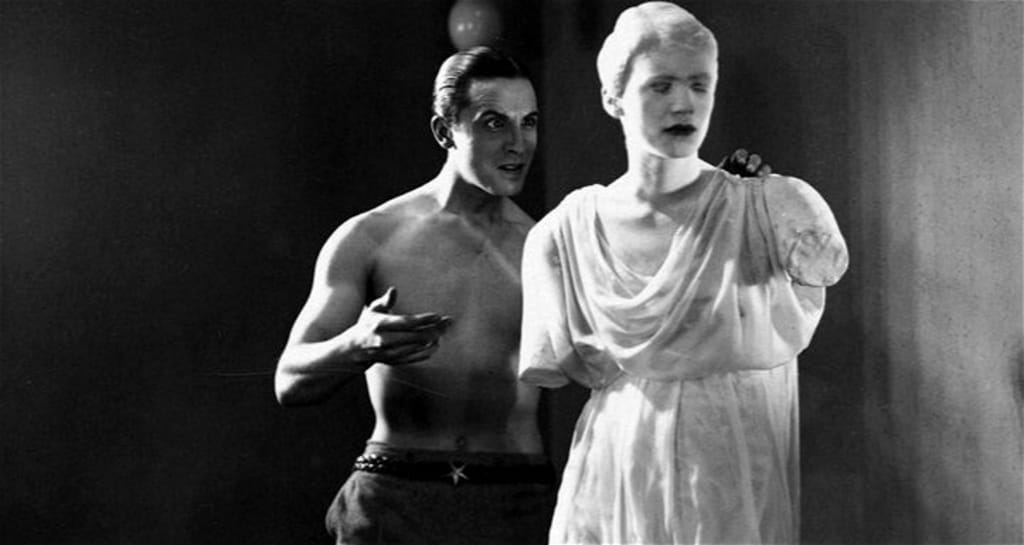
A towering smokestack is seen to crumble, echoing the image in Tarot of the Tower of turbulent trouble. An artist is at the easel, mirroring one of Cocteau's images, drawing the sloping, weirdly pudding-like visage of one of Cocteau's classically-infused drawings. He wears a powdered, Eighteenth-century wig. Before, we have seen the image of a classically Greek-looking statue come to life with a disturbingly animate face. This man, this poet, is reaching backward through time to another age, when gentleman fops created art for the pleasure of it, irrespective of the offerings of fame and, most special, commercial reward.
(But the aristocracy of the past is no different, Cocteau intimates later, than the one-eyed, not to say, completely blind bourgeois and petty aristocrats of contemporaneous times.)
The Poet (Enrique Riveros) falls through a mirror, a pool-like entryway from this liminal space of his studio, into a dark and strangely zero-gravity realm wherein he is a bug, blown by an invisible breeze of force, across the wooden facade of hotel room doorways. We have hithertoo been presented with a pentagram, the symbol of mystical union between the Body of Man and the Divine Self, which is a higher state, the State of Beingness of our grasping, searching poet, obsessed with barriers, boundaries, the rites of passage that will lead him, as Andre Breton assures us surrealism does, to "death, which is a secret society."
Blood of a Poet (Mirror Scene)
He longs for the dissolution of self, to become the living marble of an exemplified artistic past. A monument for tomorrow.
Looking in the peepholes at carefully-numbered doors (one and seven equalling eight, the symbol of Infinity, and one and nine equaling ten; quite literally one and zero, or the numbers of The Fool and The Magician in the traditional Tarot), Our Poet sees a curious tableaux of a reclinging, androgyne, born of flat representations, those sloping, half-egg lines of Cocteau, next to a whirling spiral; the entrancing device by which the hypnotism of death draws in the artist/poet, into its depths.
Piece by fleshly piece, our strange creature, neither male nor female (sex disappears into the firmament of thought), the flat, drawn being materializes, pulling back a sign that reveals a warning concerning enetring into the secret society "de la mort." We disappear into a scene with some schoolboys having a snowball fight using the remains of a snow-constructed classical statue. Art made the object of play. (Significantly, this statue is situated on a staircase, an egress of ascent, another liminal space.)
In a theater, we see that the bourgeois of yesterday, the bewigged, Eighteenth-century Bourbon monarchists sit, side by side, in a theater box next to their modern reincarnations. Death has presented itself int he form of a boy, in the form of a severe mistress with a riding crop, taking after a child wearing "sleigh bells" (slay bells?), in a card game between a beautiful woman and another dandy, over the body of the childlike image of The Poet, who bleeds from the pentagam tattoed on his head. (This follows a suicide.)
The pentagram is the ancient symbol of power, but it bleeds the Poet out in a reversal of itself. The ancient idea of sacrifice, perhaps, to a dark god, a "fallen god," the inverted pentagram the sign of sorcerers and black magicians, its angular lines forming the correct frame for the image of the diabolic Mendes Goat.
Is creation and "evil" concomitant partners? Do they walk, hand-in-claw, down a domino-colored pathway toward destruction, or destructive impulse? Must we all destroy, as Nietzsche observed, again and again, casting out the old, to be creative, smashing and destroying accepted creative principles? By splashing through the mirror, in a striking visual effect, The Poet has entred the "reverse world" (as a mirror reflects in reversal) his dreams and illusions, his hallucinations, delusions--his nightmares. Like Alice, he is, quite literally, "through the looking glass."
He swims in this black, borne aloft by its invisible lines. He seeks an egress in hotel room doorways, looking at power-numbered doors, peeping through keyholes, a voyeur (all those who gaze longingly upon art are, by default, voyeurs) . He must destroy himself, bleed himself dry, to create that which is new, to go beyond the liminal space of his Selfhood, to create the real, living breathing art, like the androgyne drawing brought to life.
A black angel with one of Cocteau's wire contraptions for wings appears at the end, the symbol of the raw (read: non-white, non-European) world brought to life as salvation, guide; the primitive man exalted by Rousseau.
Cocteau's wire constructed facial statues are both prison and source of power; a wire also conveys electrical energy. Where does the line between the entrapment of the desire for fame, and the soul's need to create authentic, living, breathing art, end and begin?
In the end, the smokestack, the "Tower," crumbles. Falls. In the culmination of death, we have the first bitter seeds of a new, fantastic rebirth. It swims, like a fish upstream, through the blood of a poet.
C'est la vie.
Starring Enrique Riveros, Lee Miller, Odette Talazac, Jean Desbordes, and Pauline Carton. Written and directed by Jean Cocteau. Produced by Charles de Noailles, with cinematography by Georges Périnal and music by famed composer Georges Auric.
The blood of a poet | Trailer | Indiecinema
Connect with me on Facebook
My book: Cult Films and Midnight Movies: From High Art to Low Trash Volume 1
Ebook
About the Creator
Tom Baker
Author of Haunted Indianapolis, Indiana Ghost Folklore, Midwest Maniacs, Midwest UFOs and Beyond, Scary Urban Legends, 50 Famous Fables and Folk Tales, and Notorious Crimes of the Upper Midwest.: http://tombakerbooks.weebly.com
The Evolution of Aerospace Connectors From Analog to Digital
The aerospace industry has undergone a remarkable transformation over the past few decades, driven by a relentless pursuit of efficiency, reliability, and innovation. One of the unsung heroes of this revolution is the humble aerospace connector a component so small yet essential to the safe and seamless operation of modern aircraft. From the early days of aviation to today’s digital, highly automated aircraft, aerospace connectors have evolved significantly. Let’s take a journey through this evolution, exploring how they’ve progressed from analog simplicity to the sophisticated digital systems that power today’s aircraft.
By Beckett Dowhan6 days ago in Journal


Comments (2)
Interesting intro & analysis of an intriguing film.
Very good work 👏