Latest Stories
Most recently published stories in Journal.
The Copenhagen Test Ending Explained: Who Was Really Pulling the Strings?
The finale of The Copenhagen Test isn’t just about twists, betrayals, and last-minute rescues. At its core, it’s about Alexander finally realizing who was behind the mind-hacking program known as Cassandra RU258, and what that truth would cost him—mentally, physically, and morally.
By Bella Anderson24 days ago in Journal
Richard Pollak, 91, Dies; Edited Magazine That Criticized the Media. AI-Generated.
Richard Pollak, the longtime editor of The Washington Monthly, passed away at the age of 91, leaving behind a legacy of fearless journalism and a sharp critique of the American media landscape. His work, especially his editorship of The Washington Monthly during the 1970s and 1980s, significantly influenced the field of political and media reporting. Known for his incisive editorial voice and relentless questioning of the media’s role in shaping public opinion, Pollak’s death marks the end of an era in American journalism. A Career Rooted in Critique and Integrity Pollak’s career was defined by his commitment to integrity in journalism and a deep skepticism about the way media institutions operated. As the editor of The Washington Monthly, a magazine that tackled the issues of the day with clarity and boldness, he was unafraid to challenge conventional narratives and hold the media accountable for its shortcomings. His tenure at the magazine was marked by a series of critiques on the very nature of media coverage, which he saw as often shallow, sensational, and far too concerned with maintaining the status quo. Under Pollak’s leadership, The Washington Monthly became known for its in-depth reporting on political issues, media analysis, and its criticism of the American political establishment. The magazine's bold, unapologetic voice set it apart from its peers and made it a crucial publication for readers seeking thoughtful and incisive commentary. Pollak’s editorial work helped shape the magazine’s reputation as a leading voice in media criticism, and he consistently pushed for more transparency and responsibility from those who shaped the public discourse. Pollak’s critical view of the media was not merely a personal vendetta or an ideological stance. It was rooted in his belief that a free press was essential to democracy, but that it required constant vigilance and reform to live up to its potential. His criticisms were grounded in the belief that the media had become too close to the centers of political and corporate power, often sacrificing the role of watchdog to become an extension of those in charge. He argued that a truly independent media was one that held power accountable, no matter how uncomfortable the truth might be. A Vision for Journalism In addition to his role as an editor, Pollak was also a tireless advocate for journalism as a tool for social change. He believed that journalism should not merely reflect the world as it was, but should aim to make it better by exposing injustices, asking tough questions, and holding those in power to account. Throughout his career, he wrote numerous essays and op-eds, exploring the relationship between journalism, politics, and the public. His writing often emphasized the need for journalists to maintain an ethical distance from their subjects, a principle that was sometimes overlooked in the race to attract readers or sensationalize the news. Pollak also took issue with the corporate consolidation of media outlets, a trend he saw as a threat to the diversity of opinions and voices in the public sphere. He warned that as a small number of conglomerates gained control over more of the nation’s media landscape, the ability for alternative voices and investigative reporting to thrive would diminish. Pollak was particularly critical of the mainstream media's failure to address important issues such as economic inequality, environmental destruction, and the concentration of power in the hands of a few wealthy elites. Despite his criticisms of the media, Pollak was never anti-media. Rather, he saw the media’s failures as an opportunity for improvement, and he believed in the potential for reform. His tenure at The Washington Monthly was about more than just criticism—it was about urging the media to live up to its highest ideals, to serve as an institution of public service rather than a tool for those in power. Legacy of Impact Pollak’s work at The Washington Monthly and his broader contributions to American journalism have left a lasting imprint on the field. His work has inspired a new generation of journalists to critically examine the media’s role in society and its relationship to power. His sharp commentary and commitment to an independent, ethical press remain relevant as challenges to journalistic integrity continue to mount in an age dominated by misinformation and media consolidation. Pollak’s death has sparked an outpouring of admiration from those who knew him, both professionally and personally. His colleagues and fellow journalists have remembered him as a man of principle, a sharp thinker, and a champion of journalistic integrity. His impact on the industry will be felt for years to come, as the issues he raised during his career continue to shape the conversation about media responsibility, public trust, and the need for a free and independent press. A Final Tribute As news of Richard Pollak’s passing spreads, it is clear that his legacy will endure. His ability to ask tough questions, challenge the status quo, and demand better from both the media and those in power is something that many journalists and readers can aspire to. In a media environment often marked by sensationalism, bias, and corporate influence, Pollak’s career serves as a reminder of the importance of holding the powerful to account and the vital role that journalism plays in shaping a healthy democracy. Richard Pollak’s life was a testament to the power of a free press to shape society for the better. His work at The Washington Monthly continues to serve as a beacon of journalistic excellence, integrity, and unwavering commitment to the truth.
By Fiaz Ahmed Brohi24 days ago in Journal
Why SEO in 2026 Won’t Die.. AI-Generated.
Every few years, someone declares SEO dead. The claim usually follows a major shift in how people use the internet. Social media. Mobile. Voice search. Now AI. The pattern is always the same. The conclusion is always wrong.
By Jason Suli Digital Marketing24 days ago in Journal
Robert Kraus: A Visionary Leader in Financial Strategy and Investment for Business Owners
As the world evolves in its financial markets, Kraus Raul Robert is ready to help business owners and traders shape the next chapter of financing. With determination, innovative thinking and global reach, he has set a great example to young entrepreneurs, investors, & experts in structured financing.
By Raul Robert Kraus24 days ago in Journal
Run Away Netflix Review 2026: Another Harlan Coben Mystery
A new year usually means fresh starts. On Netflix, it also means yet another Harlan Coben adaptation landing in the queue. This time around, it’s Run Away. And while longtime fans might be surprised that Richard Armitage isn’t front and center, the series does bring back a familiar face in James Nesbitt. So the big question is obvious:
By Bella Anderson24 days ago in Journal
Key Metrics to Track in Mental Health Billing
Introduction In the mental health landscape of 2026, billing is no longer just a backend administrative task; it is a vital indicator of clinical and operational health. Because behavioral health relies on recurring sessions and diverse payer rules, a single friction point in the revenue cycle can lead to significant cash flow gaps. Effective practices use a data-driven approach, monitoring specific Key Performance Indicators to identify where revenue is slipping through the cracks. By tracking these metrics, practice leaders can ensure that their focus remains on patient care rather than financial survival.
By Abdul Mueed24 days ago in Journal
Buying a Psychology Business: Understanding the Risks
Introduction The acquisition of a psychology practice in 2026 is a complex transaction where the primary "assets" are human relationships and clinical trust. Unlike retail or manufacturing businesses, a therapy practice's value is highly sensitive to the sudden departure of key personnel or shifts in regulatory compliance. While the mental health sector is currently experiencing record demand, buyers must navigate a landscape of "successor liability," complex payer contracts, and the emotional toll that a change in ownership can take on both staff and patients. A fair purchase price is only "fair" if the buyer has successfully mitigated the hidden risks that exist beneath the surface of the financial statements.
By Abdul Mueed24 days ago in Journal
Victoria Jones, Daughter of Tommy Lee Jones, Found Dead in San Francisco
The new year is often imagined as a blank page — clean, hopeful, and full of promise. But for one Hollywood family, January 1 arrived not with celebration, but with devastating silence.
By Omasanjuwa Ogharandukun24 days ago in Journal
Why Critical Thinking Matters More Than Ever in the Digital Age. AI-Generated.
Introduction: A World That Demands Thoughtfulness Modern life moves fast. Information arrives instantly, opinions are shared constantly, and decisions are often made under pressure. In this environment, reacting quickly can feel easier than thinking carefully. Yet this is exactly why critical thinking matters more than ever. It helps us slow down, reflect, and make sense of what we encounter instead of simply going along with what we hear or see.
By Nimra kanwal24 days ago in Journal
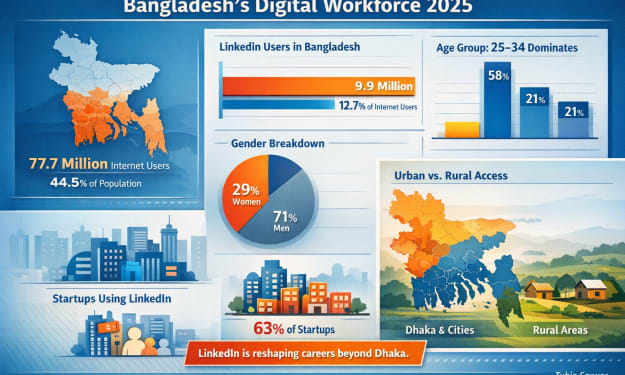
LinkedIn and Bangladesh’s Digital Workforce Transformation: Youth, Startups, and Future Skills
By Tuhin Sarwar | Dhaka। 02। December । 2025 । From her modest home in Sylhet, 24-year-old Rafia Hussain flips open a second-hand laptop, logs into the LinkedIn app and reviews an inbox of messages from clients in London, Singapore and Dubai. She adjusts a brand mock-up for a global startup, schedules a call with a US design director and uploads a revised style guide all before breakfast is done.
By Tuhin sarwar24 days ago in Journal