
Knives Out: A Close Crime, A Distant Gaze
Review of Knives out'. It is an American mystery film directed by Rian Johnson.


"Whodunnit!"—a term primarily used to describe detective stories or crime thrillers—wasn’t in vogue until the 1930s. It became shorthand for a very specific kind of fiction that emerged in the post-World War I era, where the central mystery revolved around uncovering the identity of a murderer. As the phrase suggests, a whodunnit is all about the suspense: who actually committed the crime?
The subject of our discussion, Knives Out, is a modern take on the whodunnit genre. The film gives away nothing until the very end. As viewers, we’re kept in a constant guessing game—clues are scattered generously, suspicions rise and fall—but the veil over the mystery remains tightly drawn until the climax. The tension never breaks. Two of the film’s most compelling characters—ace detective Benoit Blanc and Harlan Thrombey’s nurse, Marta Cabrera—share the screen in some of its most gripping moments.
The film begins with a suicide. On November 8th, renowned mystery writer Harlan Thrombey is found dead. As the narrative unfolds, questions begin to arise. What if this wasn’t a suicide at all, but a well-disguised murder? The latter seems more plausible the deeper we go. And if it was murder—then who did it?

Harlan Thrombey was a bestselling author whose mystery novels sold over 80 million copies and were translated into 30 languages. His younger son, Walt, was the CEO of the family publishing company. Every year, Harlan would entrust him with two new books to publish, helping the company thrive. Walt had long wanted to sell the film and TV adaptation rights to Harlan’s books. When Netflix expressed interest and offered a substantial sum, Walt brought it up during Harlan’s birthday party.
But Harlan was firmly against it. The rights, he reminded Walt, were his and his alone. Not the family’s. And certainly not Walt’s. That same day, he informed Walt that he would no longer be in charge of the publishing house. Walt, stunned and deflated, spent the rest of the party in silence.
Harlan’s elder daughter, Linda, is married to Richard, and they have a son named Ransom. Ransom, young and unemployed, had a heated argument with Harlan on the night of the party. It happened in a closed room, so no one knew exactly what was said. Only Walt’s son, Jacob, who happened to be in the adjacent bathroom, caught snippets of their exchange. Ransom stormed out before the party ended.
That evening, Richard too arrived early and had a tense confrontation with Harlan. The reason? Harlan had discovered proof of Richard’s extramarital affair. He presented photos and urged Richard to come clean to Linda. If he didn’t, Harlan threatened, he would tell her himself—pointing to a sealed envelope he claimed contained all the evidence. One of the catering staff overheard parts of this confrontation.

Another early arrival that evening was Joni Thrombey, the widow of Harlan’s deceased son Neil. A self-styled "lifestyle guru," Joni runs a skincare and wellness brand. Her daughter Meg studies at a liberal arts college, with tuition paid by Harlan. Joni also received an annual allowance from him. Recently, Harlan had discovered that Joni was embezzling—taking extra money in Meg’s name. Disappointed, he decided to cut both of them off financially, though he did write one final tuition check for Meg. A bitter pill, but one Harlan believed would ultimately do them good.
As the party wrapped up, other family members present included Walt’s wife Donna, Meg, nurse Marta Cabrera, housekeeper Fran, and Harlan’s mother—Great Nana Wanetta Thrombey.
Around 11:30 PM, Marta took Harlan to his study on the third floor to administer his medication. Joni was meditating in her room; Meg had already left to meet her college friends. Hearing a loud noise upstairs, Joni went to check on Harlan. He opened the door and told her he had accidentally knocked over the pieces of the board game “Go” he was playing with Marta. Satisfied, Joni returned to her room.

As she climbed the creaky wooden stairs, the noise woke Linda. She had a light sleep and was disturbed not once but twice that night—once by Marta leaving after her shift, and once when Harlan came downstairs for a snack. At that time, Walt was smoking a cigar outside, and Jacob was absorbed in his phone.
Meg returned home around 12:30 AM and went straight to bed. Soon after, Walt and Jacob turned in as well.
The next morning, housekeeper Fran took breakfast to Harlan’s study and found his lifeless body slumped on the sofa—blood on the cushions, blood on the rug, and a knife on the floor. She almost dropped the tray from shock. The police were summoned. Two officers—one local detective and one state trooper—began questioning the family.
But one week later, the entire family is interviewed again. This time, they’re joined by a mysterious new figure—detective Benoit Blanc.
At first, Blanc remains a passive presence—quietly seated in the background, occasionally pressing a piano key with a soft ting in response to certain answers. We don’t know who he is or what he’s doing there. But soon, we learn that he’s a famous detective—profiled in The New Yorker, celebrated for cracking high-profile cases. He describes himself with deliberate humility: “Respectful, quiet, and passive observer of the truth.”

The heart of Knives Out lies in two characters: nurse Marta Cabrera and detective Blanc. Marta was the last person to see Harlan alive, and the last to speak with him. She’s also the film’s most emotionally resonant character. Her peculiar trait—an uncontrollable physical reaction to lying—adds a brilliant twist. It becomes clear that uncovering the truth about Harlan’s death will hinge on her.
But as the story progresses, the mystery only deepens. Who hired Blanc? Even he doesn’t know. A day before the investigation began, an anonymous envelope containing cash and newspaper clippings about Harlan’s death arrived at his apartment. Someone wanted him to investigate, regardless of whether others believed it was suicide.
Blanc’s investigation unlocks an electrifying murder mystery. The film doesn’t slow down for a moment—thanks to a cascade of twists and turns. Nathan Johnson’s evocative score and Steve Yedlin’s rich cinematography deserve special mention. Rian Johnson’s screenplay is masterfully layered—just when the viewer feels they’ve figured it all out, a new surprise flips everything on its head.
It keeps you guessing until the very end—exactly what a perfect whodunnit should do.
About the Creator
Riham Rahman
Writer, History analyzer, South Asian geo-politics analyst, Bengali culture researcher
Aspiring writer and student with a deep curiosity for history, science, and South Asian geopolitics and Bengali culture.
Asp
Keep reading
More stories from Riham Rahman and writers in Journal and other communities.
How South Asia is blowing against the wind of regional cooperation Panorama
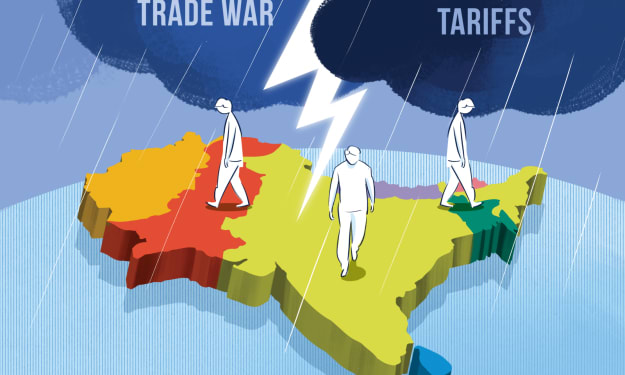
As US-inflicted tariff wars mount, the region remains disintegrated with barely 5% of its global trade among members No other region has been hit as hard as Asia by American President Donald Trump's tariff policies targeting countries having a trade surplus with the US. The overall outlook of Asia does not seem bright after the trade war triggered by what Trump termed "reciprocal tariffs". Though paused for 90 days, a baseline 10% remains in force while China faces up to 145% duties prompting it to impose retaliatory steps.
By Riham Rahman 10 months ago in Journal



Comments
There are no comments for this story
Be the first to respond and start the conversation.