
Is Donald Trump the next Pope?
Who is the next pope?

The US President, Donald Trump, has expressed a desire to become the Pope.The supreme religious leader of the Catholic faith. He stated, "I want to be Pope." Following the death of Pope Francis, the head of the Catholic Christians, the Cardinals will elect a new Pope. Approximately 135 Roman Catholic Cardinals from around the world will participate in a secret conclave next May to elect the next Pope. Amidst this, Donald Trump made such a comment.
However, Trump did not sincerely harbor this aspiration. He expressed this desire in jest. According to a report in the American news outlet Politico, Donald Trump jokingly said that his first choice to become the next head of the Catholic Church, the Pope, is himself. He told a journalist, "I want to be Pope." Immediately after joking, he shared his opinion on who could actually take on this responsibility.
Despite being extremely busy as the President of the United States, Trump is a billionaire and has been married three times. Therefore, his chances of being elected as the head of the Catholic Church are practically non-existent. In response to the question of who should succeed Francis, Trump said, "I don't have a preference, but I must say we have a Cardinal who comes from a place in New York. He is very good. Let's see what happens."
What is pope?
The Pope is the head of the Roman Catholic Church and the head of state of Vatican City. According to Catholic belief, the Pope is the successor of Saint Peter, the apostle of Jesus Christ, and Christ's representative on Earth.
The Pope's power and responsibilities are extensive. He is the supreme religious leader of the Catholic Church and the ultimate interpreter of its doctrines and practices. His decisions on religious policy, rituals, and the Church's internal law are considered final. Additionally, the Pope provides spiritual guidance to the global Catholic community and expresses his views on various social and moral issues. As the head of state of Vatican City, he also plays an important role in international affairs.
The History of the Pope: Power, Spiritual Leadership, and the Context of Evolution
In the history of Christianity, the Pope holds a significant and influential position. The Bishops of Rome, who are regarded as Saint Peter's heirs, have had a turbulent and lengthy history that spans nearly two millennia. Throughout this long journey, Popes have not only been spiritual leaders but have also played crucial roles politically and socially in the context of their times.
The Apostle Peter, a follower of Jesus Christ, is regarded as the first Bishop of Rome in the first century. Although the status of the Bishops of Rome grew gradually in the early stages compared to other bishops, a special spiritual authority was felt to be vested in them. In 313 AD, Emperor Constantine's Edict of Milan granted religious freedom to Christians, creating an important foundation for the expansion of the Pope's influence. By the end of the fourth century, the Pope's authority became more distinct, especially during the time of Pope Leo I (441-461), who strongly advocated for the spiritual authority of the Pope.
During the Middle Ages, the power and prestige of the Pope reached new heights. Figures like Pope Gregory I (590-604) consolidated the administration of the Church and exerted significant influence in both religious and political spheres. During this time, Popes were more than just religious leaders; they also crowned emperors and were not afraid to challenge their authority when it was needed, as Pope Innocent III demonstrated. The active participation of Popes in the religious Crusades further solidified their political and spiritual authority. However, from the thirteenth century onwards, the Pope's power gradually began to decline, and the Western Schism in the late fourteenth century severely weakened papal authority.
In the modern era, the Renaissance and the wave of the Protestant Reformation significantly reduced the Pope's political power. Martin Luther's Protestant Reformation, which tore apart the Catholic Church and questioned the Pope's claim to universal spiritual authority, was a catalyst for division. In the nineteenth century, the unification of Italy further diminished the Pope's temporal power, and finally, with the establishment of the Vatican City State in 1929, the Pope emerged as the head of a small sovereign state.
In the twentieth century, the Second Vatican Council (1962-1965) brought about modern reforms in the Catholic Church and conveyed a message of tolerance towards other religions and cultures. The Pope is currently regarded as the spiritual leader of hundreds of millions of Catholics all over the world and has established himself as a potent advocate for human rights, justice, and peace around the world. The history of the Pope is not merely a history of religious leadership; it is a complex narrative of the rise and fall of power, political influence, and the evolution of the Catholic Church over time. Popes' roles in various social and political contexts have changed over time, but their spiritual leadership and moral authority are still very important to the global Catholic community today.
About the Creator
Keep reading
More stories from M.A.Rahman and writers in Journal and other communities.
First American Pope!!
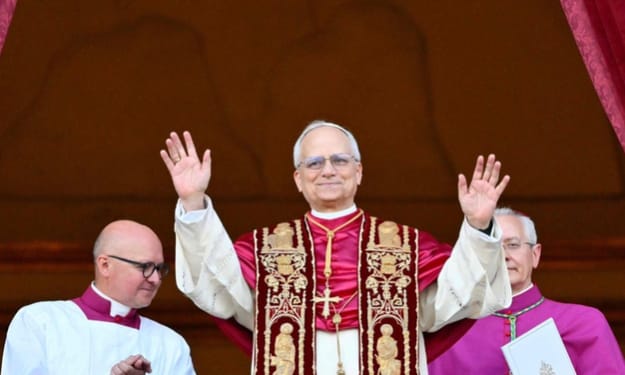
enc "Long Live the Pope!" Crowd Cheers as Robert Prevost Named New Pontiff Even before his name was announced from the balcony of St. Peter's Basilica, the crowd gathered below was chanting "Viva il Papa"—"Long live the Pope!" After his name was revealed, 69-year-old Robert Prevost was declared the 267th successor to St. Peter, taking the name Pope Leo XIV.
By M.A.Rahman10 months ago in Journal
Three Generations of Ukrainian Women on Soviet Memory, War, Faith, and Independence
By Scott Douglas Jacobsen and Anastasia Bura (Translator, English-Ukrainian) Liubov Polischuk is a Ukrainian interview participant whose recollections focus on Soviet and post-Soviet life. In the conversation, she discusses scarcity, propaganda, military surroundings, restricted travel, prayer, and Ukrainian independence. Her comments emphasize lived experience across political change, including daily survival, faith, memory, and wartime moral perspective over several decades. Tetiana Shuliaka is a Ukrainian interview participant describing civilian life during Russia’s war against Ukraine. In the conversation, she recounts nightly drone threats, prayer, fear of missile strikes, and the pressures of self-defence. Her remarks connect contemporary danger to longer Soviet patterns of military industry and constrained freedom for civilians. Anastasia Bura is the youngest participant in this group discussion and is the translator (English-Ukrainian) in this interview.
By Scott Douglas Jacobsenabout 10 hours ago in Journal



Comments (1)
great