
IoT in the Automotive Industry: Transforming Vehicles into Smart Machines
Discover how IoT is transforming the automotive industry, turning vehicles into smart machines with enhanced safety, efficiency, and connectivity for the future of driving.

The automotive industry is undergoing a revolutionary transformation, largely driven by the adoption of the Internet of Things (IoT). As of 2023, Statista reported that there are over 400 million connected vehicles worldwide, with that number expected to surpass 1 billion by 2030. This rapid growth highlights the profound impact of IoT on vehicles, enabling them to become smarter, safer, and more connected than ever before.
From advanced driver-assistance systems (ADAS) to predictive maintenance and real-time data analytics, IoT is playing a pivotal role in transforming vehicles into smart machines. By integrating sensors, devices, and software, IoT is enhancing vehicle performance, safety, and user experience, while opening the door to new business models and opportunities for the automotive industry.
What is IoT in the Automotive Sector?
IoT in the automotive industry refers to the integration of internet-connected devices within vehicles. These devices, often sensors and software applications, collect, exchange, and analyze data, enabling the vehicle to perform smarter functions. For example, connected vehicles can monitor tire pressure, track fuel efficiency, and even detect malfunctions before they lead to major failures.
IoT has led to the creation of smart vehicles that can:
- Communicate with other vehicles (V2V).
- Communicate with infrastructure (V2I).
- Gather real-time data for predictive maintenance.
- Improve driver safety through ADAS.
- Provide in-car connectivity for passengers.
The result is a new generation of vehicles that are not only more efficient but also more user-friendly and safer than ever before.
The Growing Role of IoT in Automotive Manufacturing
IoT adoption in automotive manufacturing is also on the rise. Manufacturers are using IoT to improve production efficiency, reduce defects, and streamline supply chains. According to McKinsey, connected vehicles and smart manufacturing will drive over $50 billion in revenue by 2025. The ability to collect real-time data from both vehicles and manufacturing systems creates valuable insights that can enhance vehicle design and performance.
Global Market Outlook
The global IoT in automotive market was valued at $20.5 billion in 2021 and is projected to grow at a CAGR of 25.4% from 2022 to 2030, according to Grand View Research. This growth is driven by the increasing demand for connected vehicles, the rise of autonomous driving technologies, and advancements in cloud computing and data analytics.
Key Areas Where IoT is Transforming Vehicles
1. Advanced Driver-Assistance Systems (ADAS)
ADAS represents a key area where IoT is making a significant impact. These systems use IoT devices such as cameras, radar, and sensors to monitor the vehicle’s surroundings and assist the driver in making decisions. Common features include:
- Lane departure warnings.
- Automatic emergency braking.
- Adaptive cruise control.
- Blind-spot monitoring.
- Traffic sign recognition.
Example: Tesla's Autopilot uses a combination of IoT-enabled sensors, cameras, and machine learning to provide semi-autonomous driving features, enhancing safety and comfort.
IoT-powered ADAS improves road safety by reducing human error, preventing accidents, and providing real-time alerts.
2. Predictive Maintenance
Predictive maintenance is another area where IoT is having a substantial impact. IoT sensors embedded in vehicles can monitor engine performance, tire pressure, battery health, and more. This data is transmitted to cloud platforms where machine learning algorithms predict when a vehicle might need maintenance or repairs, allowing for timely interventions.
Example: BMW offers a connected service called BMW ConnectedDrive, which alerts drivers about vehicle maintenance needs, helping to prevent costly breakdowns and improving vehicle longevity.
With predictive maintenance, drivers can avoid unexpected repairs, enhance vehicle reliability, and reduce overall maintenance costs.
3. Vehicle-to-Everything (V2X) Communication
Vehicle-to-Everything (V2X) communication is a concept where vehicles can communicate with other vehicles (V2V), infrastructure (V2I), and even pedestrians (V2P) to improve safety and traffic flow.
V2V: Vehicles communicate with each other to warn drivers of potential collisions or hazards ahead.
V2I: Vehicles can communicate with traffic lights, road signs, and other infrastructure to optimize traffic flow and reduce congestion.
V2P: Pedestrians can also be detected through connected devices, ensuring safety in urban areas.
Example: Audi has implemented V2X technology in some of its models, allowing cars to communicate with traffic signals to adjust speed and avoid traffic jams.
V2X technology, powered by IoT, aims to create a more connected and safer driving environment, especially in cities with dense traffic.
4. In-car connectivity and Infotainment Systems
Connected vehicles offer advanced infotainment and connectivity systems that enhance the passenger experience. These systems include voice-controlled interfaces, GPS navigation, real-time traffic updates, and streaming capabilities. IoT enables seamless integration with smartphones, allowing passengers to access apps, music, and other services.
Example: Ford’s Sync 4 is an IoT-enabled infotainment system that allows drivers and passengers to control music, navigation, climate, and even smart home devices through voice commands.
These systems provide an enhanced in-car experience by offering entertainment, information, and connectivity during the ride.
5. Autonomous Driving and IoT Integration
Autonomous driving is one of the most promising developments in the automotive industry. IoT technologies, such as sensors, cameras, and radar, enable vehicles to navigate and make decisions without human intervention. Through the integration of IoT with artificial intelligence (AI) and machine learning (ML), autonomous vehicles can analyze their surroundings and make decisions in real-time.
Example: Waymo, a subsidiary of Alphabet (Google’s parent company), uses IoT-enabled sensors and data analytics to operate autonomous vehicles that navigate city streets with minimal human interaction.
Autonomous vehicles powered by IoT can transform the way we commute, offering a future where driving is safer, more efficient, and less dependent on human control.
Benefits of IoT in the Automotive Industry
1. Improved Safety
The most immediate benefit of IoT in vehicles is improved safety. By integrating IoT-enabled sensors, cameras, and analytics systems, vehicles can avoid collisions, detect hazards, and monitor driving conditions, significantly reducing the risk of accidents.
2. Enhanced Efficiency
IoT enables vehicles to operate more efficiently, optimizing fuel consumption and reducing emissions. Predictive maintenance and real-time diagnostics also ensure that vehicles are running at peak performance, reducing downtime and improving operational efficiency.
3. Cost Savings
Both consumers and manufacturers can benefit from cost savings. For consumers, predictive maintenance reduces the likelihood of expensive repairs, while manufacturers can streamline operations and reduce costs associated with vehicle production and after-sales services.
4. Better User Experience
IoT enhances the user experience by providing personalized and connected services. From smart navigation to in-car entertainment, these technologies ensure a more enjoyable and comfortable journey for drivers and passengers.
5. Environmental Impact
By optimizing fuel efficiency, improving traffic flow, and reducing emissions, IoT technologies contribute to a greener automotive industry. For example, IoT-powered electric vehicles can monitor battery health and optimize charging cycles, contributing to sustainability goals.
The Role of an IoT Development Company in Automotive IoT Integration
An experienced IoT Development Company is crucial for the successful implementation of IoT solutions in the automotive industry. The development of IoT-enabled vehicles requires expertise in hardware and software integration, data analytics, and cloud computing.
1. Custom IoT Solutions for Automotive Manufacturers
An IoT Development Company can create custom IoT solutions that meet the specific needs of automotive manufacturers. Whether it’s a custom sensor for predictive maintenance or a tailored infotainment system, a skilled company can design a solution that aligns with the brand’s goals and requirements.
2. Integration with Existing Systems
Most automotive manufacturers already have some level of automation or connected systems in place. An IoT Development Company can seamlessly integrate new IoT technologies with these existing systems, ensuring smooth data flow and real-time decision-making.
3. Data Analytics and Cloud Integration
The data generated by IoT devices in vehicles is vast. An IoT Development Company can create cloud-based platforms for storing and analyzing this data, providing valuable insights that drive better decision-making in vehicle design, manufacturing, and maintenance.
4. Ongoing Support and Maintenance
IoT systems require ongoing monitoring and maintenance to ensure they function correctly. An IoT Development Services provider can offer continuous support, troubleshooting, and updates, ensuring the system remains up-to-date and efficient.
Example of IoT-Enabled Automotive Solutions
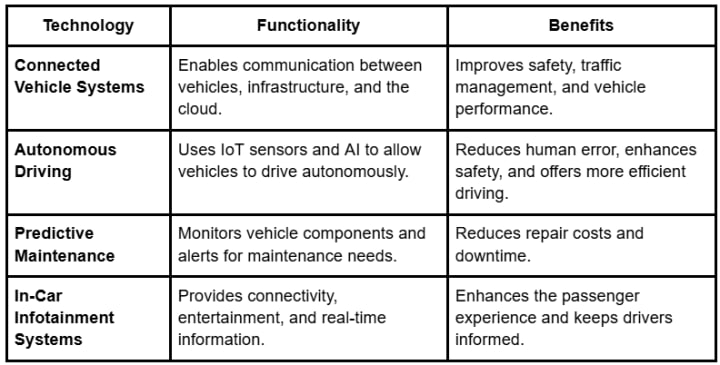
Here is a table outlining some key IoT-enabled technologies used in the automotive industry:
Conclusion
IoT is fundamentally transforming the automotive industry, turning vehicles into smart machines that offer improved safety, efficiency, and connectivity. From advanced driver-assistance systems (ADAS) to autonomous driving, predictive maintenance, and in-car infotainment, IoT is enhancing every aspect of the driving experience.
By partnering with a reliable IoT Development Company, automotive manufacturers can integrate these technologies into their vehicles, creating smarter, safer, and more efficient transportation solutions for the future. As the automotive industry continues to embrace IoT, the possibilities for innovation are limitless.
About the Creator
Casey Morgan
I'm a Digital Marketing Manager with 10+ years of experience, driving brand growth and digital strategies. Currently at HashStudioz, an IoT Development Company, enhancing online presence.
Keep reading
More stories from Casey Morgan and writers in Journal and other communities.
How Python Developers Help Build Scalable and Reliable Applications
Imagine a startup whose app suddenly gains 100,000 users in a month. Traffic spikes, data inflates, and new features expand rapidly. Without a system designed for scale, performance slowdowns, security gaps, and crashes become almost inevitable.
By Casey Morgan5 days ago in Journal
Designing Aircraft for Arctic, Desert and Tropical Operations
Aircraft are often seen as symbols of freedom and global connectivity, but behind every successful flight lies an extraordinary engineering challenge designing machines that can operate reliably in the most extreme climates on Earth. From the frozen Arctic to scorching deserts and humid tropical regions, each environment pushes aircraft systems, materials, and performance limits in very different ways.
By Beckett Dowhan6 days ago in Journal
Center Stage with Paul Stewart
*** I'm keen to republish the interviews I did for my series with Vocal creators. It's been a few years and I thought it might be nice to revisit these wonderful conversations. I'll be releasing them one at a time for a few weeks/months.
By Heather Hubler3 days ago in Interview




Comments
There are no comments for this story
Be the first to respond and start the conversation.