
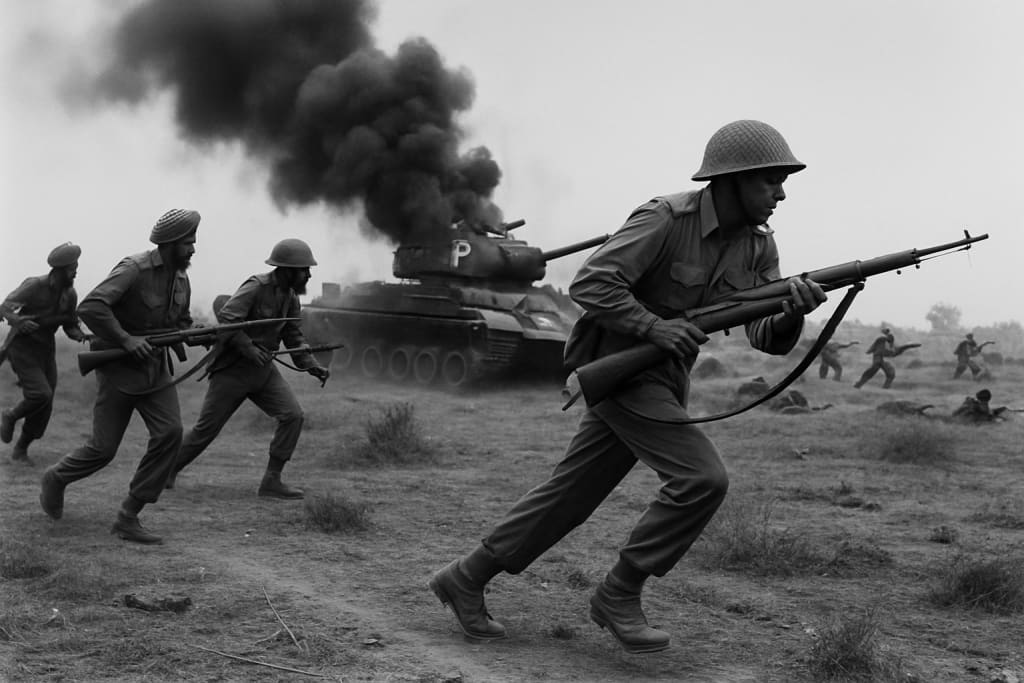
Southeast Asia's two powerful country India and Pakistan got involved in war . Pakistan and India have been engaged in a hostile relationship for some time now. This hostile situation has turned into a temporary war.
India and Pakistan were involved in the Kargil War in 1999. This war lasted for about 2 months. Many soldiers of the Indian and Pakistani armies died in this war. About 4000 Pakistani soldiers died.
The Siachen conflict, sometimes referred to as the Siachen Glacier conflict or the Siachen War, was a military conflict between India and Pakistan over the disputed 1,000-square-mile (2,600 km2) Siachen Glacier region in Kashmir. The conflict was started in 1984 by India's successful capture of the Siachen Glacier as part of Operation Meghdoot, and continued with Operation Rajiv in 1987. India took control of the 70-kilometre-long (43 mi) Siachen Glacier and its tributary glaciers, as well as all the main passes and heights of the Saltoro Ridge immediately west of the glacier, including Sia La, Bilafond La, and Gyong La. Pakistan is in charge of the glacial valleys immediately west of the Saltoro Ridge. Although a cease-fire was declared in 2003 , both sides continue to have a significant military presence in the region.
India Pakistan conflict of 2025 started on 7 May 2025 , which was triggered by India . India named this mission as "Operation Sindoor".The operation was launched in retaliation for the 2025 Pahalgam attack, in which 28 civilians, mostly tourists, were killed by militants in Indian-administered Kashmir. India claimed the strikes targeted militant groups Jaish-e-Mohammed and Lashkar-e-Taiba, while Pakistan reported civilian casualties, alleging strikes on populated areas.
In response to India , Pakistan started an operation which is "Operation Bunyan al-Marsus" . On 10th May Pakistan striked some cities of India . This conflict marks the first drone battle between two nuclear-armed nations. on 10 May, targeting multiple Indian cities. The confrontation featured the first drone warfare exchange between two nuclear-armed states. A ceasefire was declared on 10 May, with both sides agreeing to de-escalate and commence diplomatic talks on 12 May.
There is a risk for nuclear attack . Both the countries has nuclear bomb . Both are very dangerous in this field . On 18 May 1974 India detonated an 8-kiloton nuclear device at Pokhran Test Range,[129] becoming the first nation to become nuclear capable outside the five permanent members of United Nations Security Council as well as dragging Pakistan along with it into a nuclear arms race. Pakistani prime minister Zulfikar Ali Bhutto had promised in 1965 that "if India builds the bomb, we will eat grass or leaves, even go hungry, but we will get one of our own", and India's Pokhran-I test spurred the Pakistani nuclear weapons program to greater efforts. The Pakistan Atomic Energy Commission (PAEC) Chairman Munir Ahmed Khan said that the test would force Pakistan to test its own nuclear bomb.In the 1980s a series of 24 different cold tests were conducted by PAEC, led by chairman Munir Ahmad Khan under extreme secrecy. The tunnels at Kirana Hills, Sargodha, are reported to have been bored after the Chagai nuclear test sites, it is widely believed that the tunnels were constructed sometime between 1979 and 1983. As in Chagai, the tunnels at Kirana Hills had been bored and then sealed and this task was also undertaken by PAEC's DTD. Later due to excessive US intelligence and satellite focus on the Kirana Hills site, it was abandoned and nuclear weapons testing was shifted to the Kala Chitta Range. At the Pokhran Test Range on May 11, 1998, India detonated five more nuclear weapons. With jubilation and large scale approval from the Indian society came International sanctions as a reaction to this test, the most vehement reaction of all coming from Pakistan. Great ire was raised in Pakistan, which issued a stern statement claiming that India was instigating a nuclear arms race in the region. With statements such as "We are in a headlong arms race on the subcontinent," Pakistan vowed to match India's nuclear capability.
Chagai-I: (Youm-e-Takbir) Within half a month of Pokhran-II, on 28 May 1998 Pakistan detonated five nuclear devices to reciprocate India in the nuclear arms race. The Pakistani public, like the Indian, reacted with a celebration and a heightened sense of nationalism for responding to India in kind and becoming the only Muslim nuclear power. The day was later given the title Youm-e-Takbir to further proclaim such.
Chagai-II: Two days later, on 30 May 1998, Pakistan detonated a sixth nuclear device completing its own series of underground tests with this being the last the two nations have carried out to date.
Now India Pakistan conflict is a serious topic in the world . Let's see what happens next between this two powerful country.
About the Creator
Keep reading
More stories from writers in Journal and other communities.
Iran in ‘Serious Discussions’ with US, Trump Says, as Military Threat Looms
The United States and Iran are reportedly engaged in “serious discussions”, former President Donald Trump stated, as regional tensions rise and the prospect of military action looms. The announcement comes amid months of growing unease over Iran’s nuclear ambitions, regional influence, and repeated warnings from Washington regarding potential escalation.
By Aarif Lashariabout 6 hours ago in Journal




Comments
There are no comments for this story
Be the first to respond and start the conversation.