
Importance of CFD Simulation Services
Here is how CFD simulation helps solve complex engineering challenges

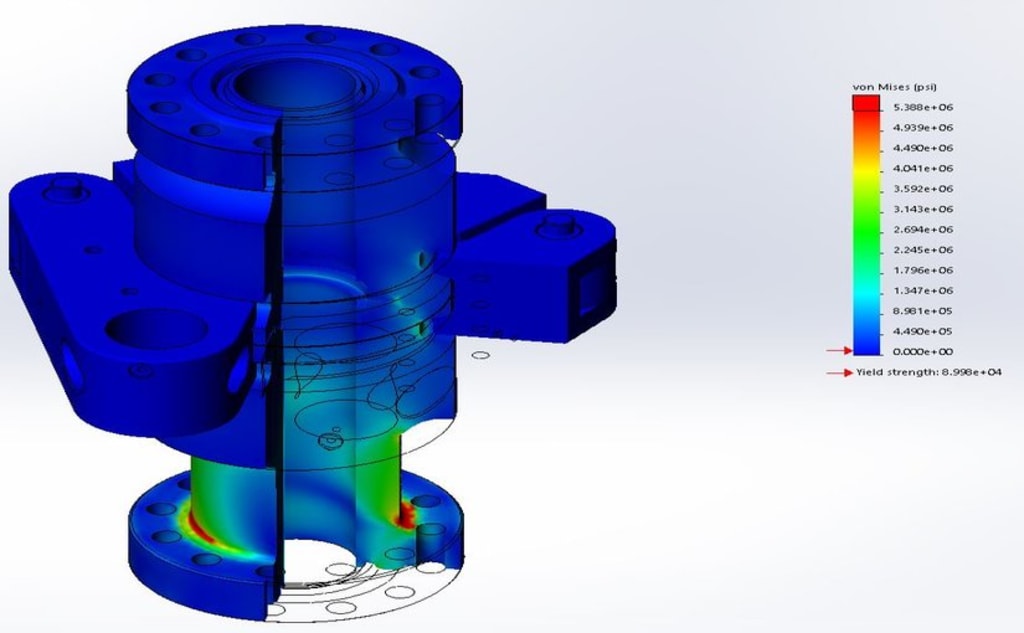
According to the project engineering company, ‘Computational Fluid Dynamics (CFD) is a numerical computer simulation that permits fluid flow around or through an object so that the impact on that object can be analyzed in detail.’
This simulation, based on steady flow analysis during design, can therefore help determine whether a product meets a client’s expectations. It can also help determine what changes, when applied to a product, will improve its general performance.
This near-perfect process results in flawless product designs that leave all stakeholders satisfied. Thus, CFD modeling reduces costs and improves turnaround time while producing reliable results. This is the reason why CFD analysis reports are considered to be completely reliable.
There are many advanced CFD software like Ansys Fluent, Open Foam, and Hypermesh which ensure the said authenticity of results. They also massively contribute to the quick delivery turnaround time.
Many companies provide CFD modeling services that help cut down prototype testing time, time- and cost-to-market. This way, businesses are constantly being saved from most technical risks and the loss of millions in investments.
CFD simulation is used to produce results in many industries that take advantage of its multi-faceted analytical abilities. These key industries include;
•Aeronautics
• Building HVAC (heating, ventilation, and air conditioning)
• The Automotive Industry
• The Chemical Industry
• Power Generation
• Manufacturing
• Process Engineering
• Product Design and Optimisation
• The Oil and Gas Industry
• Turbo Machinery
The importance of CFD simulation services is undeniably visible in many other ways that include:
1. Acquisition of a wider perspective; into complex systems that would be more tasking and costly to test through experimentation. The more computers become powerful, the less costly the process will be. CFD is therefore continuously playing into the hands of investors who now have the right information to make informed decisions.
2. The foresight of future performance; which helps optimize designs suitably without executing final processes or installing actual systems. This significantly lowers costs while retrieving essential engineering data at the same time. This data would otherwise not be acquired easily using only theoretical or experimental methods.
3. Prediction of mass flow rates; in addition to the rates of heat transfer, fluid transfer, and the action of fluid dynamic forces that include lift, drag, and pitching moments. This precise and detailed information helps detect how a product will respond to its intended environment and mode of operation.
4. Simulation of real-life circumstances; which otherwise could not be tested. For example, heat transfer and flow processes are not ideal for physical testing and CFD helps theoretically simulate such physical processes.
5. Simulation of ideal conditions; a few CFD companies in the USA have used CFD simulation to isolate specific phenomena for research purposes since it offers greater control over physical conditions.
6. Examination of data from multiple locations; unlike physical testing which limits the number of examinable locations, CFD facilitates large-scale examination in various locations in the areas of interest. This eventually yields a definite flow of parameters that can be further examined.
7. Verification of design parameters; in systems such as Vestibule Smoke Systems, Displacement and Natural Ventilation Systems, in addition to Raised Floor Systems, among others. This helps validate diverse designs like the location, the number of exhausts and diffusers, the temperature, and the flow rate of supplied air when meeting specific design criteria.
8. Identification of appropriate systems between alternatives; when it comes to HVAC systems, there are several options to choose from sometimes. CFD simulation helps detect which alternative is the most efficient and therefore worth exploring.
9. Investigation of Engineering paradoxes; CFD simulation helps engineers identify and understand problems while offering practical ideas. Through extensive analysis of velocity, temperature, and chemical concentration allocation, appropriate conclusions are drawn. It is through this that engineers come up with flawless designs that result in stellar products.
10. Quality Control; as a result of the analysis of complex fluid and thermal phenomena, the safety, and quality of products for everyday use are ensured. CFD modeling is instrumental to the automobile and the house we see in our everyday lives. The best product design concepts are identified early before the design process goes too far. This helps improve upon designs on an ongoing basis.
Conclusion
Since the production process can be so intricate, the use of simulation software based on CFD is continuously central to continued success. By using mechanical and structural software, coupled with CFD simulation, products can be brought up to speed with client needs.
Most importantly, they can be optimized to meet market demand which is the most urgent aspect if a business is to stay afloat. By responding directly to what people are drawn to, based on studied market patterns, engineers can create viable products that will produce results as required.
CFD simulation is therefore fundamental and will in some cases even eliminate the need for physical testing. With this, design performance will always be improved, serving consumers and businessmen alike. Get in touch with the CFD company for further details.
About the Creator
Alice Dcruze
Innovation - Design - Engineering
Keep reading
More stories from Alice Dcruze and writers in Journal and other communities.
Future of Automation in CNC Machining
Over the years, Computer Numerical Control (CNC) had a positive impact on industrial manufacturing. But there have been debates whether the current process of manual programming in CNC will be effective enough in the future too.
By Alice Dcruze5 years ago in Journal
How Mobile App Development Atlanta Firms Handle UX Challenges?
UX problems rarely announce themselves early. They show up after launch, when users hesitate, abandon flows, or quietly stop engaging. By then, the cost of fixing them is higher and the patience of stakeholders is thinner. Atlanta app firms that consistently deliver successful products have learned this the hard way, and their approach to UX reflects that experience.
By Nick William4 days ago in Journal
Wild Card Weekend Recap: What Happens Now?
I think I figured out why I love Wild Card Weekend so much. It's because it's the first playoff anything of the calendar year. The NFL season starts in the fall, and once upon a time, the champion was crowned either on or slightly before New Year's. The evolution of the NFL schedule has resulted in the playoffs starting just into the New Year, and currently, the final week of the season falls on the first weekend of the New Year, with Wild Card Weekend coming a week after that. So yes, chronologically, the NFL's Wild Card Weekend serves as the first playoff anything of the calendar year.
By Clyde E. Dawkins7 days ago in Unbalanced




Comments
There are no comments for this story
Be the first to respond and start the conversation.