
If You Never Try, You Will Never Know
Every Dream Starts With a Risk

It was past midnight when Rhea finally shut her laptop, her fingers numb from typing and her eyes burning from hours of blue light. The deadline was met, just like all the others — on time, professional, and soulless. Another marketing pitch approved, another email thread full of praise that somehow made her feel emptier.
She glanced at the easel in the corner of her apartment, draped with a paint-stained sheet. It hadn’t seen a brush in months. Maybe years. She told herself there was no time for that anymore — that art was a luxury for people who hadn’t tasted the real world yet.
But tonight, as silence settled over the city outside her 14th-floor window, she felt the weight of something she'd tried hard to ignore: regret. Not loud or angry. Just… there.
She walked over to the easel and pulled back the sheet. Underneath was a half-finished painting of a woman standing at the edge of a dock, looking out into endless fog. It was something she’d started the summer after college, right before she took the job she thought she wanted. Right before she packed away the last pieces of her dream and called it “growing up.”
In the quiet, the words her grandmother used to say echoed in her mind:
“If you never try, you’ll never know.”
Rhea didn’t sleep that night.
By morning, her resignation email was written. Not dramatic, not angry — just a clean break. A choice.
She booked a one-way ticket to a small coastal town she’d only read about in travel blogs. Clearwater Bay. Population: under 5,000. Known for its quiet beaches and art co-ops. The kind of place people ran to when they’d been running too long.
She didn’t tell anyone at first. Not even her closest friend Maya, who would surely say something supportive with a voice full of worry. Rhea just packed a duffel, took her paints, her grandmother’s old journal, and left.
The air in Clearwater was different. Salty, warm, and full of space to breathe. The rental cottage sat near a bluff, facing the sea. No internet, spotty cell service, and furniture that had seen better decades. But it had light. Morning light that poured through the windows like forgiveness.
Rhea painted again.
Not for a show. Not for Instagram. Just for herself.
It wasn’t easy. The first canvas looked like a child’s effort. Her brushstrokes were awkward, her colors unsure. But day by day, something returned — not just technique, but presence. She began sketching locals. The man who sold fish by the pier. The older woman who ran the bakery and told stories about the “storms of '98.” The two little girls who danced barefoot on the sand, shrieking with laughter as the waves chased them.
They didn’t know who Rhea used to be. And for the first time, neither did she.
One morning, while painting the shoreline from a cliffside bench, someone approached. A man in his early 30s, carrying a leather sketchbook and a backpack full of sand.
“Mind if I join?” he asked.
She glanced at him. “Are you going to judge my brushwork?”
“Only if you judge my terrible proportions,” he grinned, holding up a sketch of the lighthouse that leaned slightly to the left.
His name was Jonah. He’d been in Clearwater two years, a former architect who left his firm after his brother died suddenly. Art, he said, had been therapy. His sketches were raw and filled with emotion. They started painting together twice a week, then every day. They talked. They laughed. They stopped pretending to be anyone but themselves.
Rhea told him everything — about her job, her fear, her feeling of slowly vanishing inside a life that looked perfect from the outside.
Jonah just nodded. “Trying saved me,” he said one night. “But I almost didn’t.”
Months passed like days. Rhea set up a small corner gallery in town — just a rented room with white walls and hanging lights. She didn’t expect anyone to show up.
But they did.
Locals. Tourists. The girls from the beach, dragging their parents in. A visitor from the city who offered to feature her work in a small magazine.
Maya came too. She walked through the gallery in stunned silence before hugging Rhea with teary eyes. “You did it,” she whispered. “You actually did it.”
Rhea just smiled. “I tried. That was the hardest part.”
On the anniversary of her arrival, she stood once again at the edge of the cliff, painting the ocean. The fog rolled in just like the one in her unfinished painting — the one she had finally completed weeks ago. In it, the woman had stepped off the dock and into the fog, no longer watching, but moving forward.
Jonah joined her, handing her a warm cup of coffee.
“You happy?” he asked.
She looked at the sea, then at her hands covered in paint.
“I don’t know if happy is the word,” she said. “But I’m free. And I finally feel real.”
In the end, she didn’t need the world to applaud her. She just needed to stop waiting for a sign, a permission slip, or the perfect time.
She needed to try.
Because if she hadn’t, she never would have known — what it meant to truly live.
About the Creator
Keep reading
More stories from Mahayud Din and writers in Journal and other communities.
Breaking Down and Leveling Up: Crying, Laughing, and Cry-Laughing
Life doesn’t come with an instruction manual, and if it did, I’m pretty sure mine got lost somewhere between the “Stay Calm” chapter and the “You’ve Got This” appendix. There have been moments when I felt like I was breaking down in slow motion—a messy, emotional unraveling that seemed to come out of nowhere and take hold like a tornado in my chest. But, weirdly enough, those moments also turned out to be the times I leveled up in ways I never expected.
By Mahayud Din9 months ago in Journal
Why Accurate Call Monitoring Is the Secret to Happier Customers
An operations manager pulls up the monthly CSAT report and sees a three-point drop, from 87% to 84%, with no obvious cause. Ticket volumes are normal, staffing levels are solid, and the training curriculum hasn't changed. After a week of digging, she finds the culprit: agents on a particular shift had developed an informal habit of skimping on empathy statements during difficult calls. No alert fired. No supervisor caught it. The scorecard hadn't been updated in six months. The gap went unnoticed until customers noticed it first. Meanwhile, customers simply felt unheard and quietly began rating their experiences lower.
By Etech Global Services2 days ago in Journal
Early March 2026: 4 Goals Accomplished
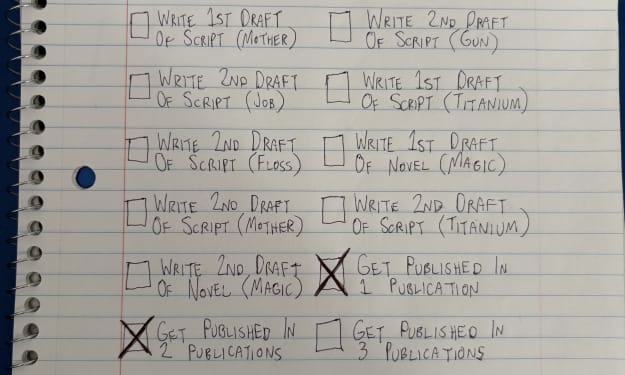
It's early March and I've now accomplished my 4th writing goal for the year of 2026. Before diving into the behind-the-scenes of it... why not tell you up front what that accomplishment was? I was published in a 2nd publication for this year. Published in Helix Literary Magazine out of Central Connecticut State University. You can read it for free right now!
By Stephen Kramer Avitabile2 days ago in Writers



Comments (1)
excellent