
How to Choose the Best Time for Sending Campaigns
How to Identify the Best Send Time for Your Email Campaigns


When should you send emails and messages to get the best results? This question never loses relevance, since the timing of delivery can influence effectiveness just as much as the content or subject line.
In this article, we’ll explain how to pick the optimal time for your campaigns, what factors to keep in mind when planning, and how automation can ensure your messages are delivered exactly when the recipient is most likely to open them.
Which Days and Times Work Best for Campaigns
Days of the Week
Tuesday, Wednesday, and Thursday are traditionally considered the most effective days. Many studies note that these days show higher email open rates across different industries.
At the same time, other data shows good results for campaigns sent on Monday and Sunday. This is explained by the fact that, while preparing for the new work week, recipients go through accumulated emails and respond more quickly to new messages.
Friday often turns out to be a “planning and decision-making” day. Users prepare for the upcoming weekend, plan purchases and leisure activities. That’s why promotional campaigns sent on Fridays can work especially well.
Saturday is usually seen as a weaker day, which is why the volume of campaigns is lower. However, less competition also increases the chance that an email with a relevant offer will be noticed. At the same time, special dates can change audience behavior. In these cases, general rules no longer apply, and campaigns require a separate strategy.

Best Time to Send Emails
Statistics show the highest engagement in the first half of the day (from 9:00 to 12:00, as well as between 12:00 and 3:00 p.m.). Morning emails catch subscribers at the start of the workday, while midday messages reach them during lunch. Evenings can also perform well: emails sent around 8:00 p.m. are opened nearly 60% of the time.
Late-night sends, however, are almost always a losing strategy. By the next morning or afternoon, they’re buried under new messages, and overnight notifications can annoy recipients and lead to unsubscribes.
How the Audience Influences Send Time

There are few direct studies linking age and lifestyle to the best time for email campaigns. For example, Sender highlights a few patterns:
- Younger audiences (roughly ages 18–34) are more active in the evening and closer to night (between 6:00 and 10:00 p.m.), as well as on weekends.
- Older audiences (45+) tend to check email mainly in the first half of the day, between 10:00 a.m. and 2:00 p.m., as part of their daily routine.
Best Time to Send Messages Across Different Channels
The optimal timing for campaigns depends not only on the day of the week or the hour of delivery, but also on the communication channel itself.
- Email campaigns are one of the most universal and widely used channels. On average, they perform best Tuesday through Thursday between 9:00 and 11:00 a.m. Additional engagement peaks are seen after lunch (1:00–2:00 p.m.) and in the early evening (5:00–6:00 p.m.).
- SMS is a channel with exceptionally high open rates (around 90% on average). Research from Textedly shows that the best times to send SMS are weekdays from 9:00 a.m. to 12:00 p.m., as well as from 5:00 to 9:00 p.m. There are also specific “windows” on weekends — for example, Sunday from 10:00 a.m. to 12:00 p.m. and from 4:00 to 7:00 p.m.
- Push notifications are effective only when they align with the user’s context and needs. They should arrive at the right moment — for example, when the offer is relevant or during the hours the person typically uses the app.
Even within a single channel, the right timing can vary greatly depending on what you’re sending:
Promotions and special offers. According to Optinmonster, the best response rates come at the end of the workweek — Thursday evening and Friday. That’s when audiences are planning purchases and are more responsive to discounts.
Educational and expert content. Most effective when sent on weekdays in the morning or early afternoon. Late Tuesday morning and Thursday morning work especially well.
Reminders and triggers. These should be delivered right after a user’s action or as close to the event as possible. The general rule: the shorter the delay, the higher the chance of engagement.
How to Handle Time Zone Differences
If your audience is spread across multiple U.S. time zones, timing becomes especially important. For example, an email scheduled for noon Eastern Time will reach subscribers on the West Coast at 9:00 a.m., which can significantly affect engagement and response rates.
To maintain effectiveness across time zones, marketers often use tools such as:
1. Time Zone Segmentation. A basic but labor-intensive method is to divide contacts by region and schedule campaigns according to local time.
2. Automation. Modern marketing platforms can factor in each subscriber’s time zone. The system automatically determines the right moment and synchronizes campaign delivery.
For example, in Altcraft Platform you can schedule delivery based on the subscriber’s own time zone. Someone in New York and someone in Los Angeles — or in London and Berlin — will both receive the message at the same local time. This makes life easier for marketers: there’s no need to create multiple copies of the same campaign or manage segments manually.

How to Automate Choosing the Best Send Time
General recommendations on when to send campaigns are useful only as a guideline. Each subscriber has their own habits: some check email in the morning, others in the evening, and some only on weekends. That’s why today’s marketing is moving away from a mass approach toward personalized technologies.
To find the optimal send time, marketers use Send Time Optimization (STO) algorithms. The system tracks the hours and days when a user most often opens emails, then predicts future behavior based on that activity history. As a result, emails are delivered at the moment when the likelihood of an open is highest.
What this means for businesses:
- Higher engagement. Emails arrive at a familiar, convenient time when the recipient is ready to read them.
- Greater effectiveness for large campaigns. The system automatically accounts for time zones and different user behavior patterns.
- Focus on strategy. Automation frees marketers from routine tasks, allowing them to concentrate on content and the customer journey.
Altcraft Platform handles automation through its machine learning–based Best Send Time (BST) module. Unlike simple scenarios (for example, “the user opened an email at 2:00 p.m., so they must always be active at that time”), the model takes multiple activity intervals into account. The data is updated daily, allowing it to adapt to changing habits, and the model achieves 82–93% accuracy even when working with large databases.
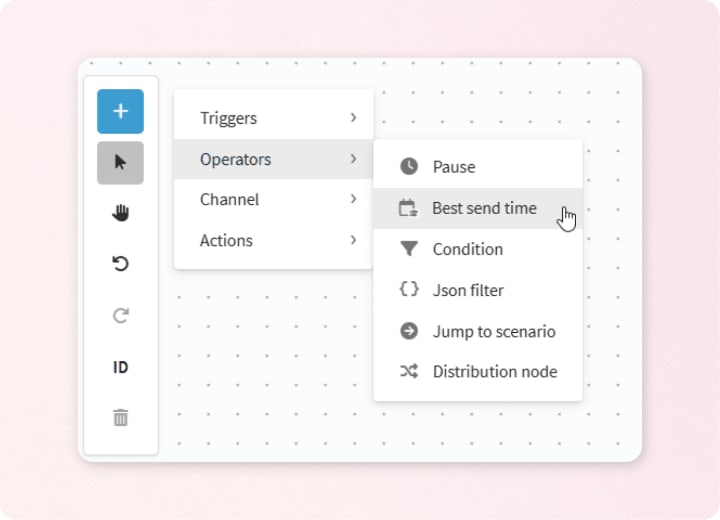
Learn more about the Best Send Time module and machine learning in our interview with Altcraft’s CEO.
Do You Still Need to Manually Test Send Times?
Using automated algorithms doesn’t eliminate the value of manual experiments. A/B testing remains an important tool: it allows you to test hypotheses on your own audience and adjust your strategy. What these tests provide:
- Understanding your audience. General recommendations don’t account for the specifics of your own list. Testing shows how your subscribers respond to particular send times.
- Facts over guesses. Regular experiments help you find effective solutions faster, rather than relying solely on intuition and general data.
- Hidden patterns. A/B tests uncover subtle insights — what works best for different segments, audience types, and campaign formats in each specific case.
How to Properly Test Message Send Times
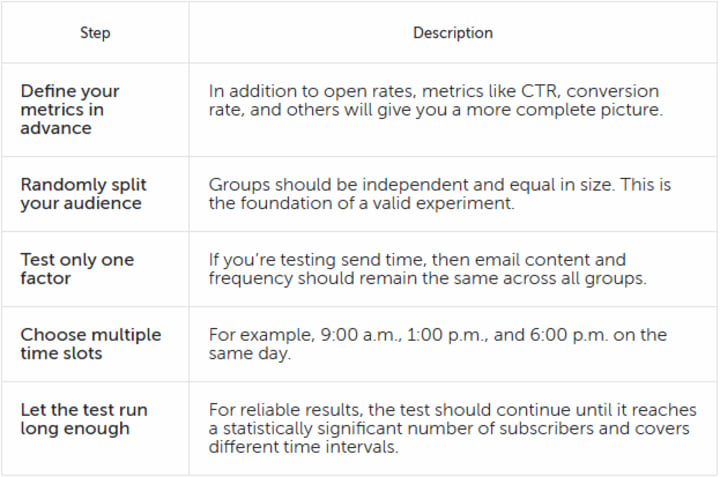
Conclusion
Marketers and companies have conducted countless studies, but they all agree on one thing: there’s no universal answer to the question, “What’s the best time to send a campaign?” Choosing the right time isn’t an exact science — it’s more of an art, about finding the moment when the recipient is most open to your message. Audience, channel, and campaign context all play a role.
You can streamline the process and make timing easier with automation tools like the Best Send Time module. Submit a request on our website, and we’ll show you how the Altcraft platform helps make campaigns more precise, timely, and effective.
The article was originally published here.
About the Creator
Altcraft
Interesting and useful articles about marketing, our product and online communications
What Is the Best Fire Extinguisher for a Car and Where Should You Store It?
Most drivers are concerned with maintenance such as changing oil filters, checking tire pressure and brakes. Nevertheless, a car fire extinguisher is one of the safety tools that is frequently disregarded. Fire of vehicles is infrequent but once it occurs, it can be transmitted rapidly. The availability of the right extinguisher can be of great help in the safety of passengers and property.
By Deborah Larson7 days ago in Journal
Yoan Iglev Reveals the Influence of Classical Art in Contemporary Murals
Public art has the ability to change how people experience a city. Large murals on walls can turn simple buildings into meaningful cultural spaces. One artist who has contributed to this form of art is Yoan Iglev, a Bulgarian painter known for creating monumental murals and artistic mosaics.
By Mark Walker6 days ago in Journal



Comments
There are no comments for this story
Be the first to respond and start the conversation.