
Black Friday and Cyber Monday: How to Make Your Campaigns Work
Effective Email Campaign Strategies for Black Friday and Cyber Monday


There’s a simple marketing truth: nothing drives sales like seasonal discounts. During major sale periods like Black Friday and Cyber Monday, shoppers spend billions. Competition for attention hits its peak — hundreds of brands send emails, push notifications, and ads at the same time. So it’s critical to stand out and avoid getting lost in the noise.
In this article, you’ll find clear tactics and examples you can use in your own campaigns.
Why Send Emails During Seasonal Sales
These campaigns aren’t just about driving purchases — they maintain contact with your audience and solve several tasks at once. For example:
- Attracting attention. Early messages warm up interest and keep the brand visible. When the sale begins, people already remember the offer and react to emails or pushes more readily.
- Driving repeat purchases. Existing customers are the most valuable group. Email brings them back gently, reminds them of the benefits, and increases interest in the product.
- Audience segmentation. Even if a subscriber doesn’t buy, their actions (opens, clicks, site visits) give insight into their interests. This data builds more accurate segments, improves content relevance, and feeds automated campaigns.
- Strengthening the brand. Each message is a touchpoint to show tone, values, and attitude toward the customer. Emails should reflect your brand style and carry a clear emotional signal.
Sales Triggers During Seasonal Discounts
To make a campaign work, it's not enough to announce the sale — the customer needs a reason to act right now. That’s where sales triggers come in: techniques that strengthen motivation.
Common triggers:
- Scarcity and urgency (FOMO). Countdown timers, limited-time offers, and “last day” labels prompt quick decisions.
- Social proof. “Already purchased by X people” or “recommended by others” builds trust and reduces hesitation.
- The zero-price effect. Free shipping, a gift with purchase, or a bonus with an order feels like a big win. A free item is often perceived as more valuable than an equivalent discount.
- Personalization and segmentation. Product recommendations, the subscriber’s name, and selections based on interests increase conversion.
- Exclusivity and VIP access. Offers like “early access” or limited sets create the sense that the deal is special and not available to everyone.
- Gamification. Games and mini-challenges drive engagement. For example, Storyly showed that adding gamification across marketing channels increased engagement by 48%.
- Anchoring effect. Showing the original price next to the sale price makes the discount feel stronger. The old price becomes the reference point, so even a small difference can feel like a win.
What else works as a sales trigger? Explained here.
Examples of Black Friday campaigns
Below are actions from well-known brands to inspire your own.
1. In this reMarkable email, a countdown timer shows how much time is left in the offer. The copy briefly highlights the product’s key benefit: using it feels close to writing on real paper.

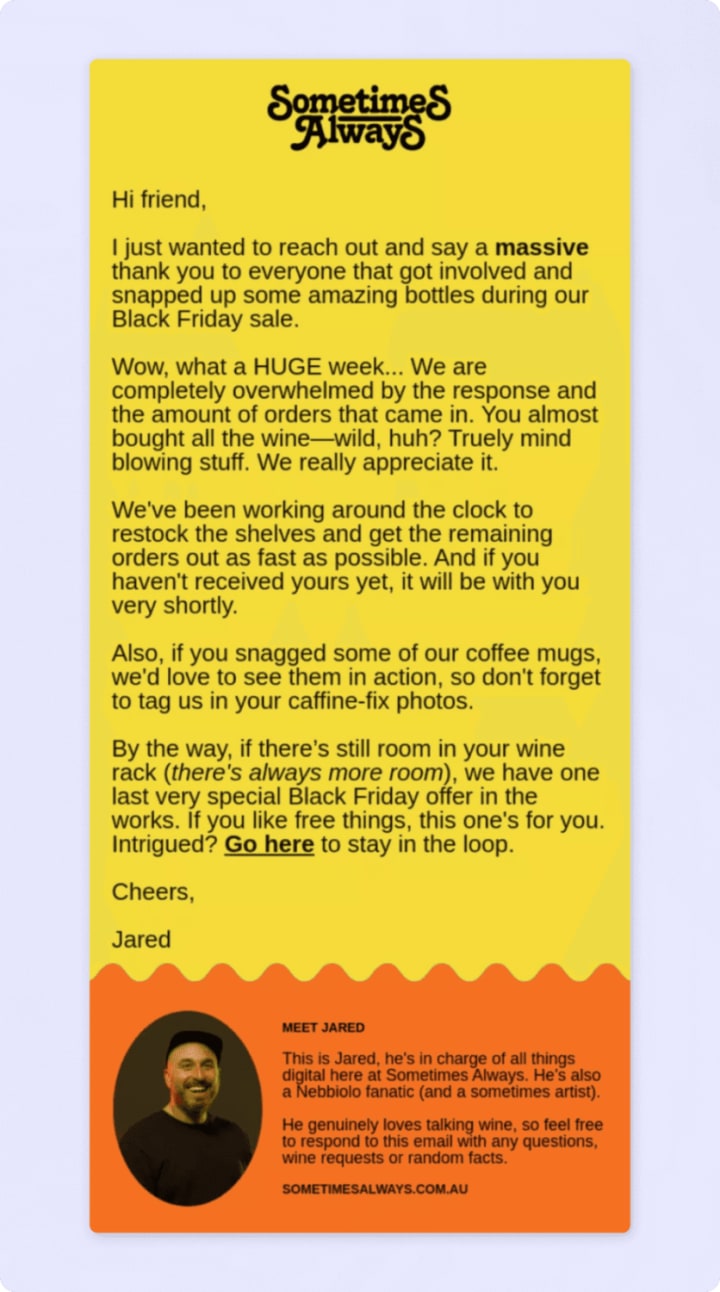
2. The wine brand Sometimes Always sent a post-sale message on behalf of a team member — complete with their photo and a personal note. The text includes a thank-you for taking part, delivery updates, and an invitation to share purchase photos. It ends with a hint about another special offer. This format keeps the connection warm after a big sale and makes the communication feel personal.
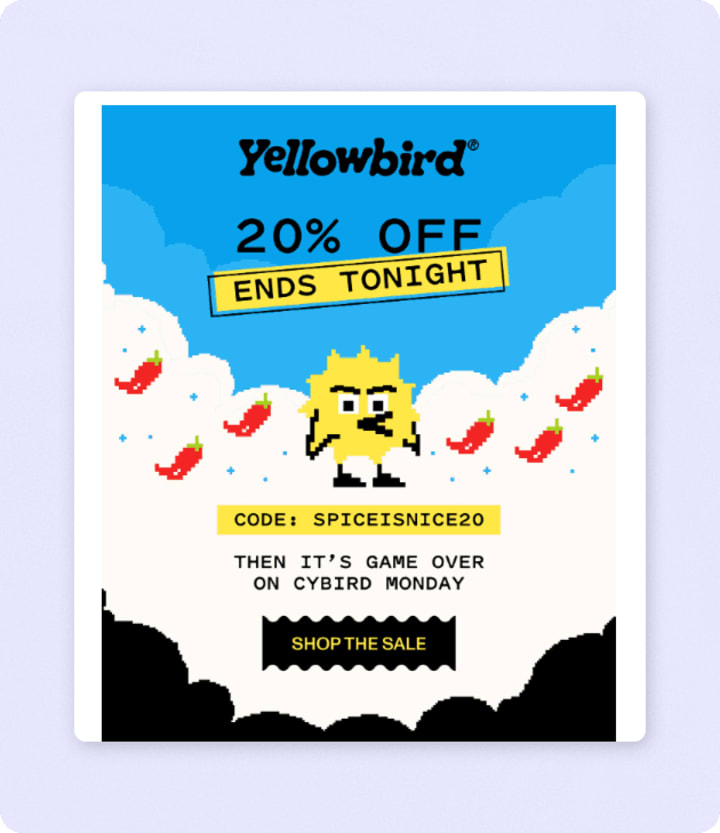
3. Yellowbird plays with the phrase “Cybird Monday” in their campaign — a fun word twist that matches the brand’s personality. Bright colors and a clear call to act quickly reinforce the message that the deal is ending soon. The tone feels lively and distinctly on-brand.
4. Not Boring Software uses a bold purple-and-black layout and a playful “boring friday sale” headline. The offer is simple: 33% off the Super membership for a limited time. The message lists all included apps and benefits, finishing with a direct line — “Get it or regret it.” The tone is confident and lightly ironic.

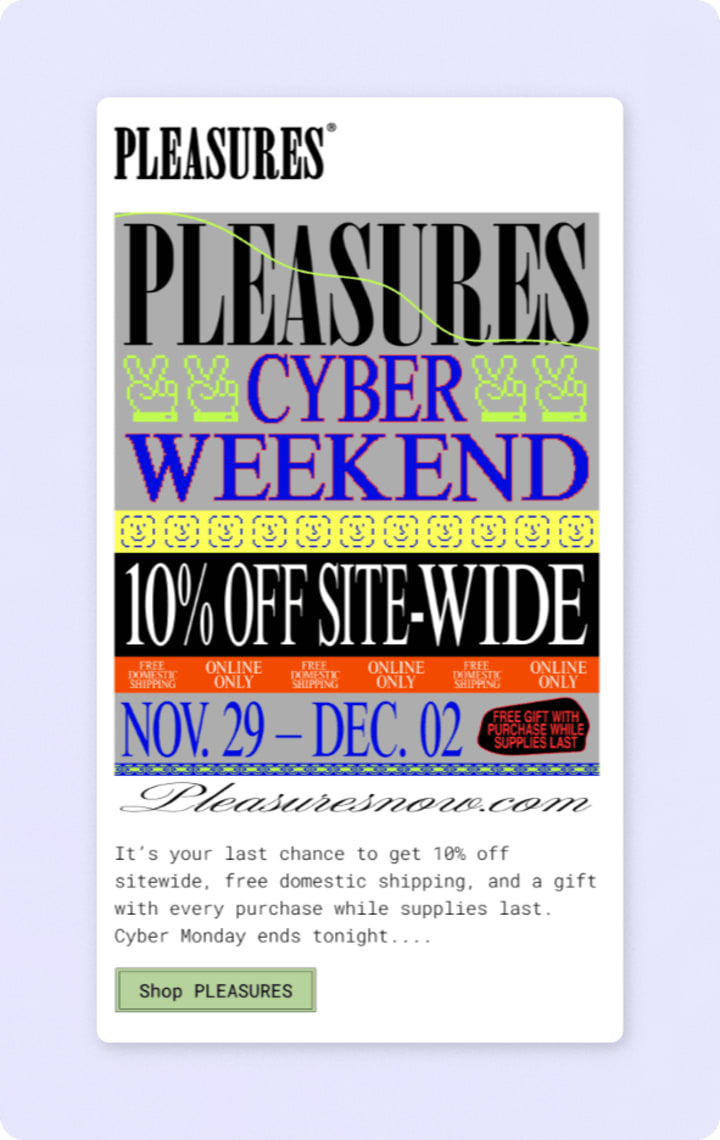
5. Pleasures ran a Cyber Monday campaign with a design that feels true to the brand. The offer has a clear end date, which creates urgency, and there’s a free gift added to motivate the purchase. It’s a simple combination of “limited time” and “extra value” — works without feeling pushy.
6. Clare’s Black Friday campaign uses a bold, eye-catching design. The “20% off” callout stands out immediately, and the end date of the offer is clearly stated, so the timing is obvious at a glance.

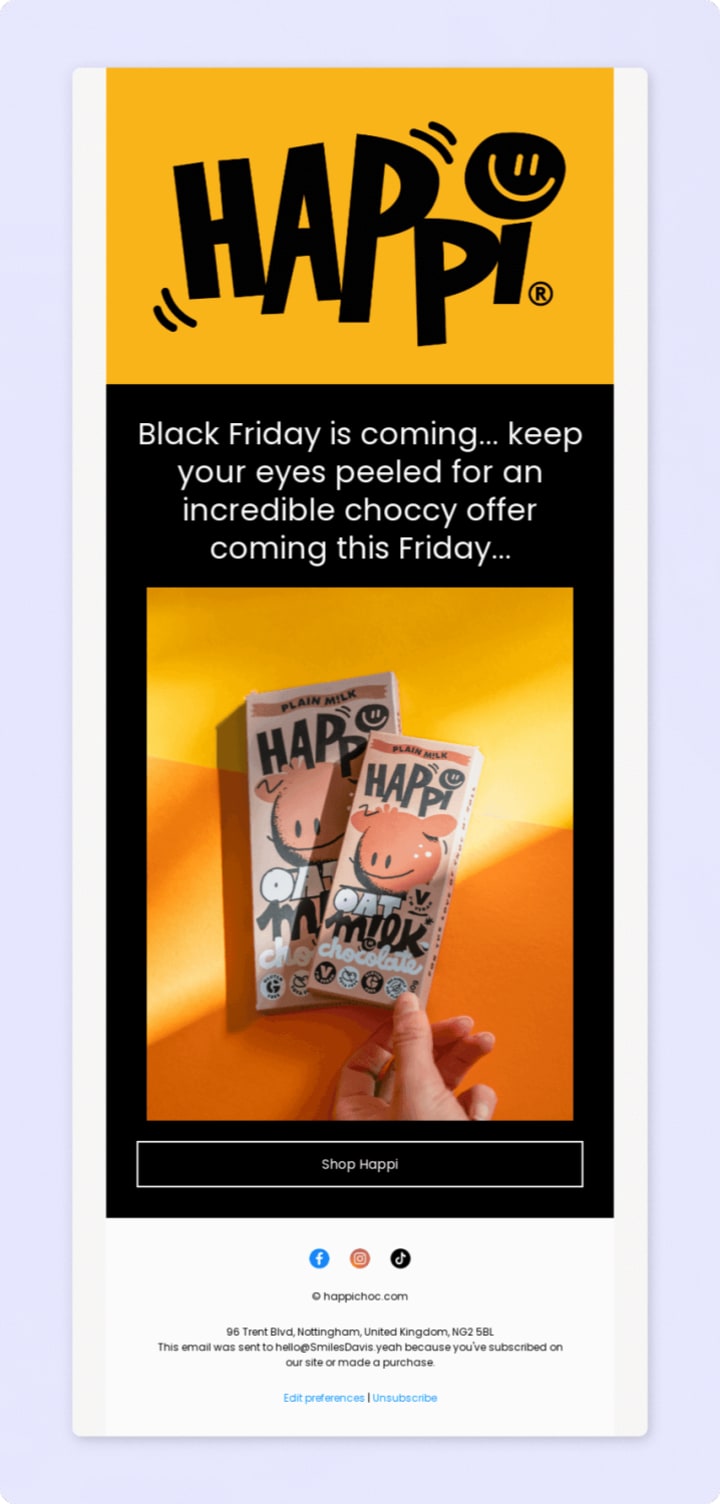
7. Happi uses bright, playful colors to remind subscribers that Black Friday is coming. The message builds anticipation and keeps the brand in mind before the sale begins. This is a classic “warm-up” trigger: create expectation now, so when the offer drops, the audience is already waiting for it.
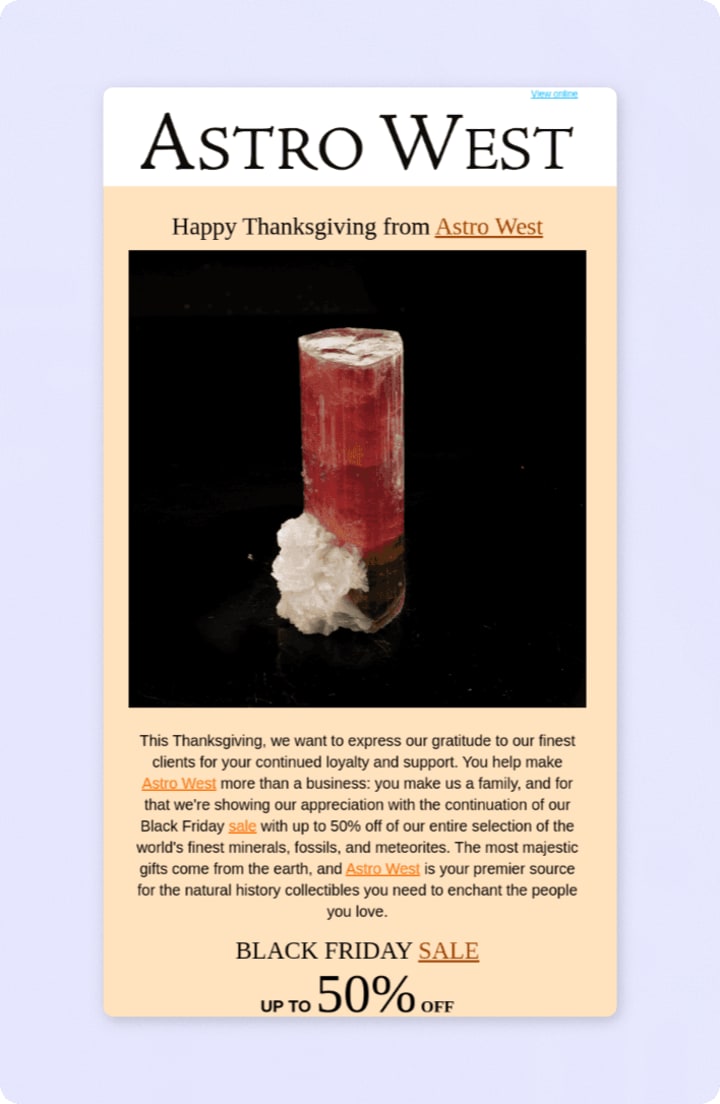
8. Astro West combines a Thanksgiving greeting with a reminder about their Black Friday sale. The beige palette stays true to the brand. The message expresses appreciation to existing customers and then smoothly leads into the offer — up to 50% off. This uses two triggers at once: emotional connection through gratitude and a clear high-value discount, making the message feel warm rather than purely promotional.
How to Get the Most from Your Sale Campaigns: A Checklist
Summary
Black Friday brings high demand and high competition. A discount alone isn’t enough — you need a thought-out strategy.
The goal is to warm up the audience in advance, make the value clear, and show exactly how long the offer lasts. All channels (email, push, SMS) should work together without contradictions or chaos.
With this approach, the sale period brings not only one-time purchases, but also strengthens customer relationships — people come back and buy again.
The article was originally published here.
About the Creator
Altcraft
Interesting and useful articles about marketing, our product and online communications
~ Fired ~
— Ai Intrusion ~ Are you Next ~ Is Ai Evolution after your job? — Few workplaces haven't been affected. Ai is in supermarkets, at doctors' offices, and even monitoring farms. I just can't think of anything this machine is not getting into, can you? For instance: Education ~ Law and Tech jobs will one day have a major influence or be taken over by these inanimate machines, with accuracy and vigor. From mechanics' diagnoses to a wide variety of everyday jobs, including fast food workers, with this input having the ability to cut their unnecessary work hours. I'm certain all of us have been touched by this with our short stories and colorful headings, have you? Even comments are very questionable 'Non-Robot' insertions.
By Jay Kantor28 days ago in Journal
Retirement Delays of U.S. Electric Generating Capacity May Continue in 2026
The U.S. electricity system is facing a notable trend: the planned retirement of older power plants — especially coal and even some gas units — is being delayed as uncertainties in energy markets, regulatory pressures, and grid reliability concerns mount. What was once expected to be a wave of closures of older generating capacity has slowed, and that slowdown may extend well into 2026.
By Sajida Sikandar5 days ago in Journal



Comments
There are no comments for this story
Be the first to respond and start the conversation.