
How Thieves Stole Priceless Jewels from the Louvre in Broad Daylight
The Seven-Minute Heist


In Paris—the city where time slows for art, where beauty is measured in centuries, not seconds—seven minutes was all it took to steal the unstealable. Seven minutes to turn history into headlines. Seven minutes to rob the Louvre, not of paintings or sculptures, but of something deeper: its breath.
Yes, the Louvre. The same sacred hall that guards the Mona Lisa’s smile. The same temple of civilization where every artifact whispers the story of a bygone empire. On Sunday morning, as the city stretched awake under a silver dawn, thieves stormed the museum’s Apollo Room and vanished with jewels so precious, so storied, that officials called them “inestimable.”
The Morning the Louvre Lost Its Shine
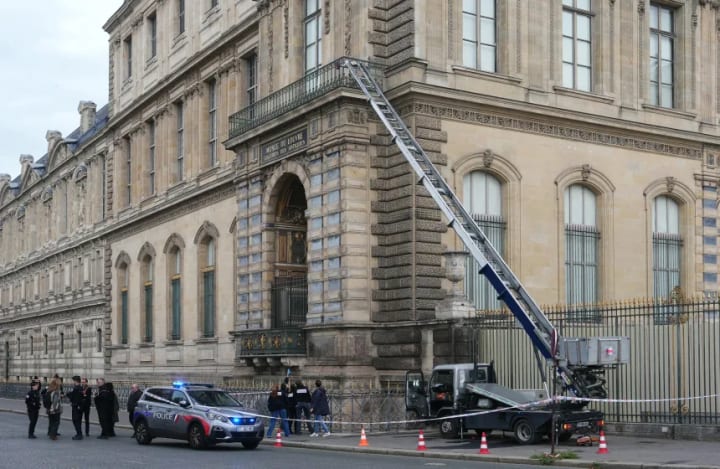
At exactly 9:30 a.m. local time, Paris police say, a team of three or four masked men executed what can only be described as a cinematic heist. Using a furniture elevator hoisted from a truck parked along the Quai François Mitterrand, they ascended to a balcony window.
And in the kind of precision move that makes Hollywood screenwriters envious, they sliced through a Louvre window with an angle grinder, slipped into the legendary Apollo Room, and helped themselves to France’s Crown Jewels—a collection that includes pieces once adored by kings and queens, and displayed for millions under watchful eyes.
Within seven minutes, they were gone. Gone like ghosts in the Paris mist.
Priceless Doesn’t Mean Unsellable
The stolen pieces weren’t just jewelry. They were time capsules, fragments of the soul of France. Some once adorned monarchs like Louis XIV, the Sun King himself, whose treasures gleamed in the very same room centuries ago.
Interior Minister Laurent Nuñez called the stolen items “priceless”, adding that beyond any market value, they carried “inestimable heritage and historical value.” It’s not the diamonds that hurt—it’s the history they carried.
One piece of jewelry has reportedly been recovered near the Louvre’s perimeter. But as the Minister of Culture, Rachida Dati, confirmed, experts are still evaluating its authenticity and condition.
The rest? They’ve vanished into the criminal ether.
A Seven-Minute Ballet of Crime
To pull off a heist at the Louvre is like stealing thunder from the gods. You don’t just walk in—you orchestrate.
According to Nuñez, “Clearly, a team had been scouting the location. It was obviously a very experienced team that acted very, very quickly.”
They didn’t run. They moved with rhythm. With precision. Every minute accounted for:
Minute 1–2: Elevator hoisted, window cut open.
Minute 3–5: Entry, identification of targets, collection.
Minute 6–7: Escape route activated—motorcycles roaring into Paris traffic before sirens had time to wake.
Eyewitnesses said the robbers fled like shadows dissolving into light.
The police found the abandoned elevator still standing—its ladder reaching like a metallic finger to the broken Louvre window, frozen mid-crime.
The Apollo Room: Where Kings Still Whisper
The Apollo Gallery, or Galerie d’Apollon, isn’t just another wing. It’s a cathedral of opulence—a gilded hall drenched in sunlight and symbolism, named for the Greek god of light. It houses the Crown Jewels of France, an emblem of monarchy, power, and divine right.
Here, every stone tells a story:
A sapphire once kissed by royalty.
A diamond that witnessed revolutions.
A chalice carved for a king whose name history remembers but whose heart time forgot.
To breach that room is to touch the nerve of French heritage. To violate it is to rob not just a museum, but a nation’s memory.
Paris Reacts: “A Theft from the Soul of France”
Culture Minister Rachida Dati, arriving on the scene, expressed disbelief:
“The theft took place as the museum opened. No injuries were reported. I am here alongside museum staff and the police. Investigations are ongoing.”
The Louvre, which sees nearly 9 million visitors annually, shut its doors “for exceptional reasons”—a poetic understatement.
Mayor Ariel Weil of Paris Center told reporters:
“They planned this meticulously. I can’t recall the Louvre being targeted in more than a century.”
He’s right. The last time the Louvre was robbed this spectacularly was in 1911, when an Italian handyman walked out with Leonardo da Vinci’s Mona Lisa tucked under his arm. That theft, too, stunned the world—and turned the Mona Lisa into a global celebrity.
History Repeats in Rhymes
A century later, history pirouettes again—proof that time doesn’t repeat itself in circles, but in spirals.
Then, it was a lone thief seeking personal glory. Now, it’s a team, a symphony of precision, exploiting modern logistics with old-world cunning. Where the 1911 thief used stealth, the 2025 crew used engineering. Where the first sought fame, the second sought fortune.
Yet both crimes share something haunting: they remind us how fragile our monuments really are.
For all its security, the Louvre was brought to its knees by a truck, an elevator, and seven minutes of audacity.
Why Art Theft Still Happens in the Digital Age
You’d think, in an era of AI surveillance, smart cameras, and laser grids, art theft would be extinct. But human ambition finds new cracks to slip through.
Art theft, in essence, isn’t just about money—it’s about ego and identity.
Collectors in the black market don’t buy art for resale; they buy it for possession. To own something no one else can. To hold history hostage.
Experts say stolen high-profile items like these are nearly impossible to sell on the open market. Their value, ironically, becomes spiritual rather than financial. Like stolen fire from Olympus, their glow is a curse to whoever dares hold it.
The Metaphor of the Louvre
Every heist tells two stories: one of what was stolen, and one of what was exposed.
In stealing jewels from the Louvre, the thieves didn’t just rob France of gems—they robbed it of certainty. They reminded the world that even the most guarded treasures can fall.
The Louvre isn’t just a building. It’s a symbol of continuity—a promise that beauty endures beyond revolution, beyond time. For it to be violated so quickly, so cleanly, feels like a metaphor for our age: a world obsessed with speed, forgetting the weight of history it tramples.
Seven minutes. That’s all it takes now—to disrupt centuries.
A City Holding Its Breath
By midday, Paris had turned the scene into a spectacle. Police sealed the entrances. Forensic teams dusted the balcony. Tourists, some still holding their tickets, stood outside, murmuring disbelief.
Inside, silence reigned. The same silence that followed the Mona Lisa’s disappearance a century ago. The silence of loss.
Investigators have yet to release the full list of stolen items, but sources say they include royal adornments from the Bourbon dynasty and Louis XIV’s hardstone vessels, each one crafted like a prayer in gold.
The government has vowed a swift recovery. Minister Nuñez, resolute, told France Inter:
“I am confident that we will find the perpetrators and, above all, recover the stolen goods.”
Between Myth and Reality
This robbery isn’t just an event—it’s a myth in the making.
Like Prometheus stealing fire from the gods, these thieves stole symbols of divine right and royal power from humanity’s temple of art. They turned the Louvre, once the keeper of beauty, into the scene of a high-stakes morality play.
The audacity of the act forces us to confront an uncomfortable truth: perhaps we’ve grown too accustomed to believing beauty is invincible. That heritage, like marble, can’t be shattered. But history has always been fragile. Always human.
Every crown jewel is a reminder that what we value most isn’t the diamond—it’s the story it tells. And stories, once stolen, take lifetimes to restore.
The Louvre’s Legacy: Enduring Beyond the Heist
The museum that survived revolutions, wars, and pandemics will survive this too. The jewels may be missing, but the Louvre’s real treasure—the collective awe it inspires—remains untouchable.
If anything, this heist rekindles something modern life has dulled: our collective reverence for art, for history, for the sacredness of culture.
When the Louvre reopens, the empty cases will say more than the jewels ever did. They will speak of vulnerability, of the human desire to possess what cannot be owned.
And in that absence, perhaps visitors will see what truly makes something priceless.
Final Reflection: Seven Minutes vs. Seven Centuries
It took seven minutes to steal what took seven centuries to preserve.
That’s the math of modern chaos: instant gratification versus timeless creation.
But art—and truth—always find their way back. Just as the Mona Lisa returned two years after her theft, these jewels too may surface, dusted with irony, in some forgotten corner of the world.
Until then, the Louvre stands not as a victim, but as a reminder. That even in loss, beauty persists. That no heist can steal history’s heartbeat.
About the Creator
Omasanjuwa Ogharandukun
I'm a passionate writer & blogger crafting inspiring stories from everyday life. Through vivid words and thoughtful insights, I spark conversations and ignite change—one post at a time.
Keep reading
More stories from Omasanjuwa Ogharandukun and writers in Journal and other communities.
Limp Bizkit Announces Death of Sassist Sam Rivers Aged 48
When the rhythm stops, silence feels louder. On October 19, 2025, that silence struck the world of rock when Limp Bizkit announced the death of their bassist and founding member, Sam Rivers, at the age of 48.
By Omasanjuwa Ogharandukun3 months ago in Journal
The goals I did not achieve
Every writing goal I made for the year is a wash. It has been this way for a while, but I think it's important to be open about my failures and the reality of how life can get in the way. This is especially true considering the several times I have posted on Vocal about my writing goals, how I was changing my approach, and where I was hoping to be for the upcoming year. I will probably do that again in a couple months, but for now, it is time to acknowledge where I am today.
By Kay Husnick16 days ago in Journal




Comments
There are no comments for this story
Be the first to respond and start the conversation.