
How PLC and Variable Frequency Drives Improve Industrial Overhead Crane Automation
Improving crane performance, safety, reliability, and productivity.

Industrial overhead cranes are vital assets in manufacturing, logistics, construction, and other heavy industries. Their ability to safely and efficiently lift, move, and position heavy loads makes them indispensable for handling bulky materials. Over the years, crane technology has evolved from manual controls and basic electric motors to advanced automation systems integrating Programmable Logic Controllers (PLCs) and Variable Frequency Drives (VFDs). These innovations have profoundly improved crane performance, safety, reliability, and productivity.
In this article, we will explore the roles of PLCs and VFDs in modern industrial overhead cranes, how they complement each other, and the benefits they bring to crane automation.
Overview of Industrial Overhead Cranes
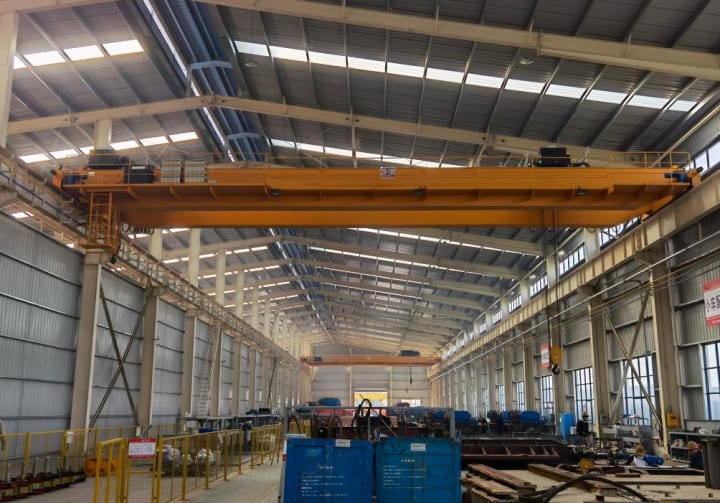
An industrial overhead crane for sale typically consists of a bridge spanning a working area, a hoist trolley that moves along the bridge, and a lifting mechanism for handling loads. Traditional cranes were controlled manually, often using contactors for motor switching and simple push buttons or levers for motion commands.
However, as industries demand higher throughput, precision, and safety, overhead cranes have incorporated automation components. Two key technologies driving this transformation are:
- Programmable Logic Controllers (PLCs)
- Variable Frequency Drives (VFDs)
What is a PLC?
A Programmable Logic Controller (PLC) is a ruggedized digital computer used for automation of electromechanical processes, such as control of machinery on factory assembly lines, amusement rides, or overhead cranes. PLCs monitor inputs (from sensors, switches, control panels) and make decisions based on a custom control program, then output commands to actuators (motors, brakes, alarms).
Key characteristics of PLCs in crane control include:
Real-time control: Fast response times for critical safety and operational sequences.
Flexibility: Customizable programs allow the crane to perform complex tasks like coordinated multi-axis movement and precise positioning.
Reliability: Designed to operate in harsh industrial environments with high immunity to noise, dust, and vibrations.
Diagnostic and Communication: PLCs provide monitoring, fault detection, and communication interfaces to integrate with factory automation systems.
What is a Variable Frequency Drive (VFD)?
A Variable Frequency Drive (VFD) is an electronic device that controls the speed, torque, and direction of an AC motor by varying the frequency and voltage supplied to it. Unlike traditional motors running at fixed speeds (determined by the AC power frequency), VFDs enable smooth acceleration and deceleration, variable speed operation, and energy-efficient motor control.
In overhead crane for sale, VFDs are used to control:
- Hoist motors (lifting/lowering loads)
- Trolley motors (moving the hoist along the bridge)
- Bridge motors (moving the bridge across the workspace)
How PLC and VFD Work Together in Overhead Crane Automation
PLCs and VFDs are complementary technologies that together provide a powerful platform for crane automation.
1. Coordinated Control and Precision
The PLC acts as the “brain” of the system, making decisions based on operator commands and sensor inputs. It sends control signals to the VFDs, which then precisely regulate motor speed and torque.
Speed regulation: VFDs allow the crane to move at variable speeds, from slow, precise positioning to faster transit motions, improving productivity.
Smooth starts and stops: VFDs prevent sudden jolts or mechanical shocks by ramping motor speeds up or down gradually.
Multi-axis coordination: The PLC coordinates movements of the bridge, trolley, and hoist motors, ensuring smooth and safe load handling.
Positioning accuracy: When combined with feedback devices like encoders, PLCs and VFDs achieve exact positioning of the crane components, critical in assembly or manufacturing processes requiring millimeter precision.
2. Enhanced Safety Features
Safety is paramount in crane operations. PLCs, with their real-time processing capability, continuously monitor the crane’s status and environment, executing safety interlocks and emergency shutdowns if necessary.
Overload protection: PLCs monitor load sensors and automatically prevent lifting if loads exceed rated capacity.
Limit switches and zone control: The PLC uses inputs from limit switches and area sensors to restrict crane movement to safe zones.
Soft stop in emergencies: VFDs allow controlled deceleration even during emergency stops, reducing risk of load swing or damage.
Anti-sway control: Advanced PLC algorithms can work with VFDs to minimize load sway, enhancing operator control and reducing accident risk.
3. Energy Efficiency and Cost Savings
Variable speed operation enabled by VFDs reduces energy consumption significantly compared to traditional motor starters that operate at full speed all the time.
Reduced inrush current: VFDs ramp up motor speeds smoothly, reducing mechanical and electrical stress.
Energy savings: Running motors only at necessary speeds lowers power consumption.
Extended equipment life: Less mechanical wear due to controlled acceleration and deceleration reduces maintenance and downtime.
Key Benefits of Integrating PLC and VFD in Overhead Cranes
Increased Productivity and Throughput
Automation reduces operator fatigue and errors, enabling faster and more reliable crane operation. Variable speed controls allow optimal speed adjustment for different tasks, balancing speed and precision.
Improved Operator Comfort and Control
PLC-based control panels and human-machine interfaces (HMIs) offer intuitive controls, real-time status displays, and diagnostic feedback. Operators can precisely control crane motions with joystick, touch screen, or remote controls integrated via the PLC.
Scalability and Customization
PLCs can be programmed to support various crane configurations, accessories, and operational modes. Modifications or upgrades to the crane’s functions can be implemented via software changes without hardware rewiring.
Reduced Downtime and Maintenance
PLC diagnostics and VFD status monitoring provide early warnings of faults or wear. Predictive maintenance schedules can be based on data collected from the automation system.
Practical Applications and Case Examples
Case 1: Precast Concrete Manufacturing
In precast concrete factories, overhead cranes move heavy concrete elements from casting beds to curing areas. PLCs coordinate dual cranes working in tandem, while VFDs regulate precise, smooth lifting and lowering to avoid cracking or damage to the concrete.
Case 2: Steel Coil Handling
Steel coils require careful lifting to avoid damage. Using PLCs and VFDs, cranes achieve controlled acceleration, precise positioning on transport vehicles, and safe load handling with automatic overload detection.
Case 3: Shipyard and Marine Operations
Marine cranes handling heavy ship components benefit from anti-sway algorithms in the PLC and variable speed hoisting from VFDs, ensuring smooth operations even under challenging conditions like wind and load inertia.
Future Trends: IoT and AI in Crane Automation
The integration of PLCs and VFDs provides a foundation for further advancements:
IoT connectivity: Real-time data from cranes can be monitored remotely for performance analytics and maintenance prediction.
AI-enhanced control: Artificial intelligence can optimize crane motion profiles for maximum efficiency and safety, based on historical operational data.
Wireless and mobile control: PLCs can interface with mobile apps and wireless remotes, providing operators more flexibility.
Conclusion
The combination of Programmable Logic Controllers and Variable Frequency Drives has revolutionized industrial overhead crane automation. By providing precise, flexible, and reliable control over crane movements, PLCs and VFDs have enhanced operational efficiency, safety, and energy savings.
Manufacturers and users benefit from reduced downtime, better operator comfort, and scalability for future expansions. As technology evolves, these control systems will continue to integrate with smart factory concepts, pushing overhead crane automation to new heights.
For industries that rely on overhead cranes, investing in modern PLC and VFD systems is no longer optional but a necessary step toward competitive advantage and safer workplaces.
About the Creator
Aicrane01
Welcome to the Aicrane Blog, your practical guide to lifting solutions. Discover articles covering overhead cranes, gantry cranes, winches, steel structures, boat lifts, and more.
Website: https://steelmillcranes.com/
EAP utilisation rates: Why employees do not use support and how organisations can change that
Employee Assistance Programs (EAPs) are common across the workplace. They are offered with good intentions; however, they tend to have a notoriously low usage rate. This leaves many organisations in a perplexing situation: they have provided a range of resources to assist their employees, only for them to go unused. The result is a poorly utilised program and ongoing issues that may have been avoided.
By Amara Gomez6 days ago in Journal




Comments
There are no comments for this story
Be the first to respond and start the conversation.