
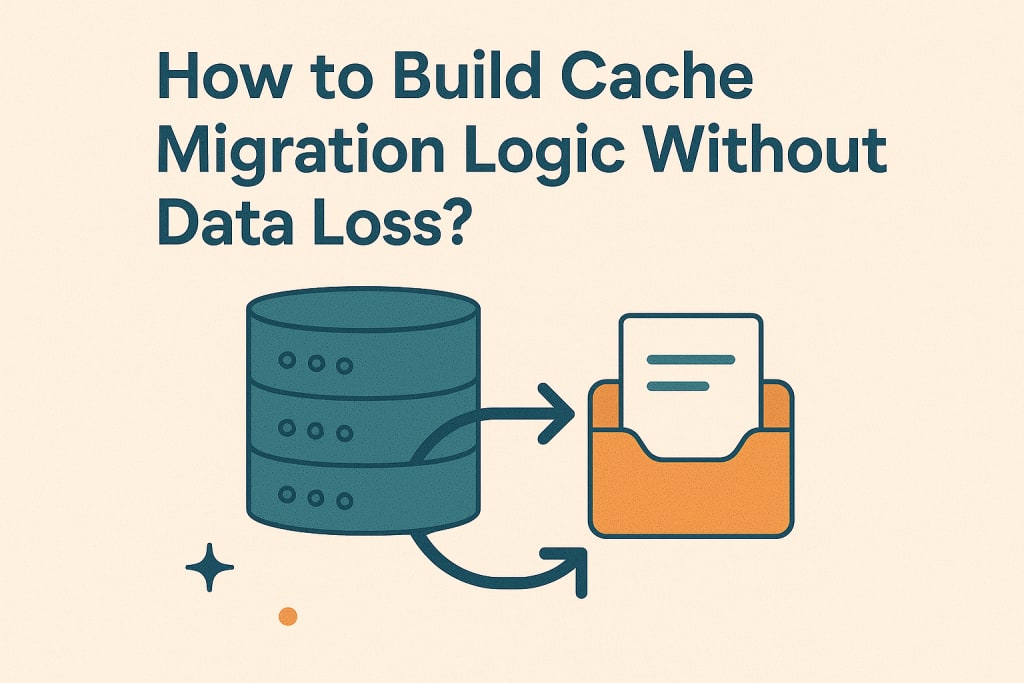
How I Built Cache Migration Logic Without Losing What Users Remembered?
A night in an airport café and the quiet realization that preserving meaning matters more than converting data.

The airport café felt colder than it should have that night. Runway lights kept sliding across the glass panels, soft and rhythmic, as if the world outside was moving slower than everything inside my head. Someone behind the counter rearranged pastries no one seemed interested in buying. I sat with my laptop open, scrolling through cache entries that belonged to an app that had lost user data after an update.
Nothing dramatic had happened during the release. No crashes. No alerts. Just a subtle emptiness where familiar content used to be. A product lead sat across from me, still on a muted call, her voice lowered so her worry wouldn’t spill into the quiet room. She wasn’t angry. She was tired. What disappeared that night wasn’t just data. It was continuity.
When Cache Stops Being Temporary
Many teams treat cached values like disposable placeholders. In the early months of a product, that assumption doesn’t cause much trouble. If a schema changes, someone clears the cache, ships a fix, and life moves on. But once real users begin relying on what the app remembers—saved searches, pinned screens, offline preferences—those “temporary” keys turn into something more meaningful.
I’ve seen apps built under tight sprints where caching was viewed only as a performance trick. Later, when the product matured, people interacted with the app through habits shaped by what it stored. Clearing the cache didn’t reset an app. It reset a relationship.
When cache disappears, users don’t think systems refreshed.
They think someone forgot them.
And that shift matters more than the technical cause behind it.
When the Structure Outgrows the Original Assumptions
Inside that café, I scrolled through the cache structure line by line. There were arrays shaped by old formats, fields that no longer existed, mapping keys pointing to indexes that were now ghosts. Every fragment represented something a person had once done.
Migration wasn’t a mechanical rewrite.
Migration was interpretation.
It meant reading old shapes with respect, not force. It meant understanding that even minor values carried meaning. One field represented the last category a user viewed. Another stored whether onboarding had already been dismissed. Removing them wouldn’t break functionality, but it would break memory—those tiny moments a person doesn’t want to repeat.
I closed the schema file gently, realizing we weren’t rewriting anything.
We were preserving shape, even when structure changed.
When You Realize You Cannot Force the System to Forget
There are moments when engineering teaches you quietly.
Crashes announce themselves.
Data loss whispers.
When data disappears silently, people don’t blame the app. They blame themselves, believing they mis-tapped, mis-saved, or misunderstood. That invisible loss is heavier than a failure because it erodes trust instead of triggering fixes.
A migration script protects against that silence.
I remember the first version we drafted. It didn’t rush to transform everything. It walked through each entry, converting when possible, holding placeholders when earlier shapes still carried meaning. It didn’t move quickly. It moved respectfully.
Watching those records shift safely reminded me that persistence isn’t storage.
It’s memory someone handed to us.
When Migration Is Not Refactoring
Refactoring changes logic.
Migration changes meaning.
The app we inherited wasn’t poorly built. It was built during an earlier chapter when assumptions were simpler. Cache could be cleared, and no one cared. But years later, those values represented preferences, patterns, and identity.
One entry stored which layout a user preferred. Older versions saved layouts as strings. Newer versions used integer identifiers. A careless migration would have treated the old value as irrelevant. But ignoring it meant rearranging the desk of someone who already set it up their way.
Migration didn’t require brilliance.
It required acknowledgment that preference is personal.
Many teams evolve structure without evolving memory.
That is where the cracks start forming.
When Data Becomes Personal
At one point that night, I stepped away from the table. Planes idled on the runway, glowing under reflective jackets worn by the ground crew. The product lead joined me quietly, still holding her laptop. She mentioned a user who had emailed support earlier that day. The person hadn’t lost anything expensive—just a small item they had saved to revisit later.
It wasn’t anger.
It was disappointment.
And that disappointment became the fuel behind our decisions.
Migration existed for that user more than it existed for any architecture.
We returned to the table and continued mapping values with a different mindset.
When Versions Must Be Treated Like Stories
We built migrations step by step, not as sweeping conversions. When arrays turned into objects, we mapped each element carefully. When indexes changed, we read the old identifiers before generating the new ones.
The app didn’t discard the past.
It translated it.
Earlier product phases weren’t mistakes.
They were chapters.
And each migration recognized time as part of the system’s identity.
Users who joined early shaped the app differently from those who joined later.
Migration needed to honor that.
When an App Must Remember a Choice Even If It No Longer Uses It
One value indicated whether a user once dismissed a certain onboarding message. The new design no longer displayed that message, but we still carried the value forward. Not because the new version needed it, but because someone had made a choice—and choices create continuity.
Future updates eventually removed the value cleanly, but not abruptly.
Memory fades slowly.
Design should, too.
Engineers often assume data removal is harmless.
Users rarely do.
When Loss Is Invisible Until It Touches Trust
Weeks later, after internal testing, nothing looked impressive.
No big feature surfaced.
No performance charts spiked.
And yet—that calmness was the result.
Data stayed where people left it.
Users reopened the app and found everything where it should be.
No praise.
No complaints.
Just continuation.
The product lead told me support messages stopped appearing after updates.
That absence is what migration earns.
A kind of stability that doesn’t need applause.
When Cache Finally Learns Its Own History
We added time markers to help future migrations understand age.
We inserted revision identifiers so conversions wouldn’t repeat unnecessarily.
Over time, the system learned to remember without hoarding outdated shapes.
It grew lighter—not by forgetting, but by translating.
Migration isn’t the preservation of objects.
It is the preservation of intention.
Every cache entry is a reflection of someone’s earlier decision.
Losing it doesn’t remove data.
It removes story.
The Quiet Flight Home
Later that night, after the café closed, I boarded my flight.
The runway lights flickered across the window as the aircraft door shut with a soft thud. A few rows ahead, the product lead scrolled through her phone. She wasn’t checking anything anymore. She wasn’t verifying results. The migration we deployed had already done its work.
She put her phone away and leaned back.
That moment stayed with me more than any script we wrote.
Migration, when done well, doesn’t impress anyone.
It reassures them.
It removes worry.
It protects choices.
It lets someone return to their screen and find themselves exactly where they were.
That is what safe cache migration means—not new features, not cleaner logic, not elegant architecture.
Just continuity steady enough that no one remembers how fragile it used to be.
About the Creator
Mike Pichai
Mike Pichai writes about tech, technolgies, AI and work life, creating clear stories for clients in Seattle, Indianapolis, Portland, San Diego, Tampa, Austin, Los Angeles and Charlotte. He writes blogs readers can trust.
Keep reading
More stories from Mike Pichai and writers in Journal and other communities.
How OS Task Scheduling Impacts Mobile App Responsiveness?
I didn’t understand task scheduling until it embarrassed me. The app looked fine on my phone. Smooth taps. Clean transitions. Then support tickets started piling up from users on older devices. Same build. Same code. Very different experience.
By Mike Pichai6 days ago in Journal
Funding Options for Recovery Homes
Full Introduction As of early 2026, the landscape for funding recovery homes—also known as sober living environments or recovery residences—has become significantly more integrated with broader healthcare and housing stability initiatives. Funding is no longer restricted to private pay models; it now encompasses a sophisticated mix of federal block grants, state-level voucher programs, and private social impact investments. Public policy has shifted toward viewing stable, substance-free housing as a critical social determinant of health, leading to new reauthorizations of federal pilot programs and a focus on evidence-based, certified residences. Whether you are launching a new community or expanding an existing one, success in 2026 depends on aligning your facility with national accreditation standards to unlock high-value government and philanthropic funding streams.
By Abdul Mueed3 days ago in Journal


Comments
There are no comments for this story
Be the first to respond and start the conversation.