
How Disorganized Follow-Ups Can Cost You Big in Commercial Real Estate
The High Cost of Missed Follow-Ups in Commercial Real Estate


A real estate broker meets a promising prospect at a networking event, a developer looking for space in a high-end corridor and ready to move quickly. They hit it off and agreed to reconnect. But then the broker gets busy. A site tour runs long. A contract negotiation takes priority. That one follow-up email gets pushed, then forgotten. A few weeks later, the developer closes a deal with someone else.
This isn’t rare. 48% of sales reps never make a second follow-up call. In an industry where timing and persistence are everything, these missed moments can quietly cost brokers six-figure deals and long-term relationships.
In this article, we’ll explore what missed follow-ups are really costing you in commercial real estate and how having the right systems in place can help you stay on top of every opportunity.
Why follow-ups matter in commercial real estate
Most commercial real estate deals don’t come through after just one conversation. It usually takes time, with multiple check-ins, ongoing communication and building real trust, whether you're working with a buyer, investor, landlord, or tenant. Research shows that nearly 80% of sales happen only after five or more follow-up calls.
In such a relationship-driven industry, the broker who follows up consistently and at the right time often wins the business.
Clients expect proactive communication. A timely follow-up doesn’t just demonstrate professionalism; it shows that you’re organized, attentive and invested in the relationship. Fail to do so and even a warm lead can go cold fast.
The hidden costs of missed follow-ups
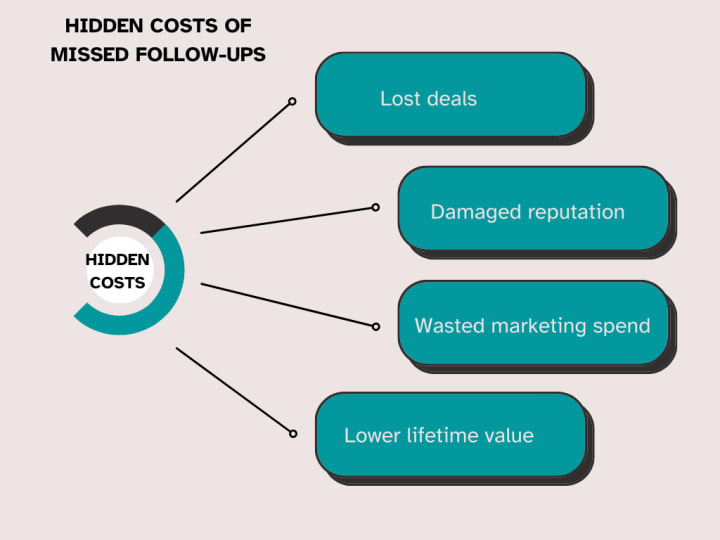
Lost Deals
This is the most obvious cost. If you’re not following up, someone else will. Real estate clients typically engage with multiple brokers and they remember the one who stays top of mind. A missed call today could be a signed contract with your competitor tomorrow.
Damaged reputation
Word travels fast in the real estate world. If clients or prospects feel neglected or forgotten, they’re unlikely to refer others. Worse, they may spread the word that you’re disorganized or unresponsive.
Wasted marketing spend
You’re likely investing in lead generation, whether through paid ads, content marketing, events, or listing platforms. When those leads enter your pipeline and don’t get followed up on, that spend is flushed down the drain.
Lower lifetime value
Some of the most valuable real estate relationships are long-term repeat clients, referrals, portfolio expansions. Missing the first follow-up can prevent you from ever entering that long-term cycle.
Why commercial real estate professionals miss follow-ups
The problem usually isn’t effort, it’s systems. Real estate professionals are busy. They juggle calls, site visits, paperwork, negotiations and more. Without a streamlined process, it’s easy for things to fall through the cracks.
Here are the most common reasons follow-ups get missed:
- Manual processes – relying on spreadsheets, notebooks, or memory
- No centralized contact database
- Inability to prioritize leads by urgency or stage
- No reminders or accountability
In short: it’s not a lack of intent, it’s a lack of infrastructure.
How technology solves the follow-up problem
This is where smart technology comes in, particularly CRM software built for commercial real estate. These platforms have become essential for brokers and firms who want to stay competitive and efficient. They are crucial for managing complex workflows, ensuring no follow-up is overlooked and automating tasks that would otherwise be time-consuming and prone to error.
A purpose-built commercial real estate CRM helps brokers and teams automate and manage follow-ups in a way that’s scalable and reliable. These tools eliminate the need for manual tracking and reduce human error, ultimately ensuring that no lead falls through the cracks.
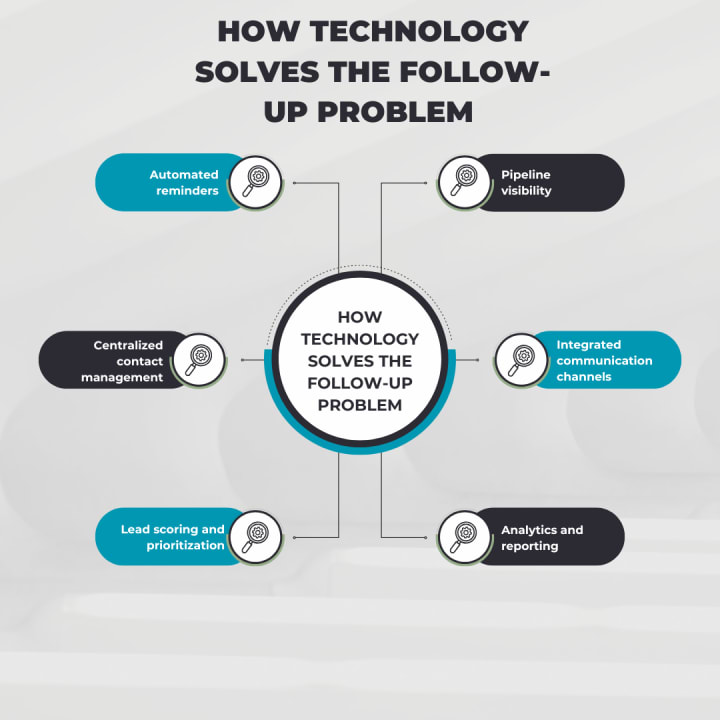
- Automated reminders: Never miss a follow-up again. CRM can automatically notify you when it’s time to follow up, whether it's based on client activity or preset timelines. You can schedule follow-up reminders in advance and stay organized without scrambling for notes or emails.
- Centralized contact management: All client details from meeting notes to email correspondence are stored in one place, making it easy to access everything you need in an instant. With this feature, you avoid searching through various apps or documents and ensure that you have all client interactions at your fingertips when needed.
- Lead scoring and prioritization: CRM allows you to score and rank leads based on their level of interest or likelihood to close. By automating this process, you can easily identify which prospects need your attention the most, allowing you to focus efforts on high-value opportunities and avoid wasting time on low-potential leads.
- Pipeline visibility: See exactly where each deal stands at a glance. With CRM software, you can track the status of every opportunity in real time, whether it's in the early stages or nearing closing. This allows you to prioritize follow-ups based on urgency and importance, ensuring that the most critical leads are always a priority.
- Integrated communication channels: Modern CRM often integrates with communication platforms like email, text messaging, or even direct dial, consolidating all your conversations in one place. This makes following up via your preferred channel quick and easy, without needing to jump between different systems or platforms.
- Analytics and reporting: CRM not only helps you follow up but also provides insights into how effective your follow-up strategies are. With built-in analytics and reporting features, you can track response rates, engagement levels, and conversion stats, helping you optimize your approach and increase your closing rate.
The bottom line
In the commercial real estate market, timing and relationships are everything. One missed follow-up might not seem like much, until it quietly costs a six-figure deal, a long-term client, or a referral that would’ve opened new doors.
Avoiding these gaps often comes down to having the right systems in place. Many high-performing brokerages have turned to tools purpose-built for managing complex deal cycles including solutions like commercial real estate CRM software that integrate follow-up automation, pipeline visibility and centralized contact management into a single platform. In an industry where consistency often determines success, the ability to follow up reliably and at scale is no longer optional.
About the Creator
Retyn
Powered by AI and advanced business tools, Retyn provides a single platform that helps companies optimize their whole operation through marketing, customer engagement and operational streamlining.
The goals I did not achieve
Every writing goal I made for the year is a wash. It has been this way for a while, but I think it's important to be open about my failures and the reality of how life can get in the way. This is especially true considering the several times I have posted on Vocal about my writing goals, how I was changing my approach, and where I was hoping to be for the upcoming year. I will probably do that again in a couple months, but for now, it is time to acknowledge where I am today.
By Kay Husnick25 days ago in Journal
The Lost Soviet Mission to the Moon. How a Single Typo Caused a Catastrophe.
The Cold War pushed space programs to the edge. You saw rockets rise as symbols of power. You also saw secrets fall into silence. One mission aimed at the Moon never returned. Its failure stayed buried for years. Declassified records now tell a harsh story. A small typing error set off a chain reaction. The result ended a lunar dream.
By Wilson Igbasi6 days ago in Journal
The Devil's Cut
“Comrade, finally you’re awake.” The voice was smooth, sensual. A flickering incandescent bar was all that lit the white, sterile room. All Vladimir remembered was everything going black. He tried to move his arms and found them strapped to the gurney.
By Matthew J. Fromm6 days ago in Fiction



Comments
There are no comments for this story
Be the first to respond and start the conversation.