
How BDD and TDD Impact Software Development: A Comparative Analysis
Exploring the Differences, Benefits, and Best Use Cases of BDD and TDD in Modern Software Development


Software development is a constantly evolving field, with new methodologies emerging to improve efficiency, collaboration, and code quality. Among these, Behavior-Driven Development (BDD) and Test-Driven Development (TDD) are two widely used approaches that focus on testing and quality assurance.
But when it comes to BDD vs. TDD, which methodology is better for software development? The answer depends on various factors, including project requirements, team collaboration, and testing efficiency.
In this article, we’ll explore the differences between BDD and TDD, their benefits, challenges, and how they impact software development.
What is TDD (Test-Driven Development)?
Test-Driven Development (TDD) is a software development practice where tests are written before the actual code. This approach ensures that the code meets predefined requirements and is thoroughly tested before deployment.
How TDD Works
- Write a test - Before writing any code, developers create a test based on the expected functionality.
- Run the test - The test initially fails because the feature hasn’t been implemented yet.
- Write the code - Developers write the minimum amount of code required to pass the test.
- Run the test again - If the test passes, the code is considered functional.
- Refactor the code -Developers optimize the code while ensuring it still passes the test.
Benefits of TDD
- Ensures high code quality by catching issues early.
- Reduces debugging time and improves maintainability.
- Promotes a structured development process by enforcing discipline.
- Enhances developer confidence when making changes to the codebase.
Challenges of TDD
- Initial setup takes time as writing tests before coding requires effort.
- Developers need to have a clear understanding of requirements before implementation.
- Over-reliance on TDD can sometimes lead to rigid and inflexible code.
What is BDD (Behavior-Driven Development)?
Behavior-Driven Development (BDD) is an extension of TDD that focuses on the behavior of the application from the user's perspective. It encourages collaboration between developers, testers, and business stakeholders to ensure software meets business expectations.
How BDD Works
- Define behavior -Requirements are written in plain language using the Given-When-Then format.
- Convert behavior into test cases - These plain-language descriptions are transformed into automated test scripts.
- Write the code - Developers implement the feature to pass the predefined behavior tests.
- Run tests - The test cases are executed to validate that the feature works as expected.
Benefits of BDD
- Improves collaboration between technical and non-technical stakeholders.
- Ensures business objectives align with development goals.
- Provides clear documentation that serves as a reference for future development.
- Reduces misunderstandings by simplifying communication with plain language specifications.
Challenges of BDD
- Requires extra effort in defining behaviors and writing test cases.
- The transition from traditional development approaches to BDD can be time-consuming.
- BDD might not be suitable for small projects with minimal collaboration requirements.
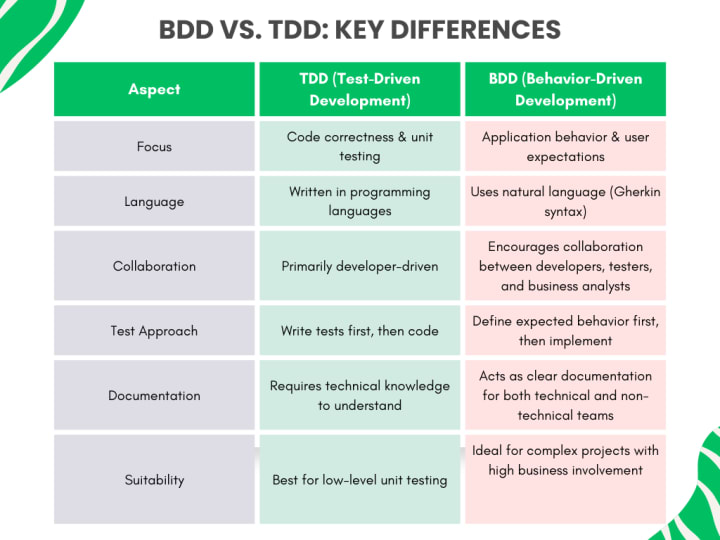
The primary distinction in BDD vs. TDD lies in their approach
TDD ensures code correctness by verifying small units of functionality.
BDD ensures business alignment by validating software behavior from an end-user perspective.
When to Use TDD vs. BDD?
Choose TDD If
- You are working on a technical-heavy project that requires unit-level validation.
- Your team is highly skilled in coding and testing methodologies.
- You need fast feedback on small code changes without focusing on user behavior.
Choose BDD If
- Your project involves cross-functional teams, including business analysts and QA engineers.
- You need to ensure that software meets business and user expectations.
- You want to automate acceptance tests and improve test coverage.
How BDD and TDD Impact Software Development?
Impact of TDD on Software Development
- Increased Code Quality: Since tests are written before the code, developers ensure that every piece of functionality is properly tested.
- Faster Debugging: Developers can quickly identify issues when test cases fail, reducing time spent on troubleshooting.
- Better Maintainability: TDD leads to modular code, making it easier to update and scale over time.
Impact of BDD on Software Development
- Enhanced Collaboration: BDD fosters communication between business and technical teams, reducing project misunderstandings.
- Improved Test Coverage: By focusing on real-world scenarios, BDD ensures that software meets user expectations.
- Simplified Documentation: BDD test cases serve as functional documentation, making it easier for new team members to understand the system.
Both methodologies contribute to higher quality software, but their impact depends on project needs and team dynamics.
Combining BDD and TDD: Best of Both Worlds
Many teams integrate BDD and TDD to maximize their benefits:
- Use TDD for unit tests, ensuring individual components function correctly.
- Implement BDD for acceptance tests, validating that the system behaves as expected.
- Encourage collaboration by leveraging BDD’s natural language tests.
- Maintain technical excellence with TDD’s structured test-driven coding approach.
By combining BDD vs. TDD, teams achieve better test coverage, clearer documentation, and a more robust development process.
Afterword
Choosing between BDD vs. TDD depends on your project’s requirements and team structure. While TDD focuses on code correctness, BDD emphasizes application behavior and user expectations.
For technical projects requiring low-level validation, TDD is the best choice. On the other hand, if your project demands business alignment and collaboration, BDD is the way to go. Many successful teams integrate both methodologies to balance technical accuracy with real-world usability.
Regardless of which approach you choose, embracing test automation leads to better software quality, faster development cycles, and more reliable applications.
Read Our Recent Article - Why Record Playback Testing is Ideal for Regression Testing
About the Creator
Leeanna marshall
Hello, I'm Leeanna Marshall, an ardent enthusiast of all things automation and a passionate blogger. visit my blog
Keep reading
More stories from Leeanna marshall and writers in Journal and other communities.
How to Build AI Agents in 2026: Stop Coding Like It's 2024
Remember when we all thought pasting a prompt into ChatGPT was "prompt engineering"? Cute. It's 2026 now, and if your "AI" can't plan a vacation, book the flights, and argue with the airline about a refund, it's just a chatbot. Learning how to build AI agents isn't just a resume booster anymore; it's the only way to survive the "white-collar shockwave" experts warned us about.
By Sherry Walker6 days ago in Journal




Comments
There are no comments for this story
Be the first to respond and start the conversation.