
How AI Is Revolutionizing Waste Management and Recycling in Real Time?
Unlock the power of real-time AI in waste and recycling: smarter, faster, and more sustainable solutions.

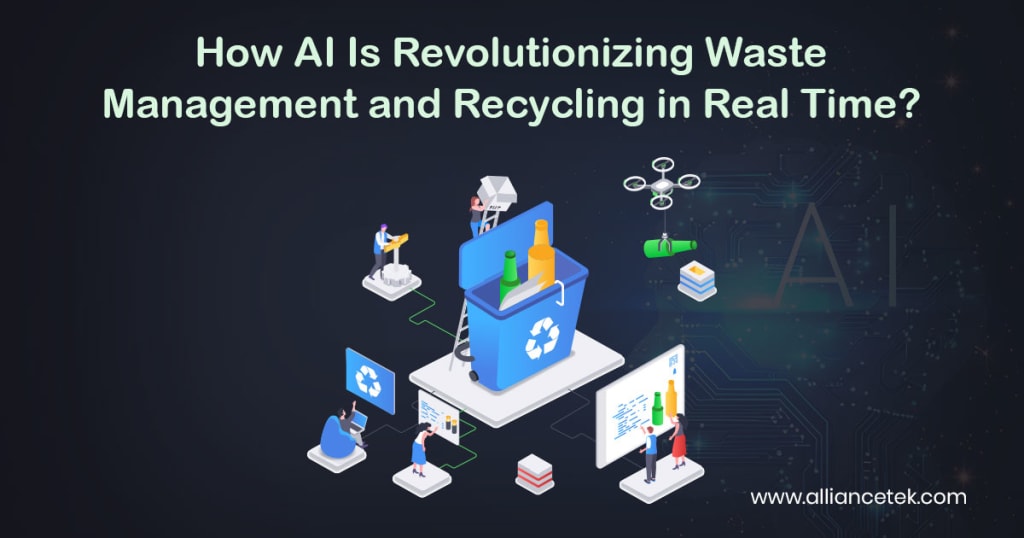
Every day, your facility handles more material than it did the day before. The pressure is not just about volume. It is about complexity. You are dealing with mixed plastics, contaminated paper, mislabeled packaging, and machines that still rely on guesswork to sort them.
You already know that inefficient sorting leads to contamination, increased costs, and lost revenue. What you need is not just faster equipment but smarter systems that understand what they are handling.
AI-powered waste management gives you that precision. These systems do not simply automate existing processes. They change what those processes can do. They make real-time decisions.
They learn. They adjust. They let you shift from reactive cleanup to proactive sorting and planning. That is how you begin to gain control over the waste problem—by making every stage smarter, not just faster.
The New Role of AI in Recycling
Bringing artificial intelligence into your waste management process does more than upgrade your tools. It transforms your decision-making at every level. These systems process massive amounts of input data to identify materials, flag issues, and optimize handling on the spot. They support your operation with a level of consistency and responsiveness that traditional tools cannot match.
You are no longer limited by human speed or basic sensors. You are guided by real-time decisions that learn from patterns and outcomes. Each layer of intelligence makes your line cleaner, faster, and more efficient.
Smarter Sorting with Computer Vision
Your sorting line defines the quality of everything downstream. AI enhances it with computer vision that goes beyond basic pattern recognition. It can detect logos, textures, label types, and slight color variations to classify materials with accuracy that human sorters cannot maintain consistently.
This matters when separating high-density polyethylene from polypropylene. That level of distinction is the difference between producing a bale of valuable recyclables or a load rejected for contamination. The more precisely you sort, the more you earn—and the less you discard.
Contamination Detection Without Delays
Contaminants cost you more than just time. They reduce bale purity, lower market value, and often lead to rejected shipments. AI-based systems identify contamination while the material is still moving. Cameras and sensors compare each item to thousands of known profiles. If the system detects oil-stained cardboard or food-smeared plastics, it removes the item instantly.
You do not wait until sorting is complete. You stop the problem before it spreads. This improves recovery quality and ensures your output meets contractual purity thresholds every time.
Material Classification That Builds Intelligence
When AI handles classification, it does more than sort. It records what it sees. You gain access to granular data that lets you analyze inputs, sort rates, and material types across shifts or facilities. This builds a feedback loop that lets you improve everything upstream.
You gain the ability to:
- Quantify how much of your input is recyclable
- Identify contamination trends by supplier
- Optimize line configurations by item flow
- Compare output performance across locations
Your decisions are no longer driven by gut instinct. They are supported by patterns that emerge from real data.
Robots That Learn as They Sort
Labor shortages, safety risks, and human error affect every operation. AI-guided robots remove those pressure points. These machines do not just pick and place. They scan, analyze, and adapt. They adjust to item shapes and sizes. They learn which materials appear most often and fine-tune their grip and drop zones over time.
They also reduce downtime. Your human team handles maintenance, performance tuning, and system oversight, while the robot sorts thousands of items per hour without needing a break.
Predictive Maintenance That Prevents Downtime
Your equipment does not just break. It sends warning signs—vibration changes, motor strain, or heat spikes. AI picks up those signs before they become failure points. Predictive maintenance tools monitor these signals constantly. They notify you when a part is behaving outside of its norm.
That lets you:
- Replace worn components during planned downtime
- Reduce emergency service calls
- Extend equipment lifespan
- Avoid costly slowdowns
Your operation runs cleaner when your equipment does, too. Implementing this level of foresight is possible with reliable AI/ML development services that focus on uptime, lifecycle tracking, and equipment-level intelligence tailored to waste systems.
Optimized Routing and Pickup Scheduling
Your efficiency does not end inside the building. AI also improves how waste is moved out. Smart routing tools use container fill levels, driver availability, traffic data, and fuel cost modeling to determine the best time and path for each pickup.
Instead of operating on fixed schedules, your system responds to real conditions. That reduces missed pickups, fuel waste, and overflows.
You keep trucks moving only when needed. That saves money and reduces your emissions footprint.
Transparent Reporting That Builds Confidence
You need more than compliance. You need clarity. AI systems produce reports that detail input volumes, output purity, contamination levels, and trends by day, shift, or material. These reports are accurate, structured, and export-ready.
You no longer spend time preparing spreadsheets or justifying totals. You show exactly what happened and how the system responded. That supports audits, improves partner trust, and demonstrates the value of your operation.
For many facilities looking to upgrade this capability, working with a trusted AI ML development company ensures the reporting tools are built to match your infrastructure, data standards, and regulatory needs.
Reducing Costs Without Cutting Corners
You are always under pressure to cut costs. AI allows you to do it without sacrificing output quality. Labor costs drop as robots take on repetitive tasks. Contamination penalties shrink as purity improves. Repairs are fewer and less urgent. Routes become leaner. Reports become automatic.
This is not about replacing people. It is about focusing them what they matter. Your skilled team shifts to quality control, system tuning, supplier coordination, and strategic improvement.
AI handles the decisions that used to drain hours. Your people make the calls that move your business forward.
Forecasting Waste Streams Before They Arrive
Anticipating volume shifts is critical. With AI, you can forecast incoming waste loads using seasonal trends, product launches, and historical data. You prepare for surges instead of reacting to them. That means less overload, smoother shifts, and better resource planning.
When post-holiday packaging hits or a manufacturing client changes output, you already know what to expect. Your system is ready. Your lines stay efficient.
System-Wide Intelligence That Connects Every Step
AI works best when applied across the entire process. Each part of your operation—intake, sorting, removal, and dispatch—feeds into the next. The more your tools talk to each other, the more accurate and responsive your system becomes.
You gain advantages like:
- Item-level traceability from bin to bale
- Error detection that improves upstream handling
- Real-time dashboard visibility for every stage
- Performance benchmarking that supports expansion
Your process is no longer just a set of mechanical steps. It becomes a digital feedback system that responds with precision.
Smart Bins with IoT and Blockchain: Securing the Waste Stream
Cities are moving beyond manual collection. Smart bins equipped with IoT sensors report fill levels, contamination, and location in real time. One recent study described a CNN‑based AI model that integrates these sensors with blockchain to create a secure, transparent waste‑tracking framework in smart cities.
These systems power waste bins that transmit data about what they contain and when they need collection, data recorded immutably on the blockchain. They also use CNNs to sort waste as it enters the bin.
This results in:
- Higher accuracy: A published model achieved 95 percent classification accuracy and an F1‑score of 0.94.
- Transparency and auditability: Blockchain ensures every bin’s contents and collection time are recorded securely and traceably.
- Reduced environmental impact: Fewer unnecessary trips cut carbon emissions by up to 30 percent.
You gain an end‑to‑end solution: from detection and classification at the bin, to secure data storage and optimized collection.
That means cleaner collections, fewer trucks on the road, and audit‑ready transparency, all without relying on guesswork or paper trails. Experienced AI/ML consulting services help you align existing municipal infrastructure with sensor logic and blockchain workflows.
AI in E‑Waste Recycling: Recovering Critical Resources
E‑waste is one of the fastest‑growing waste streams, and traditional recycling methods struggle to recover valuable metals. AI‑powered robots are now transforming e‑waste recycling processes.
These systems use computer vision and robotic arms to disassemble electronics, identifying components like circuit boards, batteries, and metal parts accurately.
The benefits are profound:
- Resource retrieval: Precious metals and rare earth elements are recovered more efficiently than manual sorting.
- Workforce safety: Workers avoid handling hazardous electronics and toxic components.
- Scalability and speed: AI systems sort high volumes without fatigue, processing materials faster than manual lines.
As global e‑waste grows, these tools become essential. They enhance recovery rates, reduce landfill volume, and create safer working conditions. E‑waste recycling centers that adopt AI are unlocking critical resource loops and preparing for the future.
Environmental Accountability That Goes Beyond Claims
You are not just managing materials. You are part of a broader environmental system where transparency and measurable outcomes define your credibility.
AI allows you to replace estimates with precise metrics. It tracks every material type, contamination level, and recovery rate, letting you report not only what you processed but how cleanly and efficiently you did it.
This gives you the ability to:
- Report landfill diversion rates by category and volume
- Track reductions in contamination by source or supplier
- Quantify emissions avoided through optimized routing
- Break down recovery volumes by shift, material, or facility
You stop relying on generic sustainability claims. You build confidence with partners, investors, and local governments by showing proof. AI transforms your role from processor to steward, from a waste handler to an active, data-backed contributor to climate responsibility.
That transformation is strengthened further with artificial intelligence and machine learning solutions that support traceable environmental outcomes at every step.
Overcoming Implementation Resistance
You may face hesitation from your team or leadership. That’s natural. But the shift to AI does not mean throwing out your current systems. It means enhancing them.
The best implementations begin with a pilot. One line. One station. Real results. That builds buy-in. You share the data, show the improvement, and let the system speak for itself.
You do not have to convince people. You show them what better looks like.
Choosing the Right AI Partner
Before committing to any platform, you need to ask the right questions. You are not just buying a product. You are investing in a system that must work under pressure.
Ask about:
- System training on your materials
- Integration time with your current lines
- Historical improvement in output purity
- Dashboard clarity for non-technical users
- Flexibility to adjust models over time
The right provider will answer without vague claims. They will give you data. They will let you speak with current clients. They will offer proof, not promise.
That is especially important when adopting custom AI/ML solutions that must work in high-volume, material-specific, or multi-location waste environments without disruption.
Results That Justify the Change
Your goal is to recover more, waste less, and report accurately. AI gets you there. You increase purity rates, reduce rework, and improve revenue from recovered material. You spend less time fixing problems and more time optimizing outcomes.
You also avoid the costs of delay, like penalties, complaints, inefficiencies, and reputational loss. Those costs are real. So are the gains that come from solving them.
Final Takeaway
AI is not the future of waste management. It is the present reality for facilities that want to stay ahead. You are not just solving for speed. You are solving for control, quality, and accountability.
The longer you wait, the harder it gets to catch up. Your competitors are already making smarter moves. You can too.
You do not need to overhaul everything overnight. You start with the process that causes the most loss. You make it smarter. Then you move on to the next one.
Soon, your entire system responds to data, not delays. And you move from reactive to predictive maintenance. That is not a technical upgrade. That is a business transformation.
About the Creator
Benedict Tadman
A results-driven Marketing Manager with 8+ years of experience in developing and executing innovative marketing strategies that drive brand growth and customer engagement.
Keep reading
More stories from Benedict Tadman and writers in Journal and other communities.
The goals I did not achieve
Every writing goal I made for the year is a wash. It has been this way for a while, but I think it's important to be open about my failures and the reality of how life can get in the way. This is especially true considering the several times I have posted on Vocal about my writing goals, how I was changing my approach, and where I was hoping to be for the upcoming year. I will probably do that again in a couple months, but for now, it is time to acknowledge where I am today.
By Kay Husnick22 days ago in Journal
The Councils of the Church and Why They Were Important
The Catholic Church has faced countless challenges since its founding, from doctrinal disputes to external persecution. One of the most important ways the Church has maintained unity, clarified its teachings, and preserved the faith is through ecumenical and local councils. Church councils are formal gatherings of bishops and Church leaders to deliberate on matters of doctrine, discipline, and practice. These gatherings have shaped Christianity as we know it today, ensuring that the Church remains faithful to the teachings of Christ and the apostles.
By Sound and Spirit3 days ago in Journal




Comments
There are no comments for this story
Be the first to respond and start the conversation.